Finance Minister Pun has not come up with an effective plan despite the ambitious goal of massive production growth, creation of millions of jobs and a leap forward in infrastructure development.
We use Google Cloud Translation Services. Google requires we provide the following disclaimer relating to use of this service:
This service may contain translations powered by Google. Google disclaims all warranties related to the translations, expressed or implied, including any warranties of accuracy, reliability, and any implied warranties of merchantability, fitness for a particular purpose, and noninfringement.
The government has introduced a traditional style budget without a plan to improve the capacity of income and expenditure. Finance Minister Barshman Pun has not brought an effective plan despite taking the ambitious goal of increasing production on a large scale, creating millions of jobs and making leaps in infrastructure development.
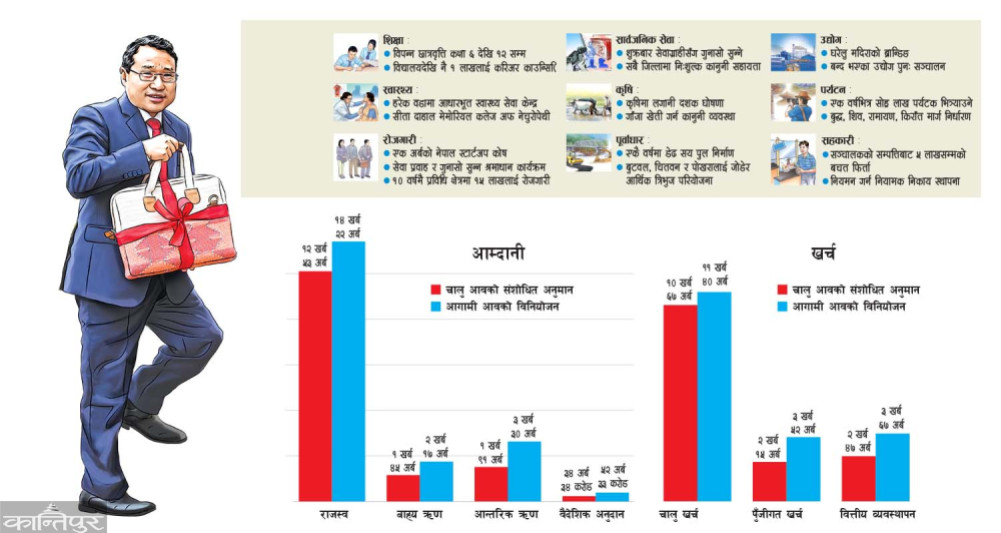
Amidst the unlimited pressure of the Prime Minister and the leaders and activists of the coalition parties, the Finance Minister has been restrained in the size of the budget. He has planned to spend 18 trillion 60 billion 30 million in the next financial year 2081/82. This figure is only 1 trillion 9 billion more than the allocated budget of the current financial year. Although the government brought a budget of 17 trillion 51 billion 31 crores for the current financial year, it has been reduced by 2 trillion due to the inability to collect and spend revenue.
The government has made a revised estimate of the total expenditure of 15 trillion 30 billion 35 million out of the allocated budget in the financial year 080/81. Forgetting this example, the government has allocated 21 percent larger budget than this year's total revised estimate for the next financial year. Economists and former finance ministers have said that it will be difficult to arrange and spend the income for the budget of 18.5 trillion allocated by the government at such a time.
Out of the total allocated budget for the coming year, current expenditure is 11 trillion 40 billion 66 crore (61.31 percent) and capital expenditure is 3 trillion 52 billion 35 crore rupees (18.94 percent). The allocated recurrent expenditure is about 7 percent higher than this year's revised estimate and capital expenditure is about 63 percent higher. This year, current expenditure is 10 trillion 67 billion 49 crore (93.5 percent) and capital expenditure is 2 trillion 15 billion 30 crore (71.3 percent), according to the government's revised estimate.
The government has allocated 3 trillion 67 billion 28 billion rupees for financial management for the coming year. This is 19.74 percent of the total budget. The revised estimate is that 2 billion 47 billion 55 crores (80.5 percent) will be spent on financial arrangements in the current financial year. The government's expenditure estimate for the coming year is 6.2 percent higher than the current fiscal year's allocation and 21.56 percent higher than the revised estimate.
UML Vice President and former Finance Minister Surendra Pandey said that the main challenge of the budget is to raise resources and manage expenses. Mentioning that the situation of resource management is weak in the current financial year, he commented that the same challenge is likely to be repeated in the coming year. It seems challenging to meet the set goals of external grants and foreign loans. Even in the current financial year, grants and foreign loans have been achieved much less than the target,' he said, 'Expenditure and overall implementation is always a challenge for us.' This year, after failing to meet the revenue collection target of 14 trillion 22 billion 54 billion rupees, it was revised to 12 trillion 53 billion 52 billion rupees. That too is unlikely to be achieved. Compared to that, a revenue collection target of more than 1 trillion 70 billion i.e. 14 trillion 19 billion 333 million rupees has been set in the next financial year. Out of this, the federal government has a revenue collection target of 12 trillion 60 billion 30 billion rupees.
Similarly, the target of collecting 52 billion 33 million rupees from foreign grants in the coming year has been taken. Even if this is done, the expenditure will be 5 trillion 47 billion 67 crore less than the income of the government. ``2 trillion 17 billion 67 crores will be raised from foreign loans to meet the shortfall,'' the budget says. The government estimates that 2 trillion 40 billion will be recovered from internal debt. Out of the amount received from this source, 4 trillion 8.87 billion rupees have been allocated through financial transfer to the provincial and local levels.
Economists, former finance ministers and private sector officials are of the opinion that there is no effective program not only from the point of view of income and expenditure, but also for the currently depressed economy. Former Prime Minister Baburam Bhattarai said that the budget could not come due to structural reforms in the economy as a whole. At a glance, he said that this budget is just a new series of continuation of the past and it cannot move the country in the direction of prosperity. "It's not just about socialism. The main objective is to increase production. But there is no plan for equitable distribution," he said. "Some popular programs and slogans have been given, the Decade of Agriculture has been announced, but the budget has been reduced. Overall, it will be difficult to follow the five objectives of the budget. The government has tried some intervention in the field of information technology through the budget. It has been announced that a Nepal Startup Fund of 1 billion will be set up to address the financial needs of startup entrepreneurs.
Finance Minister Pun has allocated 1 billion to establish a peace fund for compensation, financial assistance and rehabilitation to conflict-affected families. There has been a huge increase in customs duty and excise duty on electric vehicles of all capacities. The value added tax (VAT) imposed on apples, potatoes and onions by previous finance minister Prakash Sharan Mahat has been abolished.
Finance Minister Pun has allocated 1 billion to establish a peace fund for compensation, financial assistance and rehabilitation to conflict-affected families. The government has announced the agricultural investment decade by reducing the budget of agriculture and livestock development sector. The period from 2081 to 2091 has been declared the Decade of Investment in Agriculture by increasing investment in the agricultural sector from government, private, cooperative and development partners. It is mentioned in the budget that legal arrangements will be made for the commercial production of marijuana for medicinal purposes.
The government has allocated 1.69 billion rupees less in the agricultural budget compared to the current financial year. The amount of subsidy for chemical fertilizers, which play a key role in agricultural crop production, has also decreased. Subsidy of chemical fertilizers has decreased by 2.5 billion rupees.
The old program has been continued by increasing the budget of the Ministry of Physical Infrastructure and Transport for the next financial year. Although the overall budget of the ministry has increased, it has been reduced in Gaurav projects. The budget of Gaurav's projects, which have been paying for several years, has been reduced. Even though work has been done on the Madhyapahari, Hulaki, Kaligandaki corridors, payment has not been made, which is delaying further work. In the next fiscal year, 3 billion 68 million has been allocated for Madhyapahari and 3 billion 30 million for postal highway. Which is less than the current financial year. In the current year, 3.96 billion rupees were allocated for Madhyapahari and 3.49 billion rupees for postal.
Former Finance Minister Prakasharan Mahat said that there is no reform program in the budget and it will not stop the budget crisis. He says that even though there is a break in making a big budget, this budget is above the reality. They have said that it will be reformed for a decade. But there is no program to improve it. There is a tendency to scatter budgets. It is doubtful that big projects will be completed," he said. "They said to go on the path of reform. But they did not say where to improve. He said that removing the value added tax (VAT) imposed on apples, potatoes and onions from the budget is not right. VAT was levied on these items at the time. He claimed that removing it now would not help domestic traders.
Finance Minister Pun has announced that Nepal will be developed as an information technology hub. He said that the aim is to create 500,000 direct and 100,000,000 indirect jobs in the information technology sector to export 30 billion in 10 years. For that, he mentioned that the next year will be promoted as the departure year of the information technology decade. Similarly, the government has announced to provide broadband internet service to all wards, community schools and health institutions.
The government is going to introduce 'Fridays with customers' program to improve public service delivery and improve performance. 1 billion 50 million has been allocated for the 'Bunker to Barracks' program of the Nepali Army. Bharatpur, Butwal, Pokhara region has been proposed in Gandaki economic triangle project. It is mentioned in the budget that industrial revival and quality employment will be created by building an industrial ecosystem in partnership with the private sector under this project. It is said that the free legal aid program will be extended to all districts.
If the budget is implemented properly, the goal of economic growth will be achieved, said Chandra Dhakal, president of the Federation of Industries and Commerce. "As requested by the federation, the reform year has been announced with the formation of a high-level commission for solving the existing economic problems and for a new stage of reform," he said. The private sector is of the view that even if the upcoming budget is fine, there is a challenge in implementation. Kamlesh Aggarwal, president of the Chamber of Commerce, said that meeting resources by taking loans will have a positive effect on the economy. “Revenue targets for the private sector are of great concern, which are set realistically. Many of our suggestions are included in the budget. The budget is realistic," he said. Rajesh Kumar Agarwal, President of Nepal Industry Confederation, said that the budget was balanced and not too big and distribution-oriented as it was heard in the market. It seems that there is no pressure on the private sector as the revenue targets are also set in a balanced way. It is positive that the year of economic reform has been declared, he said.
Similarly, the government has allocated 1 trillion 16 billion rupees for social security allowances to be provided to target groups including senior citizens, single women, and those with disabilities. For the next year, the government has not increased the income tax limit and has also kept the salaries and allowances of government employees stable. Through the economic bill, the government has kept the import duty on finished goods at least one level lower than the duty on raw materials imported by the industry. Import duty and excise duty on raw materials of industries such as pharmaceuticals, induction stoves, thread, helmets, incense sticks, sanitary pads, cashew and peanut processing, spring leaf making industry etc. have been reduced.
Green tax has been imposed on the import of petroleum products and coal products. The existing threshold for registration under value added tax on mixed transactions of goods and services has been increased to three lakhs. The 15 percent customs duty on steel milk cans imported by animal husbandry firms and industries producing more than 1,000 liters of milk per day has been reduced to only 1 percent. If the exporter is unable to submit the foreign currency receipt document immediately, the limit of the export value that can be exported on the condition of submitting such document later has been increased from the previous US$ 10,000 to US$ 25,000.