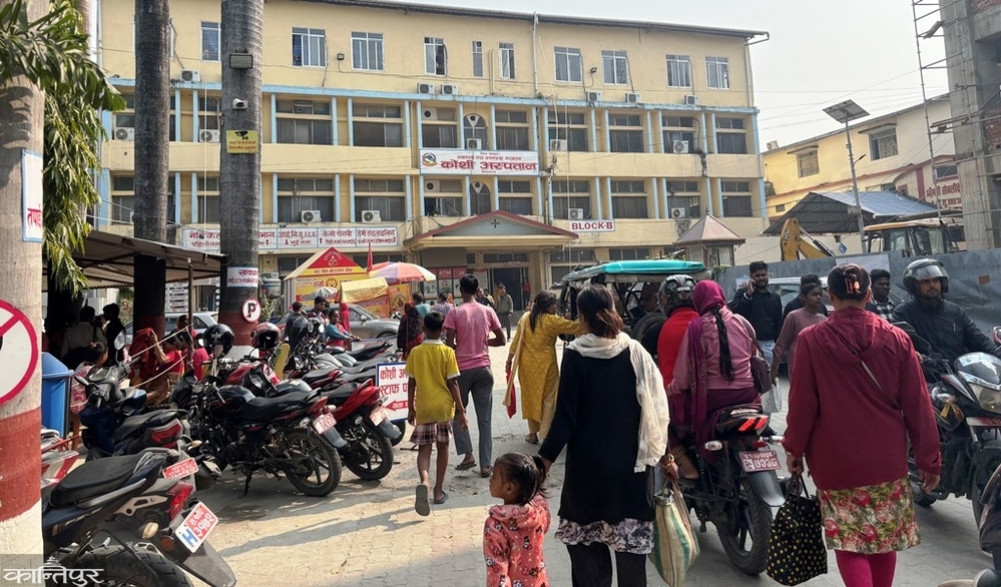
Election activity is increasing across the province. Development, infrastructure, and employment issues have been widely raised in the commitments and speeches of party candidates. However, they do not have a concrete action plan for health, which is directly related to the daily lives of citizens. What is the overall health situation of Koshi?
We use Google Cloud Translation Services. Google requires we provide the following disclaimer relating to use of this service:
This service may contain translations powered by Google. Google disclaims all warranties related to the translations, expressed or implied, including any warranties of accuracy, reliability, and any implied warranties of merchantability, fitness for a particular purpose, and noninfringement.
Election fever is increasing across the province. The promises and speeches of party candidates have widely raised issues of development, infrastructure and employment. However, their concrete action plan for health that is directly related to the daily lives of the citizens is not visible. What is the overall health situation of Koshi? The data shows a mixed picture of the health sector in the province. Some indicators are improving, while others have raised serious concerns.
According to the Koshi Province Health Ministry, 82 percent of deliveries take place in health institutions. The family planning utilization rate has reached 69.5 percent. These indicators indicate that service access has improved. However, the problems are endless. The maternal mortality rate is 157 per 100,000 live births. Which is higher than the national average. The national average is 151. The adolescent birth rate is 10.6 percent per thousand. While the national rate is only 9.6 percent. Ministry spokesperson Sambhata Pantika says, “Even though institutional deliveries have increased, the inability to refer complex cases on time is a big problem.”
Home deliveries are decreasing. This has helped reduce maternal mortality. However, the number of premature deaths due to medical negligence in hospitals has not stopped. The mortality rate of children under five years of age is 34 per thousand. This is 1 percent higher than the national average. The infant mortality rate is 28 and the neonatal mortality rate is 20 per thousand. Nutrition indicators have improved comparatively. Among children under five years of age, stunting is 20 percent, wasting is 3.8 percent, and underweight is 13 percent. 80.8 percent of children have received full vaccinations. Anemia has been observed in 34 percent of children aged 6 to 59 months. 28 percent of women aged 15 to 49 are also anemic.
The death rate from non-communicable diseases is significant in the 15 to 49 age group. Deaths due to heart disease, liver disease and chronic respiratory diseases are on the rise. The death rate in the 15 to 49 age group is 9.3 percent. Stroke is 2.5 percent in the 15 to 49 age group. The death rate from chronic kidney disease in the same age group is 2.3, the death rate from diabetes in the same group is 1.6, and the death rate from chronic respiratory diseases is 1.9 percent.

The most serious aspect is death from suicide. Which accounts for 10.2 percent of the total death rate. The mortality rate from tuberculosis is 5.8, the mortality rate from respiratory infections is 1.6, the mortality rate from liver diseases is 7.7, the mortality rate from breast cancer in women is 2.6, the mortality rate from cervical cancer is 3 percent, and the mortality rate from asthma in women is 2.4 percent. Doctors say that the problem is worsening due to lack of access to mental health services, counseling, and awareness. The prevalence of high blood pressure in 24.5 percent of adults is worrying.
Access to health institutions and private hospitals in urban areas of the Terai is relatively good. However, the service structure is weak in the hilly and mountainous districts. The service structure is particularly weak in mountainous areas such as Taplejung, Sankhuwasabha, and Solukhumbu. There are problems with the shortage of specialist doctors, lack of equipment, and regular supply of medicines.
Despite efforts to expand the health insurance program, effective implementation is still challenging. Promises like ‘hospitals in all municipalities’, ‘specialist services’ and ‘free treatment’ are repeated in election rallies. However, no party or its candidates have a clear action plan to strengthen health infrastructure, manage skilled human resources, expand services to remote areas and prioritize mental health. Nirmal Bhattarai, Information Officer at the Provincial Health Ministry, says, ‘Even if there is some improvement in the data, sustainable change is not possible without addressing systemic weaknesses.’
According to the details mentioned in the Koshi Province Health Policy (2025) based on the National Mental Health Survey (2020), mental health problems are higher in Koshi Province compared to other provinces. According to the survey, the prevalence of mental illness in Koshi is 13.95 percent, mental problems in adolescence are 11.45 percent, alcohol addiction is 6.55 percent and suicidal thoughts are 10.65 percent. This is higher than other provinces. According to the National Mental Health Survey, although the burden of mental health problems is high across the country, the rate in Koshi Province is higher than other provinces. The prevalence of mental illness, problems seen in adolescence, alcohol and drug abuse, and high rates of suicidal thoughts are worrying.
On Bhadra 8, the Koshi Ministry of Health had made public the health policy with the vision of ‘Healthy Human Capital, Prosperous Province’. The objective of the policy was to ensure that all citizens of the province are physically, mentally, socially, and emotionally healthy and able to lead productive lives. This policy is in the process of implementation, said Dr. Yaduchandra Ghimire, Secretary of the Provincial Health Ministry. ‘About 7 months have passed since the policy was implemented, and it is in the implementation phase,’ said Ghimire.
The health policy includes 6 objectives and 26 policies and strategies. It presents a long-term vision to address existing, potential, emerging and re-emerging health challenges. Health Minister Manavhadur Limbu said that the policy prioritizes improving access and quality of basic health services, expanding infrastructure, managing skilled human resources, improving nutrition, controlling communicable diseases and expanding specialist services. Experts have been commenting that the Koshi health policy is ambitious but that implementation is a challenge.
Hospitals on paper, void in services
Hospitals and health offices in Koshi Province appear to be full of vacancies on paper. However, the reality is different when you reach the service room. Doctors' chairs are empty, labs are lacking technicians and there is a crowd of service recipients.
More than half of the posts from the ministry to the laboratory are vacant. Out of 131 approved posts in five health bodies at the provincial level, only 57 posts have been filled. 74 posts are vacant. Only 17 out of 48 employees are working in the Health Directorate. There are only 7 out of 31 vacancies in the Provincial Public Health Laboratory. There are 8 vacancies out of 24 vacancies in the Ministry of Health. There are 3 vacancies out of 10 vacancies in the Provincial Health Training Center. There are 8 vacancies out of 18 vacancies in the Provincial Health Supply Management Center. Former Medical Superintendent of Mechi Hospital Dr. Pitambar Thakur says, ‘Such a shortage in the body that makes policies, monitors programs and identifies diseases is a weakness in the backbone of the service system.’
The situation in the health bodies of the districts is also similar. There is an extreme shortage of employees. It seems that only 50-60 percent of the posts have been filled in most districts. There are an average of 4-10 vacancies in districts including Ilam, Jhapa, Bhojpur, Khotang, Okhaldhunga. There are 7 out of 20 posts vacant in the Health Office Sunsari, 7 out of 19 in Morang, 6 out of 11 in Bhojpur, 4 out of 15 in Dhankuta, and 10 out of 19 in Ilam. Similarly, 9 out of 20 posts are vacant in Jhapa, 6 out of 11 in Khotang, 6 out of 11 in Okhaldhunga, 6 out of 12 in Panchthar, 4 out of 9 in Solukhumbu, 5 out of 10 in Sankhuwasabha and 5 out of 12 in Taplejung, according to the Ministry of Health. Health workers complain that this has affected everything from vaccination programs to epidemic surveillance. 'Due to the shortage of staff, one person has to handle three to four responsibilities,' says Yograj Ghimire, Chief of the Health Office, Morang.
Due to the shortage of staff, a single employee has to handle more than one responsibility. The concerned officials say that this has affected everything from regular service delivery to epidemic surveillance. According to Ghimire, Chief of the Health Office, Morang, the pressure on program management increases due to the lack of staff according to the posts. ‘In some districts, a single public health officer has to handle vaccination programs, non-communicable disease programs and epidemic surveillance,’ he said. ‘When infections like dengue increase, daily reporting, fogging coordination and regular monitoring all fall under the responsibility of a single person.’
The situation is similar in district hospitals. In some places, there are complaints that staff nurses assigned to maternity services have to handle emergency rooms and vaccination services. Similarly, since the same lab technician has to test for dengue, malaria and tuberculosis along with regular tests, there is a delay in reports, says Aheb Lekhnath Khatiwada of Mechinagar-6, Jhapa.
The most worrying situation is in district hospitals. Only 24 out of 132 posts have been filled in Sankhuwasabha District Hospital. Only 18 out of 99 are working in Panchthar and 9 out of 53 in Okhaldhunga. In some hospitals, more than 80 percent of the posts are vacant. There are 54 out of 102 posts vacant in the Provincial Hospital Bhadrapur, Jhapa, 21 out of 23 posts vacant in Madan Bhandari Hospital and Trauma Center Urlabari, Morang. There are 10 out of 50 posts vacant in the District Hospital Sunsari, 14 out of 31 posts vacant in Dhankuta, 31 out of 59 posts vacant in Ilam, 18 out of 32 posts vacant in Bhojpur, 42 out of 50 posts vacant in Khotang, 33 out of 59 posts vacant in Udayapur, and 5 out of 18 posts vacant in Solu.
According to health officials, the shortage of staff has created challenges in operating 24-hour emergency services, surgery, and blood transfusion management. They say that this has increased the rate of patients from remote districts having to be referred to large hospitals in the Terai or outside the province.
Despite the expansion of buildings and equipment in many district hospitals in Koshi Province, the service has not been fully operational due to the lack of specialist doctors and technicians. Hospital sources say that as the approved posts have been vacant for a long time, complex patients are forced to be referred to large hospitals in the Terai or Kathmandu. In some hospitals, it is difficult to conduct regular cesarean sections due to the lack of anesthesia specialists. There are complaints that radiology, pathology and other specialist services are also partially operated due to limited manpower. ‘We have the equipment, but we have not been able to make the service effective due to the lack of manpower to operate it,’ said a hospital chief in Jhapa. The X-ray machine in that hospital has been lying idle for a long time.
According to officials from the provincial health ministry, the process has been taken forward to fill the vacant specialist posts. Although efforts are being made to fill the posts through contract appointments and the public service process, they admit that it is a challenge to retain doctors in remote areas. Ghimire, secretary of the health ministry, said that specialists are not willing to stay in remote hospitals for a long time due to poor facilities, housing problems, unstable contract arrangements and lack of necessary support teams. He added, "However, due to remoteness allowance and other reasons, a certain attraction has started to increase recently.'
Even though the provincial government has approved the posts, the posts have not been filled. Health workers say that doctors are in dire need during the pandemic. The incentive policy in remote hospitals has not been effective. The problem has become more complicated due to the lack of a clear deadline to reduce the vacancy rate below 25 percent.
According to the seven-year progress report released by the provincial government, access to health has increased. Koshi Province has been declared a fully vaccinated province. It is said that 7.533 million internal, external and emergency services have been provided till Falgun of the current fiscal year.
The average life expectancy of the province is 70.4 years. The neonatal mortality rate is 20 per thousand and the maternal mortality rate is 157 per lakh live births.
A total of 1,635 health institutions, including 225 hospitals and 1,457 basic health service centers, are operational across the province. The number of Ayurveda health institutions is 118. In the last seven years, 248 pregnant and postpartum women have been rescued. There are 46 government hospitals in Koshi, which has a population of 49,61,412. An 8-storey hospital with 500 beds is under construction at Koshi Hospital.
Improvement in newborns, concern over maternal mortality
Although the data for the last three years shows that the neonatal mortality rate is decreasing, the maternal mortality rate is not satisfactory. 498 birthing centers are operational across the province. 40 basic emergency service centers and 34 full emergency services (including surgery and blood transfusion) are available.
In the fiscal year 2079/80, 273 newborns died. In 2080/81, this number fell to 240. In 2081/82, it fell to 187. There has been a decrease of about one-third in three years. In Morang, 139 newborns died in 2079/80. In 2080/81, it fell to 112 and in the current year, it fell to 72. Doctors claim that the number is higher in Morang because it is the referral center for complex patients from across the province.
However, the neonatal mortality rate is increasing in Jhapa. The number, which was 14 in 2079/80 and 11 in 2080/81, has reached 41 in the current year. In Sunsari, the rate has decreased from 9 to 27 in the current year. Although there has been an improvement in newborns, the maternal mortality rate is fluctuating. In 2079/80, 53 mothers died during childbirth. The number, which dropped to 42 in 2080/81, has increased again to 67 in 2081/82. In Morang, the number has dropped from 24 to 20, but it is still high. In Jhapa, it has increased from 3 to 10. In Panchthar, 27 mothers died last year. The ministry has stated that 6 died in Sunsari and 1 each in Udayapur, Dhankuta, Khotang and Okhaldhunga.
High-level emergency obstetric services are more common in the Terai districts. 10 in Morang, 6 in Jhapa and 5 in Sunsari. However, most of the hill districts have only one center. In Dhankuta, Tehrathum, Panchthar and Taplejung, there is no option to refer complex patients. Health workers have pointed out some main reasons why the maternal mortality rate in Koshi Province is higher than the national average. In remote hilly and mountainous districts, women with complicated pregnancies reach the hospital late. Weather and geography add additional challenges, making emergency surgeries or maternity services unavailable on time.
Health workers have experienced that it takes hours to reach district or provincial hospitals from remote municipalities due to the lack of ambulances. In addition, due to the weak blood circulation system, women who have emergency deliveries, cesarean sections, or accidents do not have immediate access to blood, which increases the risk of death.
The most serious challenge is the lack of skilled manpower. Due to the lack of doctors, obstetricians, nurses, and technicians in hospitals, a single employee has to handle many responsibilities. Despite the availability of equipment, the lack of manpower to operate the service has not made it effective. According to officials from the Ministry of Health, not only these reasons but also challenges in service quality and accessibility have increased. Ministry spokesperson Panthi said, ‘It will be difficult to reduce maternal mortality rate unless vacancies are filled and emergency services in remote areas are improved.’
Party’s pledges on health
Balendra Shah, the Rashtriya Swayamsevak Sangh (RSS) candidate from Jhapa-5, has made public his constituency-specific pledge. He has announced that Damak Hospital will be upgraded to a 300-bed hospital in the first phase. He has promised to provide 24-hour free ambulance service, establish a disability rehabilitation center, and provide free health services to senior citizens at home. ‘10 percent of the total beds will be reserved for the poor, helpless, and homeless patients who come to the hospital for treatment,’ the pledge states. The RSS has nominated him as the Prime Minister.
The maternal mortality rate in Koshi Province is above the national average. There is a huge shortage of doctors and technicians in district hospitals. Snakebites and dengue fever continue to recur in the Terai districts. Malnutrition and anemia in children are still a challenge. In such a situation, the major parties that have entered the election fray have made various commitments public, prioritizing the health sector. However, how relevant are these promises to the real problems of the province? According to Mandhara Chimaria, the Congress candidate from Jhapa-5, who is considered to be the country's 'famous' candidate, the Nepali Congress has announced that health insurance will not be voluntary, but mandatory and that all medical treatment will be covered under the insurance. There is also a commitment to provide complete relief in serious diseases. 'This is a people-oriented program,' says Chimaria, 'the people can directly benefit from it.' The UML has put forward the slogan 'Healthy Food, Yoga/Exercise: Healthy Nepal's Mahaabhiyan'. This campaign based on the concept of preventing diseases can be useful in the long term. Nutritional improvements and regular exercise are expected to help reduce non-communicable diseases.
The Nepali Communist Party has announced free treatment for women-specific diseases such as breast cancer, uterine prolapse, fistula and urinary incontinence. This commitment seems relevant in the context of high maternal mortality and reproductive health problems in Koshi. The National Independent Party has promised to provide quality health services based on 100 percent insurance and strengthen the insurance program. The Rastriya Prajatantra Party has said that all citizens will be provided with free health care and treatment at the hospital of their choice.
These promises of the party may reduce the burden of treatment costs through insurance. However, since many hospitals in Koshi do not have specialist doctors and necessary manpower, the risk of patients carrying insurance cards not receiving services remains. To reduce maternal mortality, it is essential to strengthen the ambulance, blood transfusion, emergency obstetric service and timely referral system. While insurance expansion may help cover expenses, the results are likely to be limited as the service infrastructure remains weak.
Snakebite and dengue fever have been recurring problems in the Terai districts during the summer. At such times, continuity in antivenom supply, vector control, laboratory capacity, and community-level awareness are necessary. A health worker at the Snakebite Treatment Center in Charali, Jhapa, complains that although the party manifestos mention insurance and free treatment, there is little clear framework for seasonal disaster management and preparedness.
Some district hospitals in Koshi have 50 to 80 percent vacant posts. Complaints are growing that services are affected by a lack of doctors and technicians despite the presence of buildings and equipment. Although the parties promise to expand health services and improve quality, there is little clear action plan for filling vacant posts, incentive policies in remote areas, or union-state coordination.