If an integrated Buddhist circuit can be developed by connecting Ramgram Stupa, Panditpur and Devdaha, it can attract Buddhist and cultural tourists from all over the world, which will greatly contribute to local economic development. Locals hope that employment will be created through hotels, homestays, transportation, guide services, meditation and yoga centers, etc.
We use Google Cloud Translation Services. Google requires we provide the following disclaimer relating to use of this service:
This service may contain translations powered by Google. Google disclaims all warranties related to the translations, expressed or implied, including any warranties of accuracy, reliability, and any implied warranties of merchantability, fitness for a particular purpose, and noninfringement.
बुद्ध दर्शन आजको जटिल, तीव्र र अस्थिर विश्वमा झन् प्रासंगिक हुँदै गएको छ । प्रविधिको तीव्र विकास, उपभोक्तावाद, मानसिक तनाव, युद्ध, वातावरणीय संकट र मानवीय मूल्यहरूको ह्रासबीच बुद्धका शिक्षाहरूले आजको मानवतालाई दिशानिर्देश गर्ने क्षमता राख्छन् । आजको सन्दर्भमा बुद्धको महिमाबारे कोसेलीले तयार पारेकाे विशेष प्याकेज।
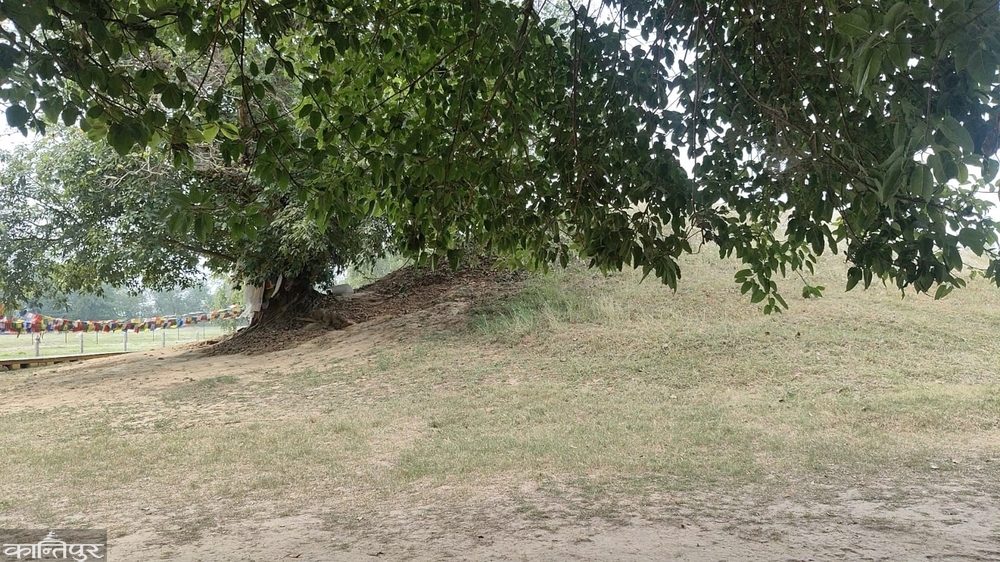
Among the major Buddhist pilgrimage sites in the world associated with Lord Gautama Buddha, the Ramgram Stupa located in Ujaini, Ramgram Municipality-7, West Nawalparasi is considered sacred for Buddhists. This is the only stupa in which the Ashtadhatu (bone remains) obtained after the Mahaparinirvana of Lord Buddha has not yet been excavated. Although the bones were taken from seven stupas and placed in different places, there is a legend that the bones of Ramgram were protected by serpents and could not be excavated.
According to the history of the Buddhist era, the Ashtadhatu obtained after the cremation of the Buddha after the Mahaparinirvana was divided into eight parts. The eight places were Vaishali, Kapilvastu, Magadha (Rajgriha), Ramgram (Koliya), Allakappa, Kushinagar, Vethdeep and Pawa. Emperor Ashoka excavated the bones of seven places during his campaign to build 84,000 stupas, but he could not excavate in Ramgram. The Tripitaka also mentions the Ramgram Stupa, so Buddhists wish to visit this holy land once.
After the discovery of Lumbini in 1896, archaeologist Dr. Huey, while visiting the area, saw a large mound of earth about 50 feet high in Ujjain and speculated that it could be a stupa. It is mentioned in various research materials that sociologist Purna Chandra Mukherjee suggested that the Ramgram Stupa should be found in the Terai region of Nepal. Later, monk Shakyananda Mahasthavir confirmed that it was the mound of earth in Ujjain. Historians have found that in 1974, Babukrishna Rijal of the Department of Archaeology, based on the travel accounts of Chinese travelers, claimed that it was the ancient Ramgram Stupa.
Excavations and scientific tests have also confirmed the existence of Ramgram and the Koliya Gana kingdom.
The Department of Archaeology has excavated repeatedly. Excavations were carried out from 1997 to 2004 and later in November 2023 by a team from the Lumbini Development Fund, the Department of Archaeology and Durham University of the UK. The ruins of a Buddhist-era pond and the structure of a monastery were found during the excavations.
The archaeological objects were found during the excavations carried out by an expert team from the Department of Archaeology and Durham University of the UK in the northwest area of the stupa from 15 Kartik to 15 Mangsir 2080. Archaeologist Bhaskar Raj Gyawali said that since a pond and monastery from the Buddhist period were found and the materials used in them were found during the excavations, there is a scientific basis for listing Ramgram on the World Heritage List.
After a geophysics survey conducted in 2018 found a large monastery, pond and other Buddhist-era materials, the excavation was carried out to determine their actual condition. But as the government has not allocated sufficient plans and budget for the excavation, the secrets and new facts of the stupa are yet to be discovered. Saying that there is not enough interest in the development, discovery and exploration of the Ramgram Stupa, Ramgram Municipality Chief Dhanpat Yadav says that despite repeated requests to the Lumbini Development Fund to pay attention to this, there has been no response.
Stating that it is compulsory to take permission from the fund to spend the budget allocated by itself on the stupa within its local level, the Department of Archaeology said that the excavation of the stupa area should continue. ‘Since the Lumbini Development Fund has not brought sufficient attention and plans, we are working by establishing the Ramgram Development Fund ourselves,’ said Municipal Chief Yadav. ‘The Lumbini Development Fund should leave Ramgram to work autonomously.’
The main core area of the stupa has not been excavated yet. It is not certain whether or not to excavate the core area. The mystery of the stupa lies in this. Although the stupa was included in the Tentative List of UNESCO's World Heritage List in 1996, it has not been listed due to the state's failure to take sufficient initiative. Similarly, objects and structures from the Buddhist period have been found in Panditpur, a Mavali house related to Ramgram. The structure of the Buddhist period city was found in the excavations conducted by the Department of Archaeology.
Kushan period copper coins and various archaeological materials were found in the excavations conducted in Mangsir 2082. 'The Department of Archaeology says that we have found structures of the Buddhist period city during excavations in this area before. The remains of walls, ancient utensils, animal statues, jewelry and Kushan period copper coins have been found in the excavations.
In the excavations conducted in 2081, the objects found underground in the form of a circular city structure were taken to the UK for examination. The Department of Archaeology has stated that the structures found in Panditpur during the study have been confirmed to be from the 6th century BC. There is currently a settlement and farming in the Panditpur area, which is spread over an area of about 60 bighas. Although it should be acquired as it is private land, it has not been acquired due to lack of budget. Although there is a plan to acquire land for the conservation of the archaeological objects found, the central government should pay attention to it due to lack of budget, the Ramgram Development Fund says.
 Development status and challenges
The main challenge in the development of Ramgram Stupa and Panditpur is the Lumbini-centric development plan. There are no residential structures, hotels and proper toilets around the stupa, which attracts thousands of foreign devotees and tourists every year. As a result, monks and tourists who come to the stupa to meditate and practice yoga cannot stay in this holy land even if they want to. They are forced to return and go to Lumbini. The Lumbini Development Fund has prepared a master plan for the Buddhist sites of Rupandehi, Kapilvastu and West Nawalparasi under the 'Lumbini Circuit'. But it has not shown interest in its implementation. According to locals, development is mainly focused on Lumbini, while Ramgram has been overlooked.
The Ramgram Municipality has established a separate Ramgram Development Fund, saying that the Lumbini Development Fund has not paid attention to the development and construction of the stupa. The mayor will be its chairman. It will work on the development, promotion and development of the stupa and the tourism sector. Shambhu Upadhyay, a civic leader and conservationist, complains that the Lumbini Development Fund has overlooked Ramgram. He alleges that the fund has not paid attention to the development of the area, which is in the process of being listed on the World Heritage List.
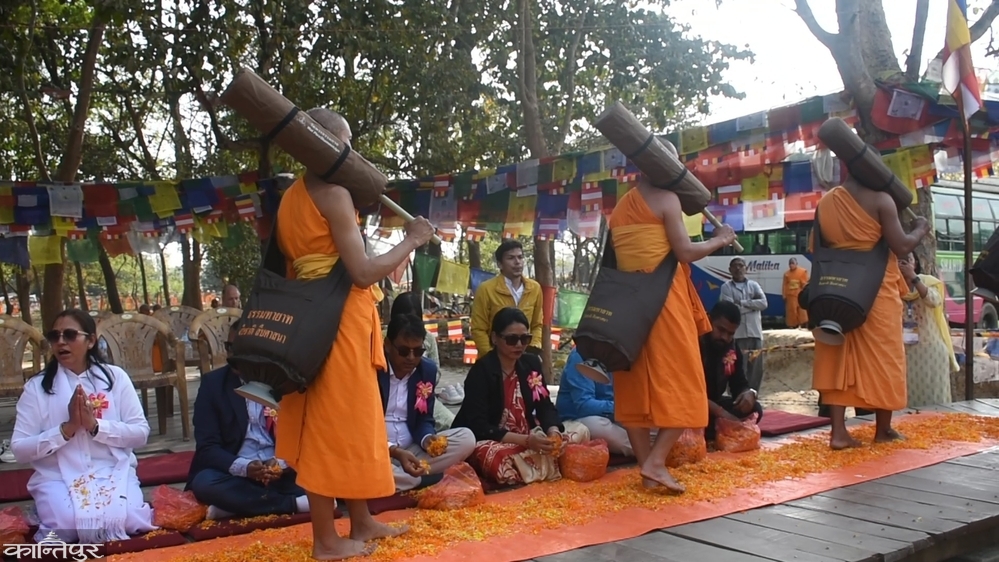 The main problem in the stupa area, which has ample grounds to become a tourist hub like Lumbini, is the lack of accommodation, transportation, meditation centers and basic infrastructure for tourists. Excavated structures are also being dug up and buried repeatedly due to lack of conservation. Tourists have felt the lack of conservation and management.
The Lumbini Development Fund has been saying that it has not been able to work as planned due to lack of sufficient budget. Gyanin Rai, Senior Director of the Lumbini Development Fund, said that infrastructure development and other work will start at the sites related to Buddha under the 'Lumbini Circuit', which is being launched with the investment of the World Bank. 'We also have to carry out physical construction work as per the instructions and plans of the Department of Archaeology,' he said. 'The development of Ramgram Stupa will also be carried out along with Lumbini and other sites related to Buddha. We have also made a plan for excavation.'
If an integrated Buddhist circuit can be developed by connecting Ramgram Stupa, Panditpur and Devdaha, Buddhists and cultural tourists from all over the world can be attracted. This will greatly contribute to local economic development - locals hope that jobs will be created through hotels, homestays, transportation, guide services, meditation and yoga centers, etc.

