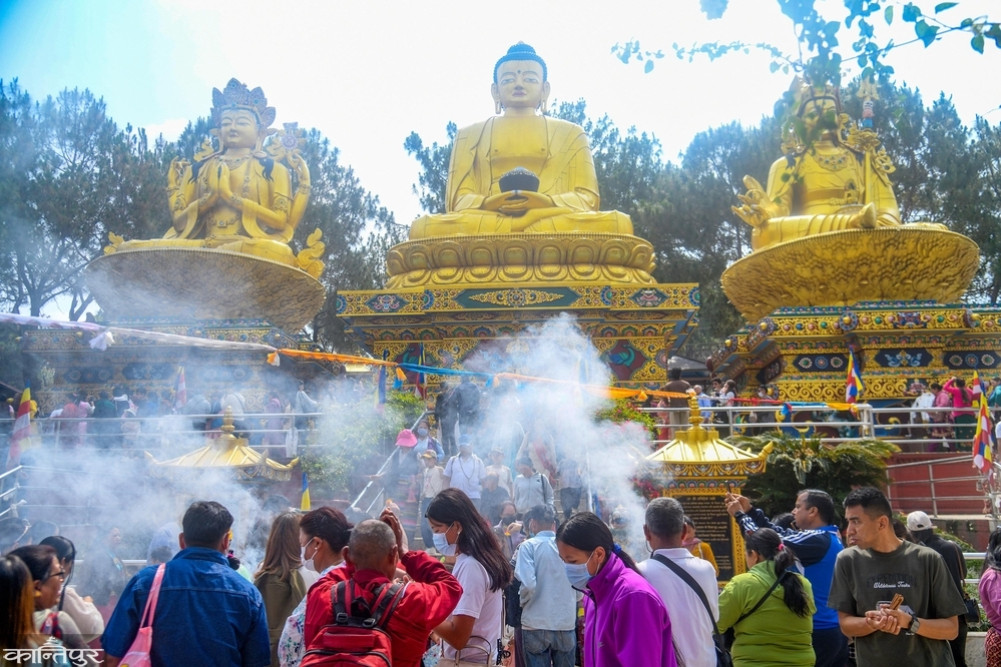
The Buddhist history of Kathmandu Valley is a historical feature of this place. It is found that a large number of monasteries were built during the Lichchhavi period and the names of those monasteries are found to be from the Sanskrit language. After the Lichchhavi period, even during the Malla period, Buddhism not only developed extensively in Kathmandu, but also remained as a Buddhist center.
We use Google Cloud Translation Services. Google requires we provide the following disclaimer relating to use of this service:
This service may contain translations powered by Google. Google disclaims all warranties related to the translations, expressed or implied, including any warranties of accuracy, reliability, and any implied warranties of merchantability, fitness for a particular purpose, and noninfringement.
बुद्ध दर्शन आजको जटिल, तीव्र र अस्थिर विश्वमा झन् प्रासंगिक हुँदै गएको छ । प्रविधिको तीव्र विकास, उपभोक्तावाद, मानसिक तनाव, युद्ध, वातावरणीय संकट र मानवीय मूल्यहरूको ह्रासबीच बुद्धका शिक्षाहरूले आजको मानवतालाई दिशानिर्देश गर्ने क्षमता राख्छन् । आजको सन्दर्भमा बुद्धको महिमाबारे कोसेलीले तयार पारेकाे विशेष प्याकेज।
When Gautam Buddha was born in Lumbini on the day of Vaishakh Purnima in 563 BC, what was the social, cultural, economic and commercial situation of the Kathmandu Valley, which is about 210 kilometers east of Lumbini as the crow flies? Gautam Buddha's hometown Kapilvastu is 30 kilometers west of Lumbini. Gautam Buddha lived a householder's life in Kapilvastu until the age of 29.
What did he know about Kathmandu while he was in Kapilvastu? These are questions that, although of great importance, are not often thought about. At the age of 35, he attained enlightenment and became a Buddha and became famous. His religion spread in all four directions. When did Buddhism enter Kathmandu? These important questions of history are not even widely debated. But this article focuses on the place of Kathmandu Valley in the history of Buddhism as a whole.
Gautama Buddha attained enlightenment on the day of Vaishakh Purnima (528 BCE) while meditating under a peepal tree in Bodh Gaya, located on the banks of the Nairanjana River (present-day Phalgu) south of Gaya, Bihar, India, and became a Buddha. He stayed there for seven weeks. And, for the first time, he went to Rishipatnamrigadavana (Sarnath) to preach the Dharma (turning the wheel of Dharma). There, the Buddha established a monk's association with 60 disciples and spent a three-month rainy season. In three months, all the monks had attained arahantship and sent them all to spread the Dharma in all four directions and then headed for Rajagriha, the capital of Magadha.
 The Buddha was so devoted to the propagation of the Dharma that he did not rest. And, his propagation of the Dharma was so effective that those who came in contact with it would attain the Dharma and become arahants by attaining arahantship. The meaning of Arhat is to fully assimilate the teachings given by the Buddha about life and the world and not be reborn again in the future, this is the last birth. This means not only knowing the teachings of the Buddha but also being able to teach others.
The teachings of the Buddha were not limited to monks, but also to householders. Monks used to reach and preach in geographical areas where the Buddha could not reach. Even among householders, traders in particular would go far and wide and discuss the Buddha and his teachings. Buddhism reached Sri Lanka through traders. The direct air distance from Vaishali, the capital of the then Vajji kingdom where the Buddha roamed, to Kathmandu is about two hundred kilometers. Moreover, according to the Tripitaka, the Buddha also used to come and go in the Mithila region. In this situation, it can be assumed that the teachings of the Buddha reached the Kathmandu Valley without delay.
When King Vidudava of the Kosala Mahajanapada fiercely attacked Kapilvastu, some of the Sakyas there also entered the Kathmandu Valley while fleeing. When they are in danger, they usually go to places they know or have contact with. In this sense, it can be assumed that the Sakyas of Kapilvastu were already familiar with Kathmandu. Merchants had long been accustomed to traveling far and wide and doing business, and when disaster struck in Kapilvastu, they would come to Kathmandu to seek relatives.
The account of the arrival of the Buddha's brother and secretary, monk Ananda, from Vaishali to Kathmandu to meet his relatives is included in the 'Mulasarvasthivad-Vinayasangrah'. In another passage of the same text, there is a description of some monks from Vaishali visiting Kathmandu. Kathmandu had already become a prosperous trading center at that time. Although the text does not clarify, it seems that Buddhism had already entered here like in Sri Lanka.
Local sources in Kathmandu say that Gautam Buddha himself came to Kathmandu, but this is not a historical fact. Moreover, to indicate that there was Buddhist activity here even before Gautam Buddha, the fact that the past Buddhas arrived when this valley was submerged and was in the form of a lake and that Manjushri Bodhisattva cut the Chobhar mountain with his sword, released the water, and established human settlements here is only a legend, not history. Buddha and Buddhism should be studied on the basis of historical facts, not on the basis of faith and belief.
Some writers who write in history mention that the religious messengers appointed by the Mauryan Emperor Ashoka also entered the Kathmandu Valley and that the religion was propagated by them. There is no mention of Kathmandu in that source, only the Himalayan region is mentioned. Even though those religious messengers entered the Kathmandu Valley, it is found that Buddhism had reached them before them. The account of the Mauryan Emperor himself coming to the Kathmandu Valley and marrying his daughter Charumati to the prince here also lacks historicity. This account is found in some Indian publications, but it is not confirmed by any historical source in India. India is mentioned as the source of Nepal, but it is not confirmed in Nepal either.
Although the world Buddhist histories are disjointed, the Buddhist history of the Kathmandu Valley is found to be in a series. Buddhist monasteries must have been built in the society of Kathmandu during the Buddha's time because Buddhist monks were not allowed to live in the homes of householders. It is not clear how many and what kind of monasteries there were at that time. It is found that a large number of monasteries were built during the Lichchhavi period and the names of those monasteries are found to be from Sanskrit. It is not reasonable to take the 'Gunvihara' in a non-Sanskrit language as the first monastery, but it can be said to be the first among those found. After the Lichchhavi period, even during the Malla period, Buddhism not only developed extensively in Kathmandu, but it remained as a Buddhist center.
When discussing Buddhist philosophy, it is often said that a hundred years after the Buddha's Mahaparinirvana, a dispute arose in the monk Sangha and two sects, namely, the Sthavira and the Mahasanghika, separated. Some have taken this as a major event. However, when studying Buddhist philosophy on a subtle and philosophical level, it is not seen that there was ever any deviation in the original Buddhist philosophy. Buddha did not preach to everyone in the same way. Just as people's backgrounds differ, their ability to understand also varies. Keeping this in mind, Buddha used various methods and skills to preach and propaganda was also carried out accordingly.
This led to the development of the idea that only what they understand is right and what others understand is wrong for some. This is the reason for the emergence of many sects. The seeds of the Sarvastivada sect seem to have been planted during the lifetime of the Buddha, and accordingly, the split between the two bodies of the Satyagraha and the Mahasanghika occurred about two hundred years later. Again, many sects began to emerge with the interpretation systems of Buddhist philosophy.
 The Kathmandu Valley was not unaware of the many ups and downs in Buddhism. The mention of Buddhist sects named Chaturvimsha Mahayana, Sambhavani, Karmika, Yatnik, Aishwarika has been found only in the Kathmandu Valley. The Swayambhu Mahachaitya in Kathmandu was built according to the concept of 'Adibuddha', which is estimated to be of the Aishwarika sect.
To say that the originality of Buddhism prevalent in Kathmandu is different is not only to promote the importance of this place, but also to bring to light existing facts. If you look at the ‘Harmika’ of the stupa here, two eyes in all four directions, the shape of the nose, and the Urna (the special curly hair on the forehead of the Buddha) are depicted on the forehead. This motif found in the ‘Harmika’, including the Swayambhu Mahachaitya, is the ‘brand’ of Kathmandu Valley or Nepal. There are thousands of styles of stupas in the Buddhist world, but the Chibha (a variation of stupa) built widely in the Kathmandu Valley is another unique feature or ‘brand’ of Kathmandu.
There are more than a thousand Buddhist monasteries with different names called Baha’bahis in the Kathmandu Valley. Baha’s are used for religious activities and Bahis for educational activities. These Baha’bahis are built according to the Buddha’s words that while building monasteries, one should not build them too close to or too far from the settlements, but in the course of settlement development, these have been incorporated into the settlements these days. The structure of these Baha'bahis is known to be two thousand to twenty-five hundred years old when compared with the structures found in various archaeological excavations in India.
These monasteries of Kathmandu are not just monasteries, they are also living examples of organized Buddhist societies. Any Buddhist is associated with one or the other monastery. In the process of developing their respective monasteries, very rich and artistic monasteries have been formed. These monasteries have been used as resting places by Buddhist scholars from India when they went to Tibet and by Buddhist scholars from Tibet when they went to India. For example, the famous Acharya Atisha Dipankar Shree Gyan stayed at the Vikramashri Mahavihara (Thamel is named after the name Thamel) in Thamel, a current tourist attraction, when he went to Tibet.
The Kathmandu Valley is the only place in the world where Buddhism was introduced during the lifetime of Gautam Buddha, where the history of Buddhism continues unbroken, and where it is renowned as a Buddhist center even today. In this respect, Kathmandu Valley is unique for the world Buddhist community.