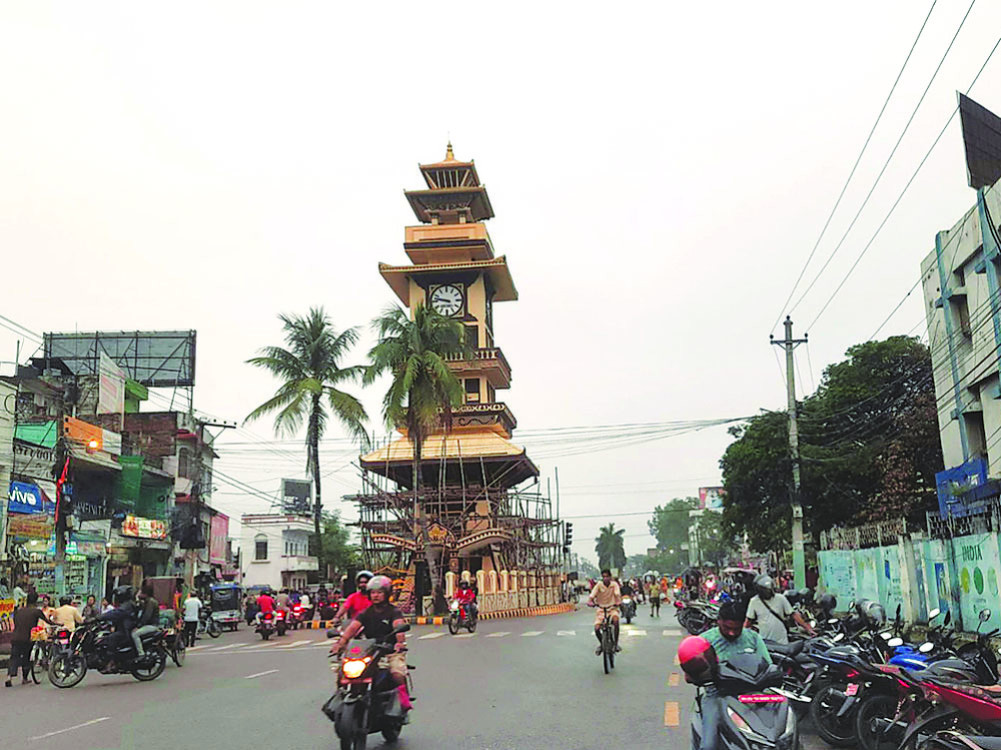
Ghantaghar – A clock that tells the time. This square in Birgunj is a traditional hub for social networking. Here, relationships are formed, broken, and reconnected.
We use Google Cloud Translation Services. Google requires we provide the following disclaimer relating to use of this service:
This service may contain translations powered by Google. Google disclaims all warranties related to the translations, expressed or implied, including any warranties of accuracy, reliability, and any implied warranties of merchantability, fitness for a particular purpose, and noninfringement.
Ghantaghar is an open book to understand the social and political life of Birgunj. This is one of the many squares in Birgunj. In the vernacular, Ghantaghar is simply called ‘Ghantaghar’ instead of Chowk. This place has had a special place in the life of Birgunj for half a century. Morning tea, newspaper discussions, afternoon tea and evening chatter have given this square the appearance of ‘Every Day Democracy’. It has become a living platform where everyday life, the weaving of relationships and collective consciousness are appearing together.
The elders used to say that when the Nepal Government Railway station was nearby, people returning from Kathmandu (then called Nepal) would flock here whenever the train came to hear the news of the government. The real story of Birgunj can be heard in this square. Ghantaghar is the ‘public consciousness’ of this city. Here people come without invitation, wait without permission and speak without formality. In the case of Birgunj, this is the place where democracy is reflected in its most original state. The synthesized sound that resonates in the parliament is expressed unfiltered in the square. The elders used to say that when the Nepal Government Railway station was nearby, people returning from Kathmandu (then called Nepal) would flock here whenever the train came to hear the news of the government. That is, even before the clock tower was built in the thirties, there was a lot of activity in this place.
Birgunj is a border town, the main gateway between Nepal and India. In this way, the clock tower is not just the center of the city, but the gateway to the border. The clock tower has seen the crowd turn into slogans and slogans turn into history. Here, the state monitors, but society lives its freedom. This is the conflict that makes this square special. This is the place where ordinary people suddenly become a ‘political entity’. The clock tower is a witness – sometimes standing here becomes a political statement.
On a normal day, this square is under the control of the state – traffic, police and rules. But, as discontent grows, this place comes under the control of the people. This ‘occupation of space’ is real politics. The government wants to control this square and the people keep ‘reclaiming’ it. Thousands of people pass through the clock tower every day. For them, it is just a road, a crossroads. But, the carpet of history has been spread over this road. Each of the streets of this intersection has a story, which tells the story of the settlement expansion of Birgunj over the past century.
To understand the square is to know about the city. And, to understand the city is to understand the symbiosis of society and power. Ghantaghar Chowk teaches us that the city is not just concrete and infrastructure. It is a living, breathing, struggling ‘organism’. The informal economy prevalent in this square can be felt by the economic heartbeat of the city. This square has become a stopover for people coming from rural areas to Birgunj for various purposes. The architecture of the clock is attractive, and a statue of social justice warrior Ramjanam Tiwari is installed nearby.
This square was narrow in the beginning, but has gradually been widened. Jatras, processions, cultural programs either take place here or inevitably pass through here. It has become the identity marker of the city. It carries the image of a collective memory-place of some events in the city. There is a confluence of six roads here, due to which this context has been identified - to go to the right of the square, to wait in the square. If someone gets stranded during the Dashain Mela or other crowded events, it is told in advance - to wait at the Ghantaghar Chowk.
Martyrs were killed here during the Madhesh movement, so Ghantaghar Chowk is considered a pilgrimage site for the struggling parties. Statues of martyrs are placed on the western northern edge of the square. Ghantaghar has now developed into a stage of protest, a symbol of struggle with the state, and a place of expression of identity in some contexts. It has become the Maitighar of Kathmandu or the Jantar-Mantar of Delhi. But not only sit-ins, processions or demonstrations are held - blood donation programs, vaccination camps, public awareness campaigns are also being conducted. It has become an unannounced center for public dialogue. That is why security arrangements and surveillance dimensions have been established here.
Morning life begins in a way at the clock tower. For those who come from different corners of the city for morning sightseeing, a moment to relieve fatigue, drinking tea, a stop for milk traders, the hustle and bustle of newspapers, the throng of school-campus goers, the gathering of those who come from the village in search of work, etc. emerge here with diverse colors. Each road here has a different characteristic. And, it has gained recognition for different activities. Just as daily wage workers wait on the southern side of the square, shoe and slipper repairers sit in a line towards the south-eastern corner. During the day, there is a rush of people, especially from rural areas, to shop, get medical treatment, and get government services. And, again, in the evening, there is a wonderful divinity.
There is a queue of people taking selfies in front of the clock tower in the flicker of electricity. Whoever comes to Birgunj wants to reach the clock tower at least once. Food is sold on the sidewalk here according to the time and weather.
There is a queue of people taking selfies in front of the clock tower in the flicker of electricity. Whoever comes to Birgunj wants to reach the clock tower at least once. Food is sold on the sidewalk here according to the time and season. There was a statue of Thirbam Malla, the immortal martyr of the seven-year people's revolution, in the premises of the clock tower, which was demolished during a movement. This was considered the second murder of Thirbam Malla. After that, he has not been able to be rehabilitated. Now, with a gap of two decades, that statue has also started to disappear from the city's memory.
There is no curriculum for conversation here, but some new and old information about the city is found here. Easy and awkward discussions about government work spill out here. Familiar and unfamiliar people meet here, exchange thoughts, sometimes argue, disagree. There is humor and social criticism too. This Ghantaghar Chowk has become a living laboratory of coexistence. And this famous Ghantaghar of Birgunj shines with different colors in literature. The square does not keep the city's culture closed like a museum, it is keeping it alive openly.
This is the place where tradition and modernity, rusticity and urban style, development and underdevelopment meet. The square teaches us that culture is not a static thing, but a constantly changing process.
Ghantaghar – A clock that tells time. This square in Birgunj is a traditional hub for social networking. Relationships are made, broken and reconnected here. This square is a rare place where different groups come into contact with each other. The fabric of society is built on many levels of caste, class, religion – the square brings all these divisions together in one place.