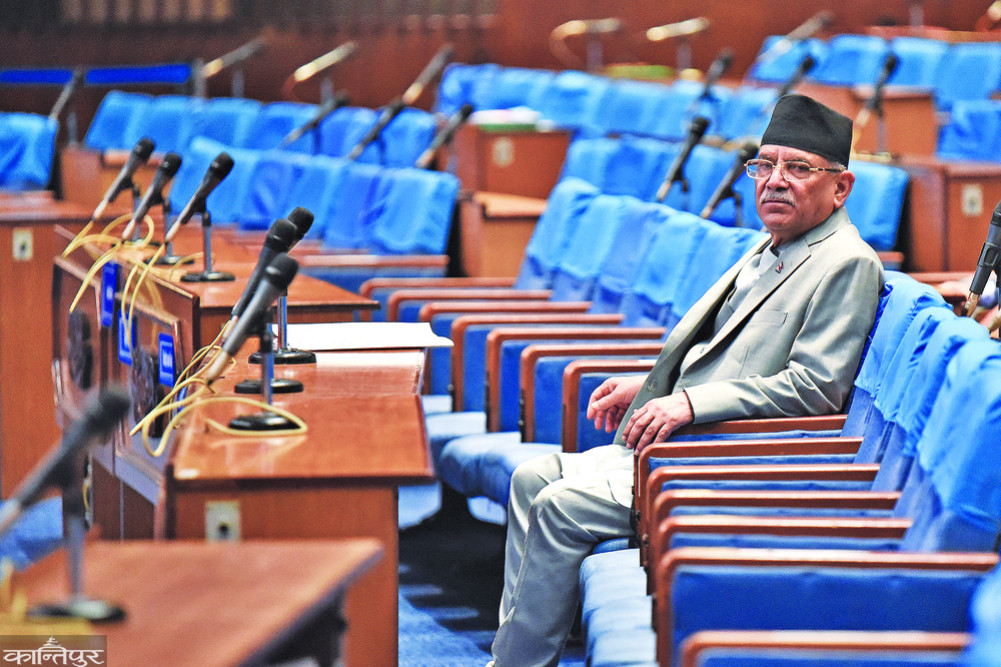
Pushpa Kamal Dahal led the government three times, but only the second and third terms were memorable.
We use Google Cloud Translation Services. Google requires we provide the following disclaimer relating to use of this service:
This service may contain translations powered by Google. Google disclaims all warranties related to the translations, expressed or implied, including any warranties of accuracy, reliability, and any implied warranties of merchantability, fitness for a particular purpose, and noninfringement.
इतिहासकै शक्तिशाली जनमतसहित वालेन्द्र शाह प्रधानमन्त्री बनेको तीन साता पुगेको छ । प्रधानमन्त्रीका रूपमा उनको भूमिका कस्तो रहनेछ ? उनलाई इतिहासले कसरी सम्झिन्छ ? अहिल्यै आकलन गर्नु हतारो हुनेछ । नेपालको राजनीतिक इतिहासमा ४० जना प्रधानमन्त्री भइसकेका छन् । तीमध्ये कतिपयलाई निरन्तर सम्झना गरिन्छ । कतिपय भने गुमनाम जस्तै छन्, औपचारिक सन्दर्भभन्दा बाहेक चर्चा गरिँदैनन् । ‘कोसेली’ ले केही प्रधानमन्त्रीको कार्यकाल सम्झना गरेको छ । ‘कान्तिपुर’ को सम्पादकीय समूहले पदमा रहँदा निर्वाह गरेको भूमिका र सार्वजनिक विमर्शमा नाम आइरहने १२ पात्र छनोट गरेको छ । उनीहरूको पदावधिको चर्चा गर्दा नेपालको मूलभूत शासकीय प्रवृत्ति उजागर हुनेछ भन्ने हाम्रो विश्वास छ ।
Pushpa Kamal Dahal, the then Maoist chairman (currently the NCP coordinator), who led a ten-year armed war to seize state power at gunpoint, led the government three times, but only his second and third terms were memorable.
He became Prime Minister after the Constituent Assembly elections held immediately after the Maoists became the first party to take a peaceful political path in the 2064 Constituent Assembly elections. Known as a rebel leader, his first term in power was marred by controversy. After being elected Prime Minister by the parliament on 31 Shrawan 2065, his announcement was to build a 'New Nepal'. He had started a 'people's war' that would change the world, but despite coming to power several times, he himself changed to a parliamentary system.
The Maoists' policy was to build a new Nepal by transforming the state structures of the judiciary, Nepali Army, police and bureaucracy. As Prime Minister, Dahal had said in his address to the parliament on 29 Bhadra 2065 that a consensus should be found for the constitution-making process. ‘At this stage of political change, due to our development and other circumstances, we cannot immediately reach communism, nor can we remain in the traditional parliamentary system as it is,’ he had said. ‘However, we are committed to establishing an inclusive and proportional state system based on federalism by embracing the values of democracy.’
Despite becoming the largest party in the parliament, questions were raised about its failure to abandon the ‘people’s rebellion’ policy. ‘The Communist Party of Nepal (Maoist), which leads the current government, is fully committed to establishing a federal democratic state and protecting and promoting the basic values of democracy,’ Dahal clarified. The government is striving to restore democracy to the doorsteps of the people and raise the voices of the people who have not been able to reach the state.’ This statement by Dahal, the NCP coordinator, has not been fulfilled.
But the case of removing the Supreme Commander of the Nepali Army, which had established a strong system for a long time, not only made the Dahal government controversial, but also forced it to resign. In his first term in 2065-066, he led the first government formed after the establishment of a republic by the Constituent Assembly in Nepal. He tried to lay the foundation for institutionalizing the new political system after the end of the monarchy, but could not succeed due to his lack of governing experience. Dahal himself has admitted that he got caught up in the 'unnecessary' case of removing the then Chief of Army Staff due to his lack of experience.
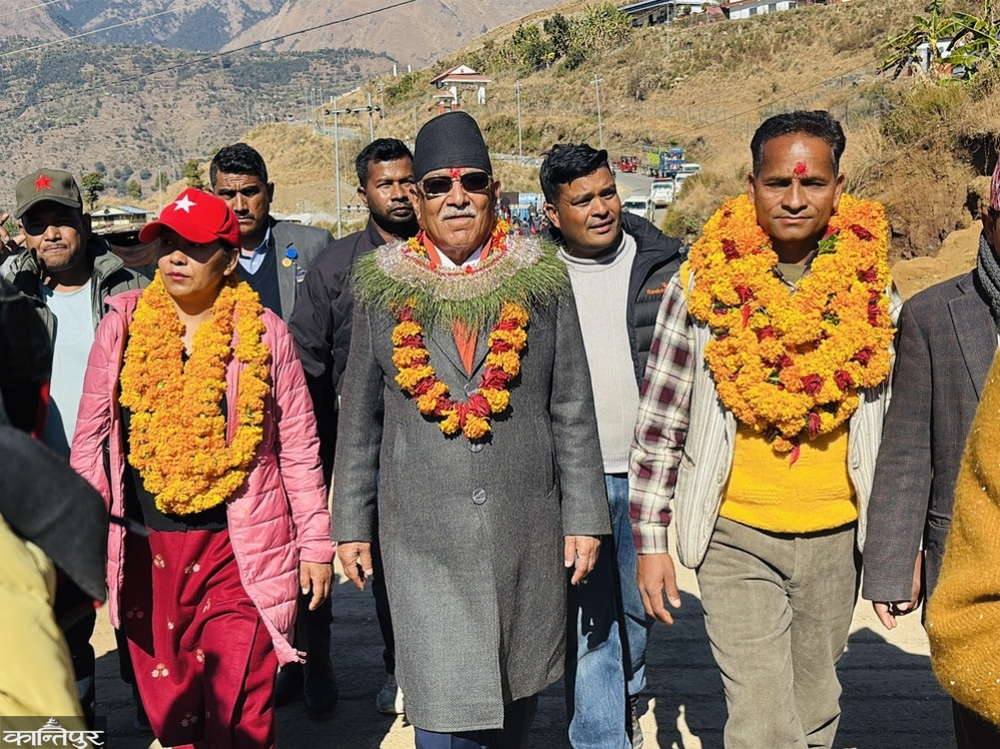 Dahal had prioritized the federal democratic republic, the process of transforming state bodies into a new structure, and post-conflict management. The Maoist government had especially begun to advance the process of managing and integrating Maoist fighters. However, the Dahal government collapsed in less than a year when it tried to disrupt the structure of the Nepali Army.
The government had decided to take action against Army Chief Rukmangat Katwal and appoint another Rathi Kul Bahadur Khadka as the Army Chief. After the decision to remove Katwal from office on 20 Baisakh 2066, the Maoist government stood on one side and the old parliamentary parties including the Congress and UML stood on the other.
The dispute between the government and the army had reached its peak due to the army leadership's refusal to integrate Maoist fighters into the Nepali Army, disobeying the government's directive to stop the military recruitment process, and the army's opposition to the decision to retire eight generals.
As the conflict between the government and the army leadership increased, the Council of Ministers finally decided to dismiss Katwal. Then, the then President Ram Baran Yadav reversed the government's decision and decided to retain Katwal as the Army Chief.
After the President reversed the decision, Dahal resigned on 11 Jestha 2066, saying that 'civilian supremacy has weakened'. Immediately after, the Maoists launched a street struggle adopting a policy of 'people's rebellion'. After Dahal, the then senior leader of the UML, Madhav Kumar Nepal, was elected as the Prime Minister. Saying that India had formed the government, the Maoists had announced in a meeting in New Baneshwor that they would 'negotiate with the master, not with the servant'.
After resigning from the post of Prime Minister in the Army Chief case, Dahal had raised the issue of citizen supremacy in his address to the Parliament on 8 Jestha 2066. ‘The question of democracy today is whether to make necessary reforms in the army to sustain civilian supremacy or to kneel before a military officer who challenges civilian supremacy and mock the achievements of the people,’ he had said. ‘To answer the question of whether to be ready to throw the nation and the people into chaos for the sake of the momentary interest of the chair or to stand firm for the independence of the nation and the supremacy of the people, regardless of the chair, I have proudly accepted the resignation of the chair as the leader of our party and its leadership.’
Breaking the tradition of going to India for the first visit as Prime Minister, Dahal visited China at the conclusion of the Olympic Games. His visit became famous in geopolitical circles. This led to a cooling of Dahal’s relations with his southern neighbor India. Dahal’s first term as Prime Minister of the Maoist-UML alliance was 9 months and 12 days.
A memorable second term
Dahal became Prime Minister for the second term after the constitution was promulgated in Asoj 072. His tenure was linked to the implementation of the constitution. Holding local elections, which had not been held for 20 years, is considered an important achievement during his tenure, which marked the first time federalism had been institutionalized at the local level as provided for in the constitution.
At that time, the country was experiencing extreme load shedding. While there was no talk of ending load shedding, the Kathmandu Valley, especially, had no electricity since the day of Lakshmi Puja of Tihar. The end of load shedding was initiated by the active efforts of Prime Minister Dahal, Energy Minister Janardan Sharma, and Nepal Electricity Authority Executive Director Kulman Ghising.
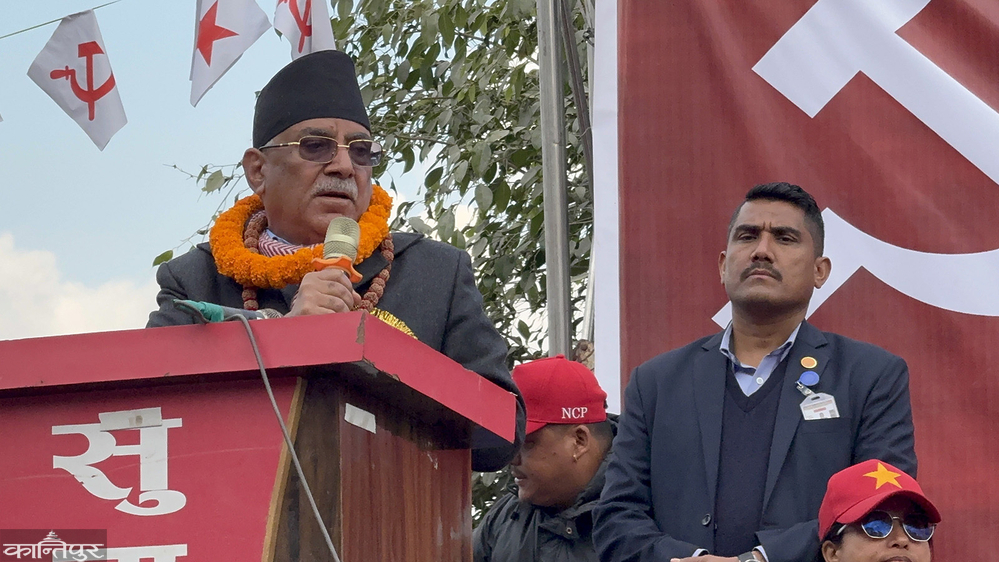 After the local elections, it seems that the government at that time played a role in implementing the constitution. As Prime Minister, Dahal prioritized the issues of economic prosperity, good governance, and social justice, but could not move forward as expected. Dahal led the government for 10 months and 4 days from 19 Shrawan 073 to 23 Jestha 074.
Third term: Good governance is the main issue of the Prime Minister with the magic number
In the 2079 general election, the then Maoists became the third party by winning 32 seats in the House of Representatives. Dahal, who had an alliance with the Congress in the election, formed an alliance with the UML after the election results using the magic number of the parliament. He became the Prime Minister with the support of the UML.
He divorced UML Chairman KP Sharma Oli in Mangsir 2077 and reunited with him in Poush 2079. The UML had supported Dahal without any major conditions. But the Oli-Dahal collaboration did not last long. The Oli-Dahal collaboration broke down after the conflict over who should be the president increased. Two months later, the Maoists and the Congress-Maoist coalition government was formed.
In Dahal's third term, the issues of good governance and corruption control were prioritized. The excavation of the Bhutanese refugee case had begun at that time. Former ministers Balkrishna Khand and Top Bahadur Rayamajhi, among others, were investigated.
The government had worked to draft laws to finalize the legal process related to transitional justice. Dahal had particularly taken the initiative to improve relations with India. During his visit to India, Dahal had given importance to religious diplomacy by performing religious prayers in Ujjain, Madhya Pradesh. But despite policy initiatives in the areas of economic reform, revenue collection, strengthening the banking system, and investment promotion, there was no improvement.
Dahal reached the opposition bench after the Congress-UML coalition government was formed in Asad 081. Dahal claimed that the government led by him was displaced because of its harsh measures in good governance. Dahal claims that the Gen-G movement occurred due to the Congress-UML coalition government. Dahal's third term began from Pus 079 and lasted for 18 months and 21 days until Asad 31, 081. This was the longest term out of the three terms.
Dahal's three terms are linked to different historical phases. The first term focused on transition management and building the foundation for institutionalizing the republic. The second term was an initiative towards implementing the constitution and strengthening the democratic structure. The third term focused on efforts towards good governance, transparency and system reform.
However, Dahal, who came from a background of armed conflict, had some shortcomings while leading the government.
First, there was a lack of stability in his political line. His attention was not focused on strengthening federalism, which had come under the Maoist leadership. He adopted a 'right-left' policy for power. Since all three governments were coalition governments, there was a lack of a clear economic vision according to the Maoist policy. While in power, the Maoists were unable to bring a policy focused on the lower classes, farmers and workers.
Dahal was unable to provide a concrete and long-term blueprint for transforming the economy. Although the slogan is socialism, in practice it has been seen that it has leaned towards capitalist policies. Dahal has failed to bring transitional justice to a conclusion while leading the government three times. About 1,444 fighters have been integrated into the Nepali Army, while a law on transitional justice has been enacted. The truth about the events that took place in the war has not been revealed.
Dahal's stormy political journey
Born on 26 Mangsir 011 in Dhikur Pokhari, Kaski, Dahal started his political life as a member of the party in the Pushpalal group of the NCP in 028 BS. He entered the fourth general convention in 034 BS, became a full-time cadre in 035 BS and a member of the Chitwan District Committee in 036 BS. He was recommended for membership by leader Amik Sherchan.
Dahal, who was elected as the Central President of the All Nepal Youth Union in 038 BS, was elected as a Central Member of the Central Committee of the All Nepal Youth Union in 040 BS. In 041 BS, he was elected as a Central Member of the Fifth General Conference of the NCP (Mashal) and became a Politburo member in 042 BS.
On 29 Baisakh 043 BS, the NCP Masal led by Mohan Baidya adopted a policy of boycotting the National Panchayat elections by attacking some police posts. The incident, known as the Sector Scandal, displaced Baidya from leadership. After Baidya left, Dahal was elected General Secretary of Masal in 046 BS. Masal and the Proletarian Workers' Organization formed the NCP Unity Center in 048 BS. The Center won nine seats in parliament when it contested the elections under the name of the United People's Front.
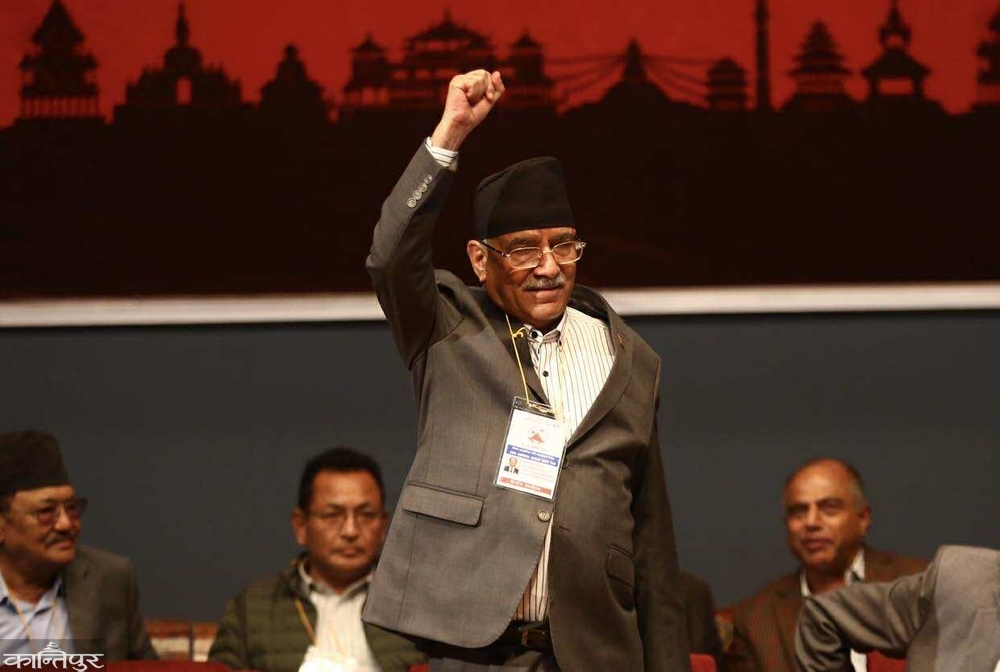 After the third extended meeting held after the first national conference of the then CPN Unity Center in 051 BS with the aim of starting a 'people's war' in the country, the party's name was changed to CPN (Maoist). Dahal, who was the general secretary of the CPN (Maoist), led the 'people's war' from 1 Falgun 052 BS. He became the chairman of the CPN (Maoist) from the second national conference in 057 BS.
On 7 Mangsir 062 BS, a 12-point understanding was reached between seven political parties and the Maoists to end the monarchy. Dahal was underground for 25 years until 063 BS. After the success of the 062/63 BS people's movement, Congress President Girija Prasad Koirala became the interim Prime Minister of the country. The government and the Maoists signed a ceasefire. On 2 Asar 063 BS, he gave up his underground life by holding a press conference in Baluwatar. After the interim constitution was promulgated on 1 Magh 2063, the Maoists participated in the parliamentary system with 83 out of 330 seats in the interim legislature.
On 5 Mangsir 2063, a comprehensive peace agreement was signed between the then Prime Minister Koirala and Dahal. And, in 2064, the first Constituent Assembly elections were held. In the direct elections for 240 seats, the Maoists won 120 seats. It had won 100 out of 335 seats in the proportional representation. Nine out of 26 people nominated by the Council of Ministers were from the Maoists. It had won 29 percent of the votes in the proportional representation. There were 601 seats in the Constituent Assembly.
The first Constituent Assembly declared a republic in 2065 Jestha. Dahal, the supreme commander of the 10-year armed war, was elected the first Prime Minister of the Republic of Nepal in 2065 Shrawan.
०४६ सालदेखि हालसम्म ३६ वर्ष उनी निरन्तर नेतृत्वमा छन् । ३ जेठ ०७५ मा नेकपा (एमाले) र नेकपा (माओवादी केन्द्र) बीच पार्टी एकता भई नेपाल कम्युनिस्ट पार्टी (नेकपा) गठन भएपछि उनी र केपी शर्मा ओली अध्यक्ष भए । दुई अध्यक्षबीच शक्तिसंघर्ष चुलिइरहेकै बेला २३ फागुन ०७७ को सर्वोच्च अदालतको फैसलापछि नेकपा (एमाले) र नेकपा (माओवादी केन्द्र) पूर्ववत् अवस्थामा पुगे ।
पुस ०७८ मा महाधिवेशनबाट दाहाल पुनः अध्यक्षमा चुनिए । नेतृत्व हस्तान्तरणको माग भए पनि सुनुवाइ भएन । कात्तिक ०८२ मा नेकपा एकीकृत समाजवादीसँग एकतापछि कम्युनिस्ट पार्टीका संयोजक दाहाल छन् ।