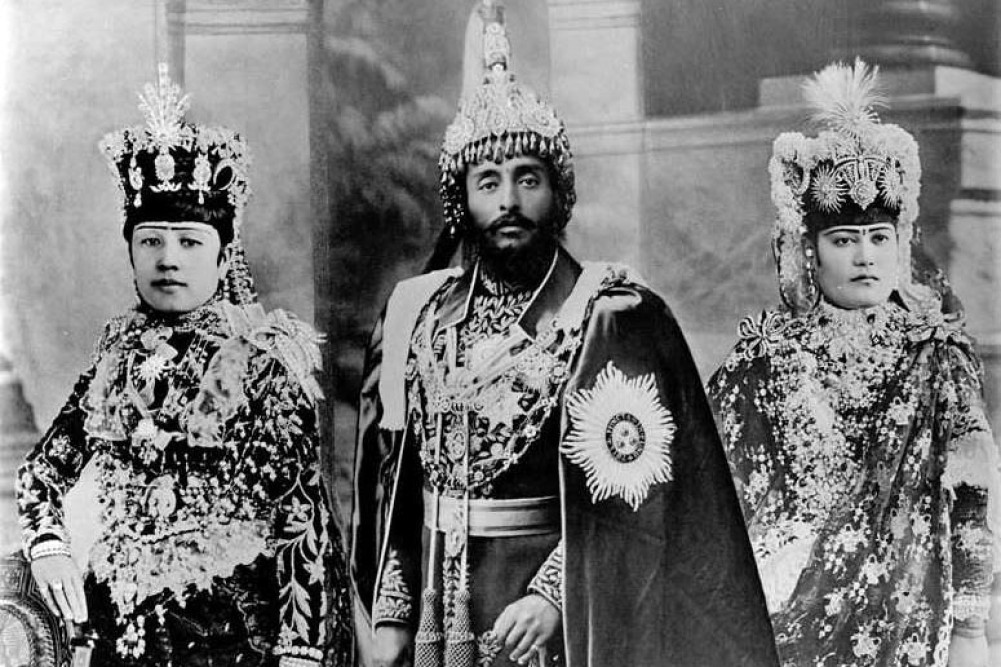
For some, Chandrasekhar was a patriotic hero, while for others, he was a cunning and cruel ruler. All historians agree on one fact: he played a significant role in the modernization of Nepal.
We use Google Cloud Translation Services. Google requires we provide the following disclaimer relating to use of this service:
This service may contain translations powered by Google. Google disclaims all warranties related to the translations, expressed or implied, including any warranties of accuracy, reliability, and any implied warranties of merchantability, fitness for a particular purpose, and noninfringement.
इतिहासकै शक्तिशाली जनमतसहित वालेन्द्र शाह प्रधानमन्त्री बनेको तीन साता पुगेको छ । प्रधानमन्त्रीका रूपमा उनको भूमिका कस्तो रहनेछ ? उनलाई इतिहासले कसरी सम्झिन्छ ? अहिल्यै आकलन गर्नु हतारो हुनेछ । नेपालको राजनीतिक इतिहासमा ४० जना प्रधानमन्त्री भइसकेका छन् । तीमध्ये कतिपयलाई निरन्तर सम्झना गरिन्छ । कतिपय भने गुमनाम जस्तै छन्, औपचारिक सन्दर्भभन्दा बाहेक चर्चा गरिँदैनन् । ‘कोसेली’ ले केही प्रधानमन्त्रीको कार्यकाल सम्झना गरेको छ । ‘कान्तिपुर’ को सम्पादकीय समूहले पदमा रहँदा निर्वाह गरेको भूमिका र सार्वजनिक विमर्शमा नाम आइरहने १२ पात्र छनोट गरेको छ । उनीहरूको पदावधिको चर्चा गर्दा नेपालको मूलभूत शासकीय प्रवृत्ति उजागर हुनेछ भन्ने हाम्रो विश्वास छ ।
In the murderous philosophy of ‘whose sword, his palace’, Jung Bahadur Rana laid the foundation of the Rana regime, each brick of which was soaked in blood. There was one prime minister with that bloody legacy – Chandrashamsher. Historians have different opinions about him and his contributions. For some, he was a great patriot, while for others, he was a cunning, extremely cruel ruler. All historical scholars agree on one fact – he played a significant role in the modernization of Nepal.
The color of the Rana regime was completely dark and murky. In the shadow of that unique period of time, there were only cries, tears and rivers of blood – Kot Parva, Bhandar Khal Parva and festivals. However, Chandrashamsher was one who did not celebrate ‘festivals’, did not play Holi of blood. Instead, he did many special deeds of social reform. And, he stood out in the long line of Rana rulers. In the story of Chandrashamsher, which is pressed by paperweights, there are no blood spatters – they are found in tenderness and redness.
Author Madanmani Dixit has a book – ‘Patriotic Great Man: Shri 3 Chandrashamsher’ . In the book, Dixit has described Chandrashamsher as ‘the first revolutionary patriot and social reformer among the Prime Ministers of Nepal’. Madanmani is engrossed in praising Chandrashamsher’s reforms and development, but without reviewing his wrong steps, he has adorned him with hundred leaves and velvet garlands of praise. For example – Madanmani does not see Chandrashamsher’s fault in the imprisonment and killing of Subba Krishnalal Adhikari, saying that all the mistakes were his brothers’. Madanmani has written, ‘Some high-ranking officials of Chandrashamsher’s then powerful party have elevated him to the position of Prime Minister of the country.’
Some historians have considered Chandrashamsher to be a ‘conservative’ and ‘autocratic’ ruler, but he has some good deeds for the country, which have made him ‘immortal’. Writers like Madanmani believe that Chandrashamsher has made a significant contribution to the modernization of Nepal. However, there are also historians who say that those reforms and good deeds were mostly done with the aim of strengthening Chandrashamsher’s family and rule. Madanmani writes, ‘The fact that Chandrashamsher, who worked for material progress, was considered by respected writers of Nepal to be ‘cunning, extremely ruthless, cruel and unbridled in his activities’ is only due to his ego and inhuman outlook.’
Madanmani writes that Chandrashamsher, who ruled for 29 years during that dark and gloomy time, should not be called a ‘great man’. His personality and work should be evaluated only to the extent that it is, if the crown that historians have placed on his head is fake, it should be taken away. The sky that remains in his personality after taking away that crown is the real Chandrashamsher. What is the environment created by the light and brilliance of Chandrashamsher’s work like? Only a correct evaluation of that will make him a ‘great man’. Let us discuss his role in the modernization of Nepal.
000
Has become like a legend or a fable – Shri 3 Chandrashamsher (1920-1986 B.E.). When we look back at the reign and life of Shri 3 Maharaj of the Rana regime and the 13th Prime Minister of Nepal, Chandrashamsher, why does he sometimes seem like a ‘patriotic great man’ and sometimes a ‘cruel ruler’? To understand that, we have to look at his ‘self-portrait’.
Chandrashamsher ended the evil practice of ‘Sati’, where women were burned alive while they were alive, in 1977 B.E. Chandrashamsher brought justice to thousands of women who were burned on the pyre along with their husbands’ bodies – through legal means. Hindu society used to say that – committing Sati is the main symbol of women’s chastity. Sujit Mainali, the author of the book ‘Sati’, believes that ‘if William Bentick in Calcutta and Chandra Shumsher in Nepal had not abolished it, the practice of sati could still exist sporadically in the Hindu community.’
But in the same year that sati was abolished, Subba Krishnalal Adhikari was sentenced to prison on the charge of ‘slandering’ after writing the book ‘Maize Farming’ and he died in prison. Chandra Shumsher was terrified by the powerful words in the book ‘British dog’ and ‘maize-eating red-headed and black-headed insect’.
Chandra Shumsher is the same Chandra Shumsher who abolished the system of slavery in Nepal in 1980. When the system was abolished, he had to pay 6 million rupees to the owner of the slave. After reports came out that his second wife, Rani Balkumari's eldest son, Vishnu Shumsher, had eaten beef at a restaurant in Calcutta, Chandra Shumsher not only expelled his son from the 'rollkram' but also exiled him from the country. And, he also banned his entry into Nepal in the future. Even after his death in Spain, his body was not allowed to be brought to Nepal, and he was cremated in Varanasi.

Chandra Shumsher had issued an order to send Nepali youth to Lahore. When Chandra Shumsher was in power, the First World War was going on. And, he forcibly sent Nepali youth to fight in the World War. The criteria for a young man eligible for recruitment were - healthy, strong hands, feet, eyes, and ears. By sending him to the World War, he played with the dreams and lives of many young men.
 Out of the five hundred and one thousand soldiers who joined the Indian British Army in the World War, 55 thousand were Nepalese. Chandrashamsher issued a Sanad in the name of Kipatiya, Talukdar, Mukhiya etc. throughout Nepal. The Sanad states the qualifications of the young men who want to be recruited: Age – 18 to 25 years, Height – 5 feet 2 inches and Chest – 32 inches. It also states the caste qualifications – Thakuri, Chhetri, Gurung, Ghale, Magar, Limbu Kirati Rai, Sunuwar, Ranabhat, Nagarkoti, Matwali Khas, Tamang and Sherpa are considered eligible castes for the army. There is a special bonus arrangement for those who send back – three rupees and three stamps for those who recruit one to 10 people, four rupees and two stamps for those who recruit 10 to 24 people and five rupees for those who send more!
The charter reads, ‘You all know that the British Government and the Nepal Government have been on friendly terms since before… Since the number of recruits who voluntarily join the regiment is very small and is not enough to complete the recruitment at any one time, the British Government has written to the Nepal Government on behalf of friendship, stating that the entire recruitment will be recruited in the summer….’ (A copy of this charter was provided by historian Rajkumar Dikpal.)
The ‘emancipation of slaves and the abolition of slavery’ during Chandrashamsher’s prime ministership is considered a unique event in Nepal. ‘At that time, there was no limit to the work that a slave could do in the master’s house.’ After working in the fields until death all day, at night, they had to do everything from rubbing oil on the feet of all the owners and mistresses of the house, making them clean, raking grass, leaves, and flowers, to carrying doli at everyone's weddings, becoming a kalsini and a lokanti. Servants and maids were given as dowry at the wedding of the rich - the price of a good young maid in the market reached three hundred and ninety rupees. If we were to calculate it at the prevailing price, it would be eight to nine thousand rupees. They were bought like cows and buffaloes.' (Nepal at that time, Part 1, Bhim Bahadur Pandey)
Before the Kariya Mochan speech given in the name of the nation from under the Khari tree in Tundikhel, Chandrashamsher had also recited the story of King Harishchandra and Vishwamitra and recited poems. The speech regarding the Kariya Amlekh was written separately in English and Nepali.
Chandrashamsher had said in his speech – On Magh 14, 1981, Nepal had a total population of 55,73,788. There were 15,719 Kariya owners and 51,419 Kariyas. His appeal was – all Kariya owners should get their Kariyas to agree and redeem them for free. Fourteen lakh rupees were set aside by the then government to compensate those owners who did not redeem their Kariyas for free despite the government’s appeal. (Nepal at that time, Part 1, Bhim Bahadur Pandey) .
Chandrashamsher was abandoning traditional beliefs and adopting modernity as a practice at that time. Lekhnath Poudel and Laxman Shrestha's research paper titled 'Modern Chandrashamsher's Journey to the Treaty of 1923' states, 'The abolition of slavery was not as easy as the abolition of Sati. Although the social basis of Sati had been destroyed, it was a socially complex task as the practice of keeping slaves remained. Gurus, priests, pundits, lords, landowners of the hills and Madhesh were against the abolition of slavery, but he abolished slavery by providing compensation from the government treasury. The freed slaves were settled in the city of Amlekhgunj.'
When Chandrashamsher banned the practice of Sati in Nepal, no one resisted. However, five years later, when the Kariya system was enacted, the state had to be careful about whether the world would resist. In his book ‘Sati’, historian Sujit Mainali writes, ‘It had to resort to the provisions against the Kariya system described in the scriptures, including the provision of compensation for the owners who lost the Kariya system. Before that, there was opposition when the East India Company banned the Sati system in India.’
000
Historians have written that Chandrashamsher was a patriot. He was afraid that if he took personal advantage, he would be subjugated by Britain. That is why even when he was dying, he did not call a foreign doctor for medical treatment. And, he did not import medicine from abroad, he used local herbs.
In the eyes of historians, Chandrashamsher was also a ‘dreamer’, who would ‘hide’ the affairs and decisions of the government in the evening or at night. And, his importance is established in the dream of nation building. Therefore, his shadow is creating a huge circle in the hearts of women and all the people because they did not have to go through sati and did not have to be slaves.
At that time, Nepal did not have a national anthem. The British tune was played in Nepal - God Save the King. Chandrasher had Chakrapani Chalisa made the national anthem.
In a meeting, Madanmani told the story of his own family connected to Chandrasher, 'The Dalai Lama government from Tibet used to send large and expensive and beautiful gold and silver ornaments to the Nepal government in the form of 'cannon' once every 5 years. That time, a very beautiful white horse was also brought to Nepal in the grand cannon that Chandrasher received. Such a horse was called 'Chinese Chanta'. The horse was kept in Singha Durbar. One day, Chandrasher had a bad dream. The horse arrived at my grandfather's private stables, saying that if he donated a horse, the dream's defects would be removed. My grandfather would ride the horse tied to the stable and run fast from Ghairidhara's house to Tundikhel. He would whip the horse that was running behind him and take him to Tundikhel. One day, the white hair on the body of a Chinese horse got on the black coat of my grandfather Kashinath Acharya Dixit. He reached the Kharibot of Tundikhel. Chandrashamsher, seeing the white color on the black coat, looked at his brothers and said, 'Look! How beautiful the white stars look in the black sky?' My grandfather considered that statement an insult. And without getting off the horse, he said, ‘From now on, I will not live in your kingdom.’ Then, when he was about to reach Marfa via Thankot, Nagarjuna Hills, and Chitlang, the Lieutenant General sent by Chandrashamsher persuaded his grandfather and brought him back to Kathmandu.’

Madanmani has written, ‘If he had a bad dream, Chandrashamsher would donate a golden balance, i.e., a person’s weight in gold.’
It is written in history that Chandrashamsher used to drink a lot when he was young. Before becoming the Prime Minister, he almost fell on a wooden crate while trying to board a ship at Mukamaghat on the banks of the Ganges in Bihar, India. Seeing his condition, an Englishman said, ‘You are becoming the Prime Minister of Nepal tomorrow.’ You should not drink alcohol like this.’ It is said that from that day on, Chandrashamsher did not drink a single drop of alcohol.
Chandrashamsher was not very fond of women like other Rana prime ministers. After the death of his married elder wife Lokbhaktadevi, he married Balkumari as his younger wife. Apart from them, he had no other wives. However, it is said that Balkumari suspected Chandrashamsher of having an affair with the singer Melwadevi. And, she tried to ruin the singer’s voice by mixing vermilion in her food and drink. Chandrashamsher had brought a doctor from Britain to treat Melwa’s throat.
Chandrashamsher was interested in classical singing. He himself did not sing. However, when he went hunting every year, famous singers from Lucknow and Banaras were invited to join him. They used to sing Melavadevi's songs - The further I go, the more I love you, the better I am, there is no one to cry, my ride is in my train. Chandrashamsher was engrossed in Melavadevi's voice and beauty.
 Chandrashamsher became such a legendary character, about whom Madanmani Dixit has written in detail in his book. According to Madanmani, when Chandrashamsher went to Calcutta, the British government provided him with a motorcar for his transportation. Chandrashamsher learned about its structure from the driver when he got on the motorcar. According to the driver, the main engine that powered the motorcar was connected to the seat of the person sitting behind at that time. After hearing that, Chandrashamsher said, 'The engine of the motorcar should be placed in front, not under the seat.' After that, the engine of all motorcars in Britain was placed in the front.
Chandrashamsher had brought the ‘fountain pen’ to Nepal from Britain. That pen proved to be a boon to those who studied accounting at a time when they had to write with bamboo or reed.
According to the book ‘Patriotic Hero: Shri 3 Chandrashamsher’ written by Madanmani, some of Chandrashamsher’s bright ‘good deeds’ for the country are as follows:
– Ending the Sati system from Nepal (1977)
– Abolishing the system of slavery from Nepal, which is called Kariyamochan (1980). Not only did Chandrashamsher liberate the slave laborers, but he also established settlements in Amlekhgunj and Chandranigahapur for their burial places.
– Chandra Shumsher had the ‘Chandranahar’ constructed to send water to the fields for the benefit of farmers in Saptari, Siraha, Sarlahi and Rautahat for the development of agriculture.
– Chandra Shumsher had the first electricity service in Nepal started in Pharping (1910).
– Chandra Shumsher had the motorable road constructed from Amlekhgunj to Bhimphedi via Bhainse. At that time, the first tunnel in Nepal was constructed in the Chure Mountains.
– Chandra Shumsher had also the ‘ropeway’ constructed from Dhursing Mountain near Bhimphedi to Mata Tirtha in Kathmandu. That ropeway helped reduce the price of consumer goods imported into Nepal from India and Britain. He had started railway transport by constructing a railway line from Amlekhgunj to Raxaul. It was named – Nepal Government Railway.
– Chandra Shumsher had formally concluded a treaty between Nepal and Britain declaring Nepal an independent state with sovereign power (1924).
– Chandra Shumsher established Trichandra College (1919). At that time, it was commented that by opening the door to education, the Ranas had stabbed themselves in the foot. It is also said that he had donated 4 to 5 lakh rupees to the Banaras Hindu University (1977).
– Chandra Shumsher had Singha Durbar constructed under the supervision of building experts brought from Britain. He also had the current President's House, Sheetal Niwas, constructed by him.
– Chandrashamsher also built steel bridges over rivers – Thapathali, Khokana, Aryaghat, Gaurighat, Tadi, Arughat, Betravati, Benighat, Dolalghat, Chobhar to Raxaul in 25 places.
– Chandrashamsher himself was a tuberculosis sufferer, who took Ayurvedic medicine throughout his life. He built the treatment center in Bhaktapur and the tuberculosis hospital and houses for patients in Tokha on Budhanilkantha. ‘Singhdurbar Vaidyakhana’ was also built by Chandrashamsher.
– After the amendment of the Act, Chandrashamsher imposed a maximum prison sentence of 20 years for those who committed crimes. He did not execute anyone during his reign.
– He waived government money collected from the public in the name of religion. He remained active in the construction of Kotihom, Agnihotri, Satal and the renovation of the monastery.
– During Chandrashamsher’s time, the first motor car was imported to Nepal from Britain.
– Chandrashamsher had established the ‘Gorkha Bhasha Prakashini Samiti’ in Sambat 1978. Later, the same organization was changed to ‘Sajha Prakashan’ in BS 2017.
As Madanmani said, Chandrashamsher is not a great man of Nepali history, but he is a hero of Nepal’s modernization efforts.
000
The Rana rulers are alive in many stories and anecdotes. As it is said, there was one Mohanshamsher, who used to wash his hands 10 times a day with the help of three men who were helped by a gold-plated Karuva. And, he used 20 new handkerchiefs to wash his hands. Mohanshamsher used to take a very long time to defecate. People who came to the chakdi used to tell their pain while they were defecating. Mohan Shamsher would pronounce the verdict at that moment.
There is another story – of Juddha Shamsher. Only after Nepal's first doctor Siddhimani Acharya Dixit examined the genitals of Juddha Shamsher and said 'it is fine', did Juddha suffer the executioner.
Another story that will make your heart ache is like this – a person sentenced to death was put in a large pot of boiling mustard oil and the brain juice that was drained from the skull of the dying person was used as a life-saving medicine in Nepal until the time of Rana Prime Minister Bir Shamsher. (Patriotic great man, Madanmani Dixit) .
The Rana palaces that survive in the pages of history and stories are also storytellers of their time – their ruins narrate the social and cultural outline of the then society. Just as the Singha Durbar reminds us of Chandrashamsher’s style of governance and dignity.
The Singha Durbar, which was hidden in the pages of history, was an old and impregnable fortress of power that reminded us of Chandrashamsher – which was reduced to ashes in the flames of the Gen-G movement. Along with the Singha Durbar, the signs of the glory of the Rana era that reminded us of Chandrashamsher burned down.
 The Singha Durbar was not just a magnificent building and administrative structure, it was also a living record of Nepali history and politics. Its magnificent ‘architecture’ built by Chandrashamsher was a proclamation in itself – of the power to rule over the common people. Chandrashamsher built a 350 ropani land in 1911. This magnificent palace, built in 1960 at a personal cost of 2.5 million rupees, had 1,700 rooms and various courtyards. This palace reminded us of the elite timeline of the Nepali Rana dynasty.
Kamalmani Dixit has an influential book on Chandrashamsher – Chandrajyoti , Dixit has written about Singha Durbar, ‘Chandrashamsher had built Singha Durbar for himself, for his own family – it was already decided which part of it would be given to whom.’ But later Chandrashamsher realized that such a house and palace could not be maintained by the Chheras. So he made Singha Durbar the official residence of the Prime Minister.'
In Singha Durbar, Chandrashamsher would lie sprawled on a comfortable couch, in front of him would be a large silver paan bowl filled with various kinds of sweet spices, an artistic silver hookah, a rubber hose tied with gold at the end, and a couple of couches. The talukwals would sit on the couch and other worldly officials would sit sprawled on the carpet. The Prime Minister would listen to the (Nepal at that time) .
Even after the Singha Durbar fire incident of the Gen-G movement, if Chandrashamsher were still alive, he would have wondered in that butterfly garden – what would he do with a pile of ashes after turning his own house into ruins?
(The facts/data on Chandrashamsher mentioned in this article are taken from the book ‘Patriotic Hero: Shri 3 Chandrashamsher’ written by Madanmani.)