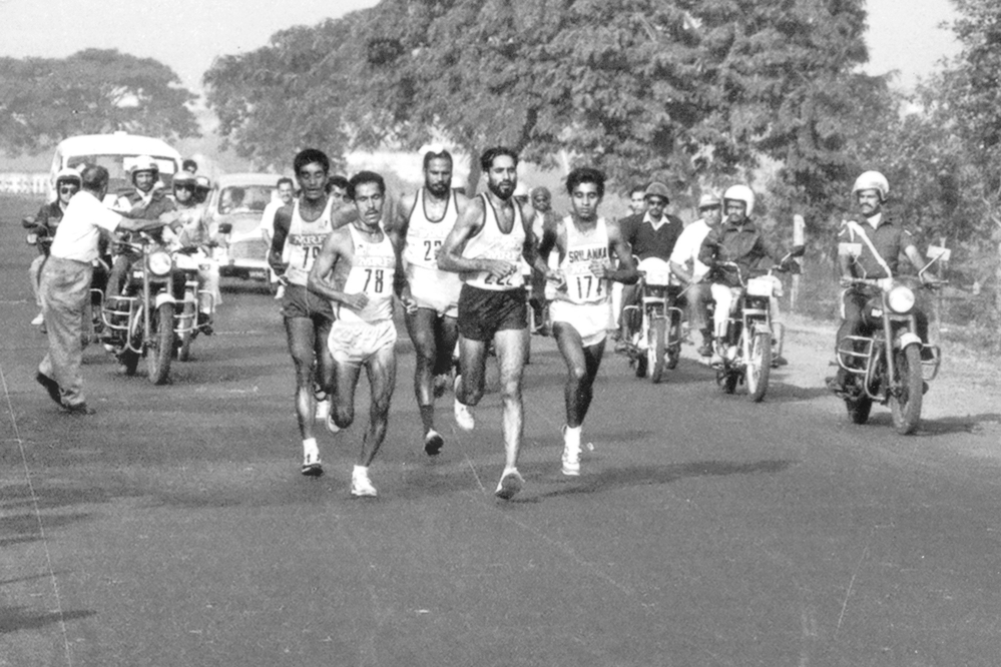
Vaikuntha Manandhar's performance is an all-time high in Nepali sports overall, he has also scored a hat-trick of gold medals.
We use Google Cloud Translation Services. Google requires we provide the following disclaimer relating to use of this service:
This service may contain translations powered by Google. Google disclaims all warranties related to the translations, expressed or implied, including any warranties of accuracy, reliability, and any implied warranties of merchantability, fitness for a particular purpose, and noninfringement.
First of all, a question. Who is the first international gold medalist for Nepal? There is very little written history about Nepali sports. So, until recently, there was no definite answer to this question, it was just speculation.
When the 13th South Asian Games (SAG) were organized in Nepal in 2019, that question got a definite answer. What happened was that while the competition was going on, everyone was curious about who would win the first gold medal for Nepal in the biggest competition of the South Asian Games? Coincidentally, the answer to this question would also determine the first international gold medalist for Nepal.
After long discussions and debates, the answer was found and he was Baikuntha Manandhar. The first South Asian Games were held in Nepal in 1984. At that time, Nepal had won four gold medals. One was the gold won by Manandhar in the marathon, the other two were in boxing and one in men's football. When asked by the Nepali media, Manandhar himself said, ‘I won the first gold.’ Usually, the marathon competition is held towards the end of any major competition. But the marathon was the first event to be decided in the first edition of the SAG. Therefore, the good fortune of winning the first gold medal for Nepal went to Manandhar.
One event that Nepal was certain to win gold at that time was also in this marathon, and Manandhar performed as expected. ‘At that time, the whole of Nepal was in sports, I was naturally happy to win that historic gold medal.’ At that time, Manandhar had completed the 42.195-kilometer distance in 2 hours 27 minutes and 11 seconds. At that time, the silver medal also went to Nepal, Arjun Pandit came in second place. He had completed the same race in 2 hours 41 minutes and 43 seconds. By the time Pandit finished the race, Manandhar had already had time to rest. The time of Indian runner Joginder Singh to come in third place was 2 hours 50 minutes and 51 seconds.
The credit for organizing the South Asian Games is given to Nepal, because it is hard to imagine what would have happened if Nepal had not stepped forward to organize this competition. But the second edition of the SAG was not long in coming, this competition was held in Dhaka, Bangladesh in 1985. In that too, Manandhar won the gold medal as expected. At that time, the time he completed the race was 2 hours 22 minutes 7 seconds. His performance had improved further compared to the first edition. In Dhaka, India's Prem Singh came in second place and his time was 2 hours 29 minutes 12 seconds. In this too, the time difference that Manandhar made while coming first was amazing.
Nepal's Krishna Bahadur Basnet came third, in 2 hours 30 minutes 20 seconds. In 1987, Kolkata, India hosted the third edition of the SAG, and Manandhar's performance in it was historic. At that time, in Calcutta, he came first with a time of 2 hours 15 minutes 3 seconds. This was not only a national record for Nepal, but also a South Asian record. This is a record that has not been broken yet. Manandhar himself has repeatedly said, ‘I would be happy if someone broke this record. My only wish is that a Nepali runner surpasses this record. I am especially waiting for this time.’
This performance by Manandhar is an all-time high in Nepali sports as a whole. In the process, he also achieved a hat-trick of gold medals. At that time, Sri Lanka’s VKL Samar Singh came second, and his performance was also excellent in itself. He completed the race in 2 hours and 16 minutes. Perhaps it was because of the challenge presented by Samar Singh that Manandhar achieved this record, and some credit for this should be given to the Sri Lankan runner. The time difference between the two was not very large. India’s Swaroop Singh came third, and his performance was also not inferior. He completed the race in 2 hours, 20 minutes and 13 seconds. In fact, the race itself was full of intense competition.
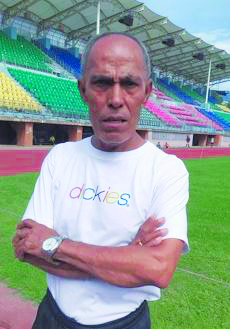 Recalling those days, Manandhar says, ‘At that time, I did not know that a new record had been set. Later, I was told about it and I was happy. But I didn't know that it would take time to break this record.' Although it has been 39 years since this record was set, let's say it is almost four decades old, but no one has been able to come close to it yet. The then coach Khadga Ranabhat, who witnessed that performance in Kolkata with his own eyes, says that he will never forget that occasion. He said, 'Manandhar ran very well that day, that is why the record was possible. I think Nepali sports will never get a player like him. If he gets one, it would be good.'
According to him, if Manandhar had the facilities he has now, along with good foreign coaches and opportunities, he would probably have been a player with the potential to win medals in the Olympics and Asian Games. Ranabhat further believes that Manandhar was born to run, the naturalness and rhythm that can be seen in his running is still not found in others. After that performance in Kolkata, Manandhar had already decided to retire from running, and he probably should have made the same decision. But not everything in every athlete's life goes as he says. Under some pressure, Manandhar also had to participate in the 1989 SAG, without much preparation.
This SAG was held in Islamabad, Pakistan, and he came in third place. Moreover, he was limited to a bronze medal. At that time, the first place was the same Sri Lankan athlete Samarsinghe. He completed the race in 2 hours, 19 minutes, 42 seconds. The second place was also occupied by the Sri Lankan runner, G. Bandula Samarsinghe. The time was 2 hours, 20 minutes, 15 seconds. While settling for the bronze medal, Manandhar completed the race in 2 hours, 21 minutes, 35 seconds. His time itself was not bad, but the performance of both Sri Lankan runners was good. In that sense, credit must also be given to those runners for the gold and silver medals in this race.
Recalling those days, Manandhar said, ‘When the race reached the decisive stage, both the Sri Lankan runners had already taken a good lead. I had no chance to overtake them.’ Having said that, how can this performance eclipse the achievements of the previous three gold medals? Those three gold medals and the record time are still unsurpassed in the history of Nepali sports. Not only that, he is also the first big star athlete of Nepali sports, whose name there will be few Nepalis who do not remember. In a situation where no one in South Asia has been able to touch his performance in Kolkata, it must be said that that performance in itself is the all-time great of Nepali sports.