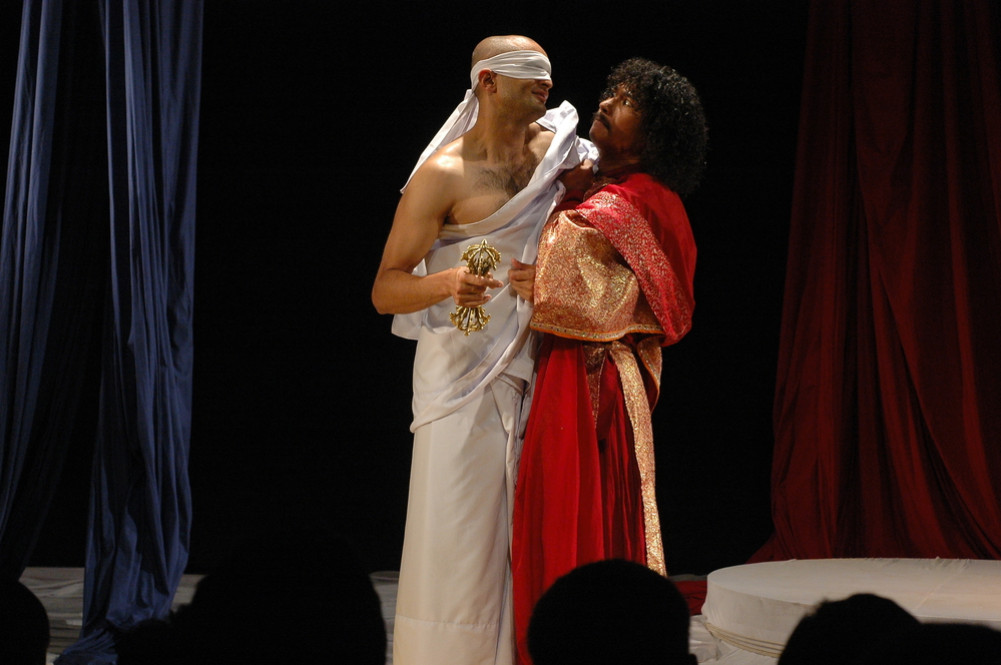
There was a huge theater in Singha Durbar, where the Rana Prime Minister and the nobles would watch Parsi plays. Balkrishna Sama broke down the walls of the court environment and brought the plays outside.
We use Google Cloud Translation Services. Google requires we provide the following disclaimer relating to use of this service:
This service may contain translations powered by Google. Google disclaims all warranties related to the translations, expressed or implied, including any warranties of accuracy, reliability, and any implied warranties of merchantability, fitness for a particular purpose, and noninfringement.
There are two reasons why I believe that Nepali drama and stage should be viewed together. First, my opinion on the subject. Second, my experience and practice. There is another aspect of Nepali drama as well. That is the method encompassed by academic studies, which takes drama as a literary genre, not the stage, and analyzes and criticizes it, and teaches it in the literature curriculum like poetry or other prose genres.
This subject of teaching drama has a long tradition and it is a respected practice. Playwrights like Balkrishna Sam, Bhimanidhi Tiwari, Gopal Prasad Rimal gave strength to this aspect through playwriting. But the stage aspect of drama has a strong history. Without understanding that aspect, Nepali theatre cannot be understood. In fact, I have already written on this subject in my book ‘Nepali Theatre as I See It (2007)’ and in many articles. I would like to raise this article from an important topic that has not been discussed much here.
Nepali theatre is linked to Parsi theatre or stage. The use of Parsi theatre in Nepal is a matter of historical interest. Anuradha Kapoor, a scholar and Emeritus Professor of the ‘National School of Drama’ and a mentor of our theatre artists Sunil Pokharel, Anup Baral and Bimal Subedi, and a good acquaintance of mine, has written about the Parsi stage.
In an article, she said, ‘Parsi theatre originated in India and remained a strong stage influence from 1850 to 1930. Parsi theatre created a secular magical effect and it created new experiences and new desires and new consumers.’
This Parsi theatre had an impact on the Nepali Rana court. This stage of entertainment remained a great tool. There was a huge theater in Singha Durbar, where the Rana Prime Minister and the Bhardar used to watch Parsi plays. There was a crane to fly the characters. There was Dambar Shamsher Rana who studied drama in Calcutta.
A little later, another one was Manikman Tuladhar of Asan who studied drama in Calcutta in 1900. Other seekers and showmen of drama were, including Manikman’s sons Kesharman, Dambarman and Karkatman and Bekhanarayan Maharjan, Hari Prasad Rimal. Some of them performed plays inside and outside the palace.
Parsi-style plays are also found in the history and memoirs of other places in Nepal. Stories of such plays and stages are especially found in Dhankuta, Tehrathum, Palpa and Pokhara. Dambar Shamsher also had a Parsi theater in his home, Durbar Dnyaneshwor. This theater used to run in his house. On the night when one such play was performed on the palace stage, a baby was born there. That baby was Balkrishna Sam (1902-1981).
Sam broke down the walls of the court environment and brought drama outside. There was no established theater stage outside. He performed plays in the Durbar School and similar places. It was a simple but independent and free theater stage. It was a historical beginning and revolution. I had the opportunity to talk and listen to Sam very intimately. It was his inspiration that later I started writing plays.
Nepali theatre did not have a structured tradition. There was determination and awareness. The strength of Nepali theatre to date lies in that. Thus, there was no place to sustain the institutional tradition of free theatre. At that time, the context of Gopinath Aryal's work should be added. Hari Prasad Rimal, who came from the Parsi style of theatre, was active. People like Prachanda Malla were among Sama's other collaborators during this period.
Nepal Pragya Pratishthan aka Nepal Academy performed many plays under the leadership of Vijay Malla and the direction of Prachanda Malla. Nana Tiwari, sister of playwright Bhimanidhi Tiwari (she is perhaps the first strong female theatre artist), Shakuntala Gurung, Harihar Sharma, Hari Bahadur Thapa, Madan Shrestha, Narayandevi Pradhan and other artists have a history of originally performing plays on the stage of the Academy. Shanti Maske's name also comes up among the characters who played female plays in the past. Nepal ITI honored Subhadra Adhikari, Shakuntala Gurung, Narayandevi Pradhan, Nisha Sharma (now the Chancellor of the Natya Academy) and Laxmi Shrestha on the occasion of International Theatre Day in 2005. In recent times, many strong women theatre artists have come forward.
Arohan Gurukul is important in the history of Nepali theatre. The main creator of this theatre is Sunil Pokharel. Gurukul worked from 23 Magh 2059 to 30 Poush 2068. During this period, Gurukul became a medium for spreading the message of Nepali times and society that was undergoing changes. Poetic texts, symbolic acting, familiar dialogues, all were staged by Gurukul.
During that period and still maintaining continuity, Pushkar Gurung created the Double Theater. He operated it in his own way. This organization, which promotes Buddhist drama tradition, staging and discussion, has been working in the theatre industry. The Sarnaam Theatre, conceived by Ashesh Malla and built by his own organization in Kalikasthan, is an important venue for modern Nepali drama theatre. Anup Baral created many stages and groups. Now he has created a theatre in Pokhara. These seekers are contemporaries of Sunil, Ashesh and Pushkar.
Yubaraj Ghimire, an active artist of the previous Gurukul, ran the Shilpi Theatre. Active young theatre artists have run the Mandala Theatre since 2008. In addition, the activism of Sirjana Subba, Dayahang Rai and other young people should be appreciated. Theatres in Kathmandu and outside have also been working in various ways. I have visited Kausi Theatre, Theatre Village Nepal, One World Theatre (English medium), Theatre Mall, Shaili Theatre, Studio Theatre, Purano Ghar Theatre, Kunch Theatres and watched plays. Satyamohan Joshi Dai and I jointly inaugurated the ‘Purano Ghar Theater’, which was opened by a couple of artists in their own home. Gurukul staged five of my plays. Dubli and Shilpi staged one each. My play directors are Sunil Pokharel, Pushkar Gurung, Nisha Sharma, Shiva Rijal, Bimal Subedi and Yubaraj Ghimire.
Finally, the beginning of Nepali drama has been accompanied by stage and text. All those who teach drama should highlight this. Another thing is that the drama genre also has importance in the teaching of text. Many things can be seen through it. The history and activities of Nepali theatre, from Parsi to Sama to the recent past and the present, show this. Nepali The Nepali tradition of the Nepali theatre stage is also an important and controversial topic