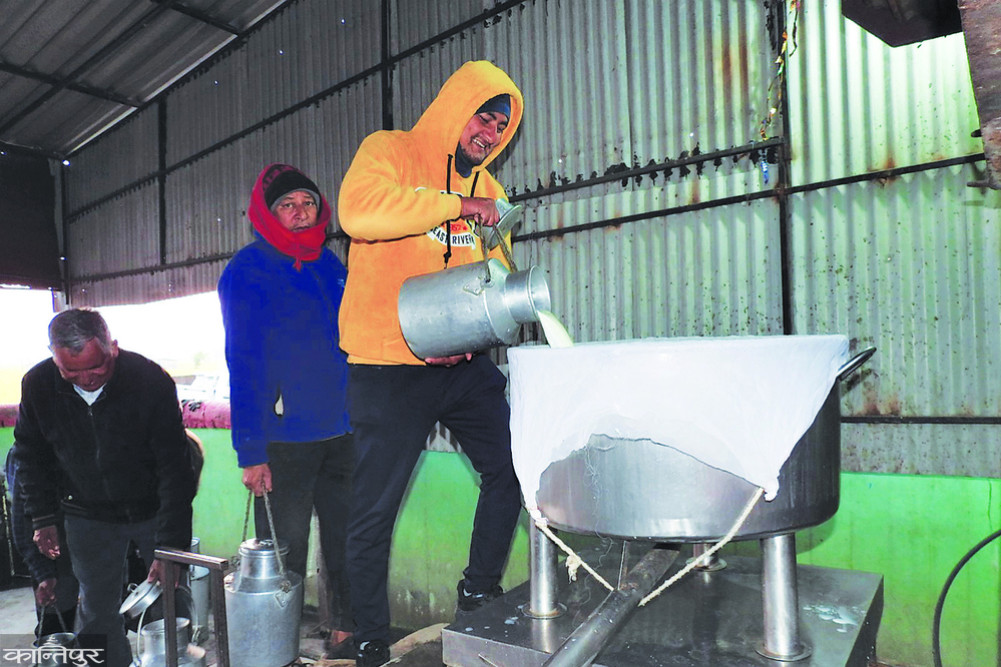
The metropolis provides subsidies of around 90 million rupees per year to milk farmers based on production.
We use Google Cloud Translation Services. Google requires we provide the following disclaimer relating to use of this service:
This service may contain translations powered by Google. Google disclaims all warranties related to the translations, expressed or implied, including any warranties of accuracy, reliability, and any implied warranties of merchantability, fitness for a particular purpose, and noninfringement.
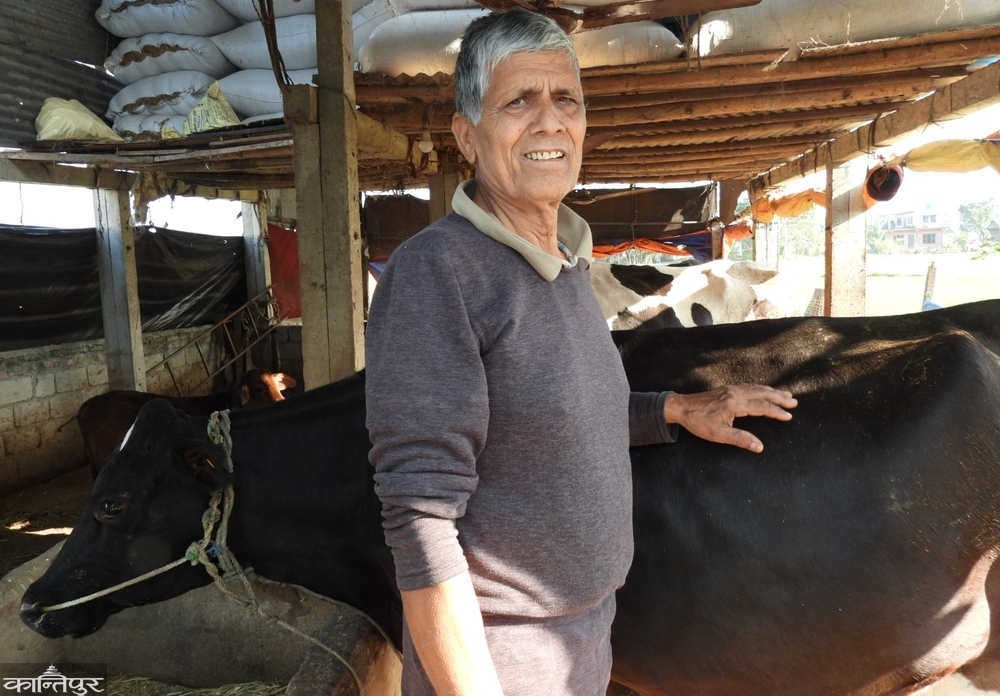
Homanath Pokharel, who is in his 80s, and his wife Meena are often seen busy in the cowshed. The Pokharel couple, who once sold up to 100 liters of milk a day, have now reduced the number of cows, saying they are not enough.
He started raising cows and selling milk in 2041. Pokharel, who migrated from Gorkha to Chitwan Parsa, moved to two places in Bharatpur after Parsa.
Currently living in Kesharbagh, Bharatpur Metropolitan City-6, he says he will not change his mind about raising cows and buffaloes. ‘I sold some cows because I thought it would be a bit inconvenient. If my health improves, I will fill the cowshed by bringing 100 liters,’ he said. Despite being involved in animal husbandry for so long, he has neither taken a loan from the bank nor submitted any documents hoping for any government grant.
Money has been accumulating in his account for the past few years based on selling milk. ‘Last year, I received around 70,000 rupees. I added 20,000 rupees to that and bought a cow. I also buy cows with the bonus money I received. That is why the cows in the cowshed are increasing,’ said Pokharel. The 70,000 rupees that went into his bank account is a local level grant amount to help add cows to the cowshed.
Bharatpur Metropolitan City has been providing a subsidy of four rupees per liter to farmers who sell milk to cooperatives within the metropolis. Pokharel has taken advantage of this. Otherwise, he has not received any subsidy before and has been raising cows based on his own hard work and dedication. The metropolitan city started providing subsidy on milk from the fiscal year 074/75.
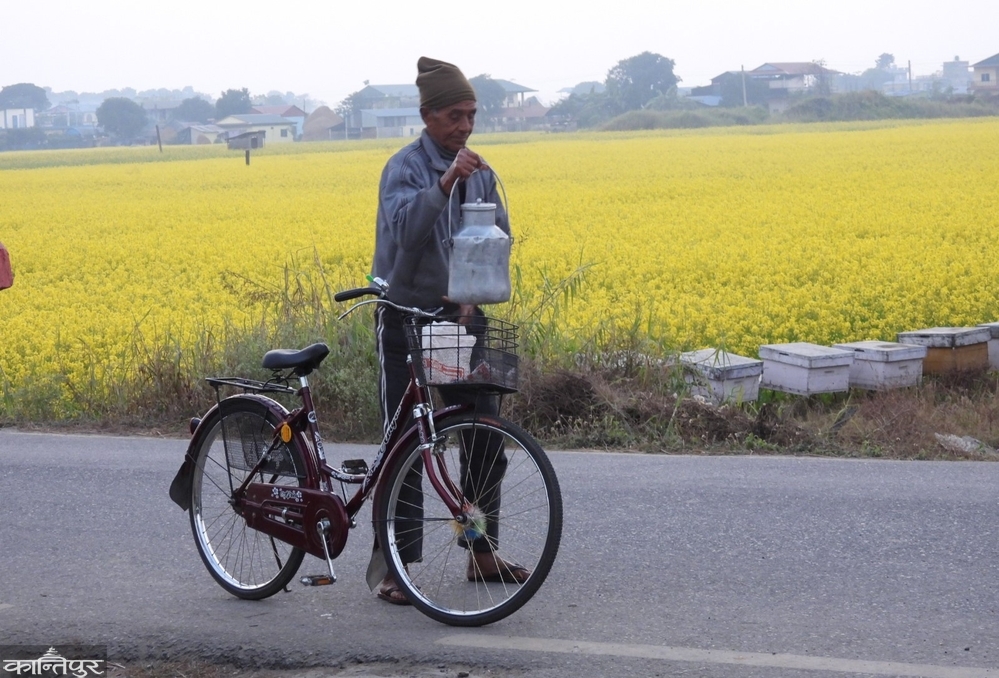
Initially, the subsidy given by the metropolis was 25 paisa per liter of milk. Two years later, it increased to one rupee. From the fiscal year 078/79, the subsidy amount was fixed at three rupees per liter. It reached four rupees in the fiscal year 081/82. Tejendra Prasad Poudel, head of the metropolis's economic development division, said that 78 dairy cooperatives in the metropolis have distributed subsidies to 10,560 farmers. Telling the story of how the subsidy started, dairy farmer Bhagirath Timilsina says, "We went to the mayor of the metropolis to talk about the subsidy around Poush-Magh 2074 BS. There is an annual budget of 1.6 million rupees for animal husbandry there. Discussions have begun on what to do with this budget.' Timilsina of Kesharbagh, Bharatpur Metropolitan City-6, has been rearing cows since 2043 BS.
Timilsina, who reached the central committee of the dairy cooperative, repeatedly asked the Ministry of Agriculture and the Animal Services Department to provide subsidies for milk production. But everyone who listened to his proposal dismissed it as impossible. With the intention of starting this seemingly impossible thing in the metropolis, he proposed to Mayor Renu Dahal, 'Let's not do anything else with this money. I will provide subsidies based on milk production as much as possible.'
In the meeting, which included representatives of the Bharatpur Metropolitan City-level dairy cooperatives, everyone agreed to spend the budget on production-based subsidies. That year, 6.7 million liters of milk were collected in the metropolitan-level cooperatives. 1.675 million rupees were spent on providing subsidies based on that. 'This program was started after the proposal was made that farmers involved in the livestock sector should not have to pay anything else, but should provide subsidies to milk farmers based on production,' said Bharatpur Metropolitan City Mayor Renu Dahal. She said that even though they started with the budget they had, it had a good impact. According to the details received from the Economic Development Division of the metropolis, in the first year, 6.7 million liters of milk were collected in the fiscal year 2074/75, and in 2081/82, 23.8 million 88 thousand 484 liters of milk were sold through the cooperative and received subsidy money. The number of farmers involved in milk production increased with the subsidy.
‘The farmers seemed very happy. The cooperative was encouraged. This scheme was very result-oriented. Its impact was good on milk production,’ said Mayor Dahal. The metropolis has been providing subsidies to farmers who sell milk to the cooperative. Private farms also sell milk to the Dairy Development Corporation (DDC), and Poudel, head of the Economic Development Division, said that subsidies will also be provided to them. ‘The cooperatives request money from the metropolis based on the details of milk collection. We verify the details and send the money to the cooperative. The cooperative should provide us with the details of each farmer who has sent money to their bank account,’ said Poudel. There is a rule not to give money to milk farmers who do not have bank accounts, such farmers are not often found.
Among the cooperatives, the Annapurna Milk Producers Cooperative Society of Bharatpur-6 is the one that receives the most subsidy from the metropolis. Pradeep Timilsina, the chairman of the cooperative, said that the organization received Rs 8.8 million as subsidy from the metropolis last year. ‘We have about 650 farmers who bring from one or two liters of milk a day to five hundred liters of milk,’ said Chairman Timilsina. Timilsina says that all farmers are entitled to the subsidy. ‘What made it easier with the metropolis’ subsidy was that the money came after production. There was no need to write a proposal anywhere, nor did anyone have to access it. The farmers directly received the amount they produced,’ he said. Those who were raising a few cows and buffaloes and selling a little milk or who did not have access even though they produced a lot had not experienced the subsidy.
But Bhagirath Timilsina said that the metropolis’ subsidy policy has created an environment where everyone can get money. ‘I have been talking to the ministry and department for such farmer-oriented subsidies since 2067/068. But the local government listened to me,’ he said. Homanath Pokharel, who has been involved in milk production for a long time and has not given up this profession even in his old age, still needs encouragement. Dilli Prasad Gautam, who came from Ratnanagar Pithuwa to purchase cows at Pokharel’s barn, saw this need. ‘The local level has provided subsidies, it is a good thing for such hardworking farmers. But I have seen that if the municipality put the subsidy money in the hands of such hardworking farmers, it would have been even more motivating. Because Pokharel’s passion is amazing,’ Gautam said.
Bharatpur Metropolitan City’s annual budget is 5.19 billion 7.166 billion rupees. The metropolis provides subsidies of around 90 million rupees per year to milk farmers based on production. ‘There are good subsidies in the agricultural sector abroad. "Even if we cannot provide a large grant, we are trying to provide some support," said Poudel, head of the Economic Development Division.