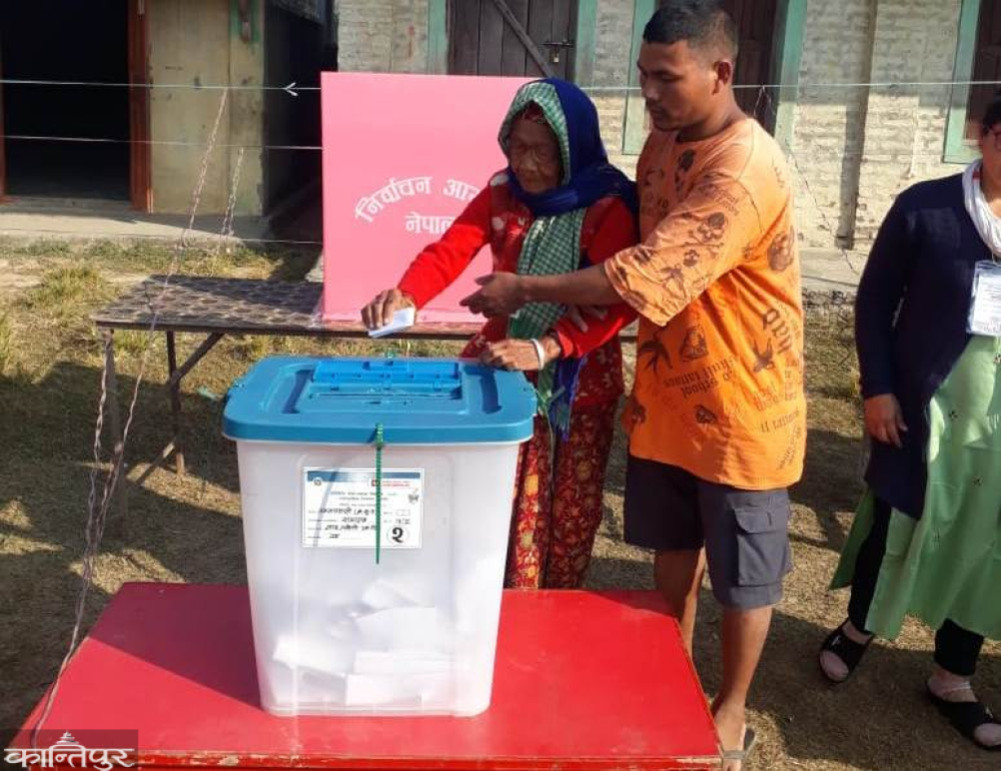
After the restoration of democracy, five elections to the House of Representatives were held in 2048, 2051, 2056, 2074, and 2079. During this period, the Congress, UML, and the Maoist Center have alternately become the main forces.
We use Google Cloud Translation Services. Google requires we provide the following disclaimer relating to use of this service:
This service may contain translations powered by Google. Google disclaims all warranties related to the translations, expressed or implied, including any warranties of accuracy, reliability, and any implied warranties of merchantability, fitness for a particular purpose, and noninfringement.
The party-less Panchayat system implemented by King Mahendra in a coup on 1 Poush 2017 lasted for almost three decades. After the success of the 2046 People's Movement, an interim government was formed under the leadership of Krishna Prasad Bhattarai. During the same government, elections to the House of Representatives were held in 2048. At that time, 205 constituencies were established in 75 districts. One MP was elected from each constituency through the first-past-the-post system.
048- Election to the House of Representatives
As announced on 28 Magh 2047, the election was held on 29 Baisakh 2048. The Congress won 110 seats in the election and became the first party. The UML came second with 69 seats and the United Janamorcha came third with 9 seats. After the election, Congress General Secretary Girija Prasad Koirala became the Prime Minister.
By-elections to the House of Representatives were held twice during this period - on 26 Magh 2048 in Sunsari-3 and Kathmandu-5 and on 25 Magh 2050 in Jhapa-1 and Kathmandu-1.
2051- Election to the House of Representatives
After the proposal to thank the King for presenting the government's policies and programs failed, the then Prime Minister Girija Prasad Koirala dissolved the House of Representatives in Asad 2051 and announced mid-term elections for 27 Kartik. However, since that day fell on a big Ekadashi, the election was later postponed to 29 Kartik. On that date, general elections were held across the country.
In the election, UML came first with 88 seats, Congress came second with 83 seats, and RPP came third with 40 seats. After the election, a minority government was formed under the leadership of UML Chairman Manmohan Adhikari.
During the same term of the House of Representatives, by-elections were held on 11 Magh 2053 in Sunsari-1, Kathmandu-1, Rautahat-2, Rupandehi-2, and Baitadi-1.
2056 – House of Representatives Election
After the 2051 election, there was extreme instability in the country. Girija Prasad Koirala became the Prime Minister again through Manmohan Adhikari, Lokendra Bahadur Chand, and Surya Bahadur Thapa. After the power sharing between Congress and ML broke down in 2055, a power sharing between Congress and UML began. The seven-point agreement made by the two parties mentioned that new elections would be held within Chaitra 2055. Accordingly, the House of Representatives was dissolved on 1 Magh and elections were announced for 20 Baisakh 2056. Elections were held in 36 districts on 20 Baisakh and 3 Jestha in 39 districts. The elections for Kathmandu-1 and Kathmandu-3, which were postponed due to the death of the candidate, the then UML President and former Prime Minister Manmohan Adhikari, before the elections, were held on 26 Jestha.
In this election, the Congress again emerged as the largest party. It won 111 seats. The UML, which came second, had 71 seats and the RPP, which came third, had shrunk to 11 seats. Even before the election, the Congress had said that Krishna Prasad Bhattarai would be made the Prime Minister. Bhattarai became the Prime Minister after the party got a single majority in the election.
During this term of the House of Representatives, by-elections were held in Jhapa-6, Morang-1 and Rautahat-4 on 23 Mangsir 2056.
The then Prime Minister Sher Bahadur Deuba dissolved the House of Representatives on 8 Jestha 2059 and set the election date for 27 Kartik. Later, although preparations were made to hold elections in 6 phases (15 districts on 27 Kartik, 14 districts on 9 Mangsir, 13 districts on 21 Mangsir, 10 districts on 3 Poush, 12 districts on 14 Poush and 11 districts on 26 Poush), they were postponed. Amidst the preparations to postpone the elections, on 18 Asoj, the then King Gyanendra dismissed Prime Minister Sher Bahadur Deuba.
2074 – House of Representatives/Provincial Assembly Elections
3 Asoj 2072 After the new constitution was proclaimed, the then Constituent Assembly played the role of the legislature for two more years. Elections were held in Mangsir 2074 to replace that legislature.
5 Bhadra 2074, the government decided to hold elections to the House of Representatives and Provincial Assemblies nationwide on 10 Mangsir 2074. However, on 14 Bhadra, the government decided to hold the first phase on 10 Mangsir and the second phase on 21 Mangsir. As per the responsibility given by the government, the Election Commission decided to hold elections in 32 districts of the Himalayan and hilly regions on 10 Mangsir and the remaining 45 districts on 21 Mangsir. Accordingly, the elections were held in two phases. Elections were held for 165 MPs in the direct elections. The remaining 110 MPs were elected through the proportional system.
In the House of Representatives elections held in November 2074, the then two major communist parties, UML and Maoist Center, entered the election in an alliance. They won 80 and 36 seats in the direct elections, respectively. They won 41 and 17 seats in the proportional elections, respectively. Thus, these two parties had 174 seats in the House of Representatives. These two parties also dominated in 6 out of 7 provinces (except Madhesh Province).
UML became the first party in the then Province 1 (Koshi) with 51 seats. Similarly, UML became the first party in Province 3 (Bagmati) with 58, Province 4 (Gandaki) with 27, Province 5 (Lumbini) with 41, Province 6 (Karnali) with 20 and Province 7 (Sudurpaschim) with 25 seats. In Province 2 (Madhesh), the then Federal Socialist Forum became the first party with 29 seats.
UML Chairman KP Sharma Oli became the Prime Minister after the election. By-elections were held in Kaski-2 on 14 Mangsir 2076.
2079 – House of Representatives/Provincial Assembly Elections
The Oli government, formed after the 2074 elections, dissolved the House of Representatives on 5 Poush 2077 and decided to hold elections in two phases on 17 and 27 Baisakh 2078. However, the Supreme Court ruled the dissolution of the House of Representatives unconstitutional, making the election unnecessary. The House of Representatives was dissolved again on 7 Jestha 2078. At that time, it was decided to hold elections on 26 Kartik and 3 Mangsir 2078. The Supreme Court also ruled the dissolution of the House of Representatives for the second time unconstitutional.
The House of Representatives, which was spared from dissolution twice, completed its five-year term. Finally, as per the decision of the Council of Ministers on 19 Shrawan 2079, the elections to the House of Representatives and the Provincial Assembly were held in a single phase on 4 Mangsir of the same year.
The Congress, Maoists, Unified Socialists and other parties had formed a nationwide alliance for the elections to the House of Representatives and the Provincial Assembly. After the election, the Congress emerged as the largest party. It won a total of 89 seats, including 57 directly and 32 proportionally. Similarly, the UML, which came in second, won 78 and the Maoists, which came in third, won 32 seats. Through this election, the new party, the Rashtriya Swayamsevak Sangh (RSS), came in fourth with 20 seats.
There were mixed results in the provinces as well. The UML emerged as the first party in Koshi Province with 40 seats, Madhesh Province with 23 and Lumbini Province with 29 seats. Similarly, the Congress emerged as the first party in Bagmati Province with 37, Gandaki Province with 27, Karnali Province with 14 and Sudurpaschim Province with 19 seats. After the election, the chairman of the third largest party, the Maoists, Pushpa Kamal Dahal, became the Prime Minister.
Two by-elections have been held since the Mangsir 2079 elections. By-elections were held on 10 Baisakh 2080 in Tanahun-1 and Bara-2, which fell vacant after Ram Chandra Poudel became President and Ram Sahay Prasad Yadav became Vice President, and Chitwan-2, which fell vacant after Rabi Lamichhane was removed from office. Similarly, by-elections were held on 15 Baisakh 2081 in Ilam-2, which fell vacant after the death of Subash Nembang.
(This material has been prepared with the help of ‘History of Nepal’, reports, gazettes, various books and newspapers published by the Election Commission.)