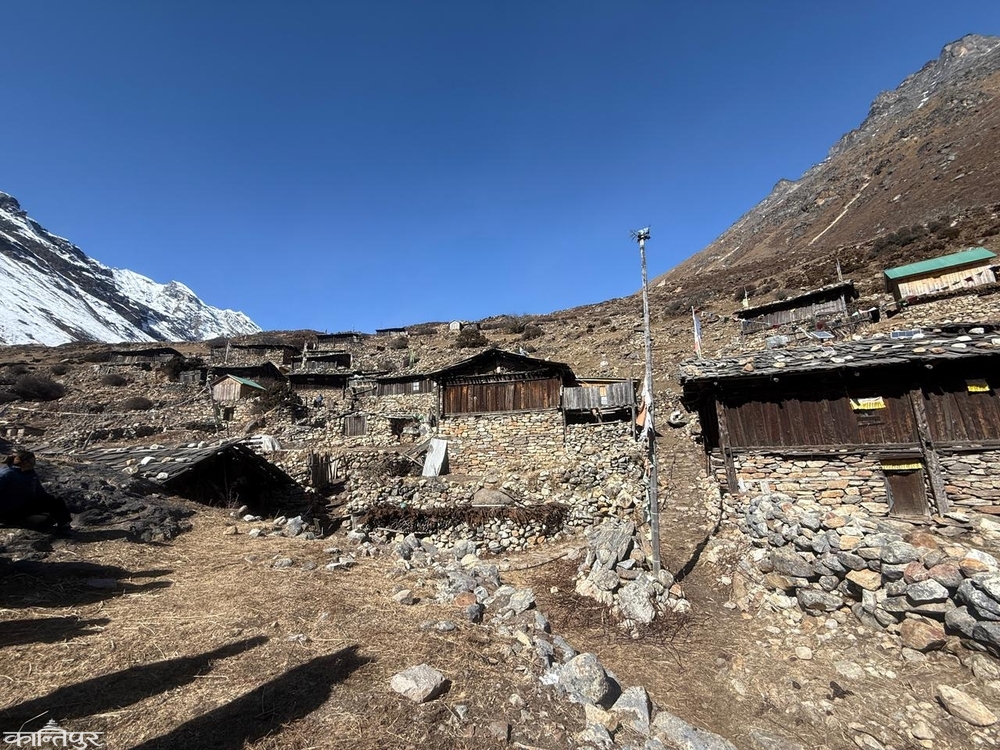
Everyone in the village would descend to Chene at once and return to Yangma, during which time the village would be in a state of mourning – the Bhote Talcha of Tibet. However, since last year, the residents of Yangma have started a different practice. In an attempt to bring about a change in the traditional way, they left the settlement for only 20 days, and stayed in the village for the rest of the days, enduring the cold.
We use Google Cloud Translation Services. Google requires we provide the following disclaimer relating to use of this service:
This service may contain translations powered by Google. Google disclaims all warranties related to the translations, expressed or implied, including any warranties of accuracy, reliability, and any implied warranties of merchantability, fitness for a particular purpose, and noninfringement.
Dorje Sherpa Bhotia of Yangma, Phaktanglung Rural Municipality-7, at an altitude of 4200 meters, is busy transporting potatoes to a chenna near Dobato near Olangchunggola. Packing the potatoes dug from the field and piled at home in sacks and placing them on a wooden pallet and moving the chenna has now become his daily routine.
He is preparing to sell 50 muri potatoes this year to feed himself, feed his livestock and friends, and to sell 50 muri potatoes. Here, where there is a tradition of selling potatoes, one muri costs 8 mana, and one muri costs 20 muri. One muri contains 60 kg, while 50 muri contains at least three quintals. He has kept more potatoes than he sells for household purposes.
It takes him two whole days to reach Chene with the potatoes from Yangma. On the first day, he stays in Mayathok. The ward has built a building for him to live there. On the second day, he reaches Chene. He carries potatoes on both sides of his 72 yaks. An adult yak can carry up to one muri (a sack of 10/10 muri on both sides of his back) at a time.
This daily life is not unique to him. This is the lifestyle of 10 families in Yangma, the most remote and highest place in Taplejung. After two snowfalls last October, the weather in this area has now cleared. Taking advantage of the cleared weather, they are transporting potatoes and firewood.
The residents of Yangma have been transporting potatoes in this way for decades. They would bring household items like clothes, cooking utensils, rice, salt, oil and other things with the potatoes. Each family would carry a tent and plastic. Everyone in Chene has their own huts, which they would maintain.
Chene was 1,400 meters lower than Yangma, or 2,800 meters above sea level, so they felt warmer. When would they move? The exact date was not certain. When the cold made it difficult to live in Yangma, the descent began. After descending, they would spend at least three months there. The descent and return to Yangma would be done by all the families in the settlement at the same time. The entire people of the settlement would get up and leave the village together. During this period, all the houses here were locked with locks bought from Tibet, China, which did not fit together. If they were lost, they had to be broken.
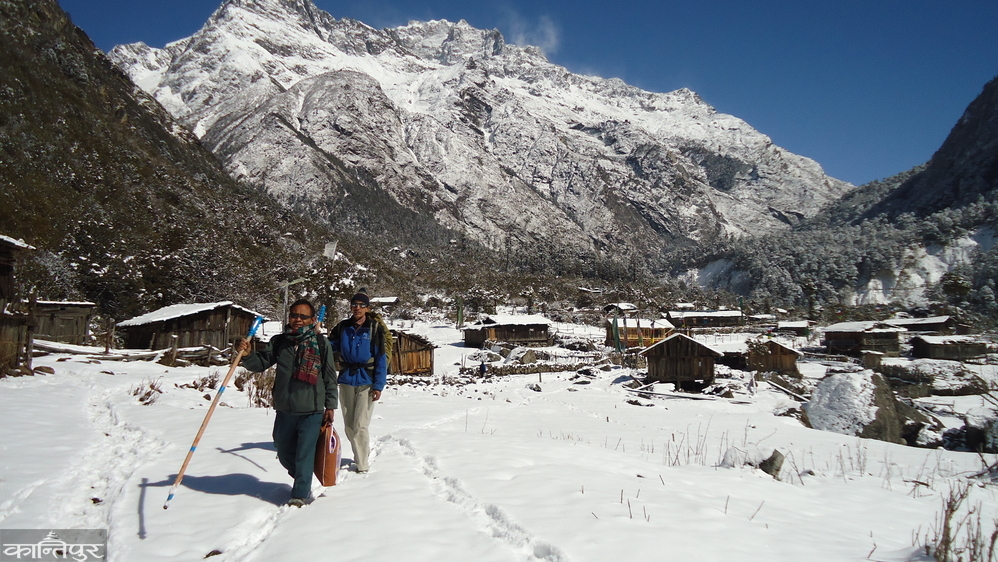
However, the residents of Yangma have started a different practice since last year. In an effort to bring about a change in the traditional style, they left the settlement for only 20 days. The rest of the time, they stayed in the village, enduring the cold. This year, they have shortened it too and decided to stay in the village throughout the winter. They have received support from the residents of Olangchungola, who are at an altitude of 3,100 meters.
The ward office has built a warehouse in Chene to store their potatoes, where more than five hundred murs (30 quintals) of potatoes can be stored. Their potatoes are bought in full by traders from Olangchungola. That is, those who come from the village and stay in Chene do not have to sell or exchange them. Until last year, two potatoes were exchanged for one potato. Now, a millet potato costs up to Rs. 150. At this rate, their potatoes cost Rs. 75 per potato.
They sell them to traders from Olangchungola with some concessions. Since most of the buyers and sellers are relatives and most of them are from the same household, there is no big problem, says Cheten Sherpa Bhote, the outgoing chairman of Faktanglung Rural Municipality-7. Now, he has left the potatoes at the warehouse after writing the name of the buyer on the sack.
Last year, the Gola traders carried the purchased potatoes from the market to the North-South Highway on mules. From there, they took them to Lelep and Tapethok on a tractor and sold them. Tenzing Walung of Olangchungola says that the trader is preparing to do the same this year too.
According to Walung, there has been a mutual agreement between the farmers of Yangma and the traders of Olangchungola about who will keep their potatoes. On average, at a rate of 50 potatoes per family, potatoes from 10 families are sold for around 500 potatoes. Farmers from Lelep, Tapethok, Ikhabu, Sawadin, and Khezenim prefer to buy potatoes here for seed. Tenzing says that there will be no problem in selling as the seeds are considered good.
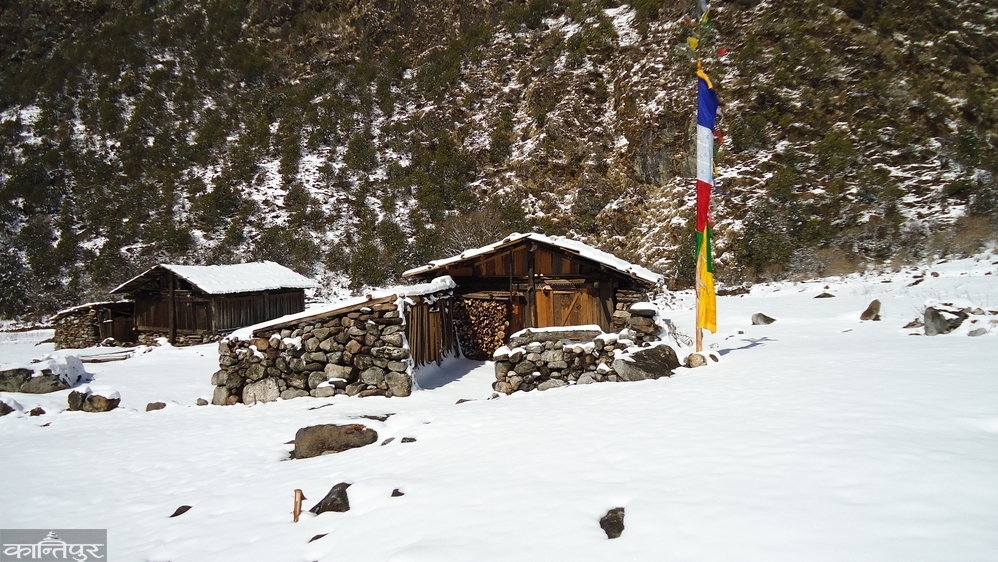
Even though all the potatoes produced are sold in one go, it is easier for them to face the cold of Yangma, Tenzing said. The residents of Ghunsa have been doing this practice for a decade. However, in Ghunsa, there is no complete agreement like in Yangma. It is half/half, sometimes 70/30, 60/40. More than half of the families leave the settlement to escape the cold. Some stay there. According to Dandu Sherpa of Ghunsa, until a decade ago, the entire settlement used to leave Ghunsa.
They would go to the district headquarters Phungling, Kathmandu, Darjeeling, Sikkim and other places in India. Some would move to Phale, which is an hour and a half away. Despite the short distance, Phale became a settlement for Ghunsa to escape the cold. In recent years, even when many people have left the village, some people stay in the village. The police station here supports those who are in the village.
The police at the station do not leave. The police live with the villagers and the villagers live with the police. After the police headquarters of the Border Police Station, which was reestablished after the armed conflict, did not give permission to move, and after spending two years in the village, the locals also started living there, says Tashi Sherpa, tourism assistant at the Kanchenjunga Conservation Area Management Council.
Practice of livestock
Along with the people, the residents of Yangma also practiced another practice last year. Since they did not live in the village, i.e., the village, they did not bring the livestock they raised to the village. On the contrary, they chased them to the pastures towards the lake (Himachal Pradesh). Even in the cold of Poush and Magh, they reached the vicinity of the 5,000-meter-high Cherchhen Lake, which is up to 800 meters above the settlement. To take care of them, three or four families would go together to look after them and sometimes stay in the barn.
Dorje has experienced and understood that from last year's experience, there was no problem with the cold in the livestock and that they too were not in a difficult situation. After staying in Yangma the entire year this year, Cheten Sherpa Lama, ward chairman of Olangchunggola, Faktanglung Rural Municipality-7, returned to Yangma in the first week of November.
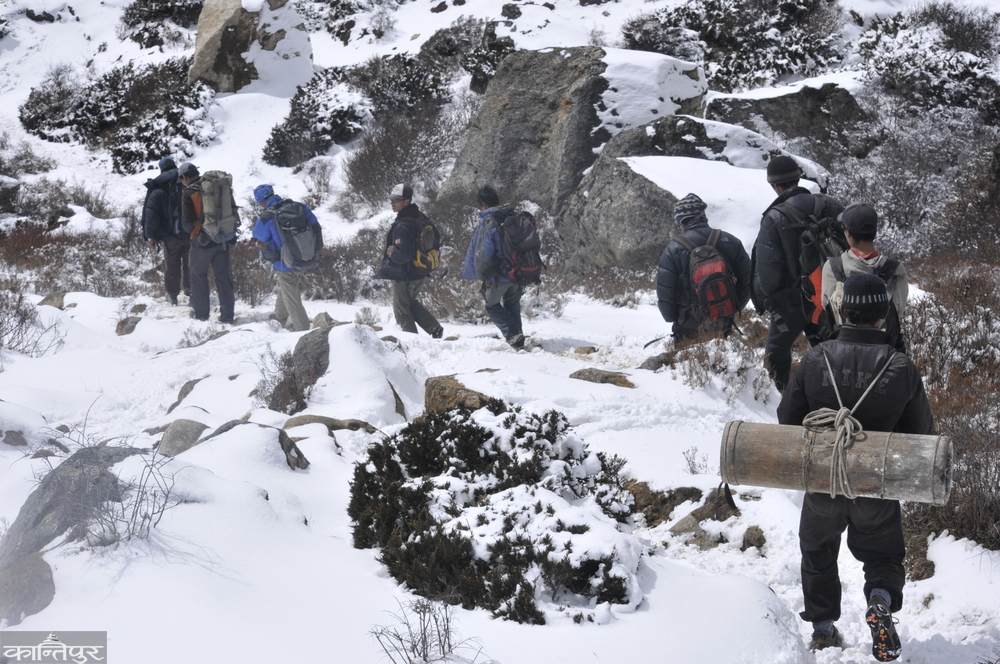
He said that he had brought medicine and other supplies for the cold to meet the people here who do not even have telephone contact. 'I reminded them that there is no telephone, it will snow, it will be difficult, it would be better not to stay,' Cheten said. Cheten said that he had also taken health workers and talked to the locals about what food to eat and what medicine to take if it is very cold.
Now, only the settlements of Mikwakhola-5 Tokpegola, Phaktanglung-6 Khambachen, Lonak, Pangpema, and Cheiram will be completely closed. However, all the businessmen here also have their homes in the aul area.
This is how they prepare
The residents of Olangchungola, at an altitude of 3100 meters, collect the grass from Jongin in the third week of Kartik. After cutting and drying the grass here, which is three hours away from the settlement, they put it in sacks and carry the straw to the settlement. Yangmaka cut firewood and grass in the area around Maiyathok and Jaritar last year and this year. He carried the yak that was brought to carry the firewood and grass to the settlement. Farmers from Ghunsa also brought grass and firewood from the pastures of Thangen and Gyabla to the settlement.
The villagers keep the grass and firewood they have brought on the ground floor of the house, and the people of the house live only on the second floor. They take the yaks, noses and goats out to the big pastures and tar. Nupu Sherpa of Olangchunggola says that the goats from Yangma reach the border with China. According to him, there is hardly any milk at this time. The few that are left are kept around the house and given hay and hay with salt and chaff. Even the young calves are kept in a place accessible to people.
After Kartik, the cold starts to increase in the Himalayan region. According to Ward Chairman Cheten, even now, the water has started freezing in the mornings and evenings. Three years ago, the temperature was recorded as low as minus-14 degrees, but now there is no temperature measuring machine. It does not always rain in the Himalayan region after Mangsir. When the sky becomes cloudy and it starts raining, snow falls instead of rain. They make great preparations to be safe from that snow and cold. ‘The snowfall that occurs from Mangsir/Pus lasts until Falgun/Chait,’ said Nupu of Olangchungola, ‘Unseasonal snow has also started falling in Asoj-Kartik and Baisakh-Jeshtha.’
Since the main occupation of the people of the Himalayan region is animal husbandry, there are many farmers who keep at least 8/10 to 150-200 livestock. After keeping livestock like buffaloes, yaks, goats, cheongras, and chickens safe, people start to feel safe. Food, warm clothes, firewood, and cow dung bags have been arranged for the people. Ward Chairman Cheten claims that each house in these settlements has already arranged enough rice, lentils, salt, oil, soap, and spices to last until Baisakh. Firewood has been placed around the house for burning. The cages for keeping domestic animals like goats and chickens have been made as warm as possible. Cheten says that the houses where people live are also made to be warm and air-tight.
When the temperature here drops below zero, the water gets stagnant. Water stops flowing from the tap. Dharke Sherpa of Ghunsa said, "We, the residents of the Himalayan settlements, who experience minus temperatures every day and that continues for months, should make preparations to protect ourselves from the cold with our own strength." When it starts snowing, sometimes you have to stay indoors. Most of the settlements are unable to leave and you have to become hostages in the village.'
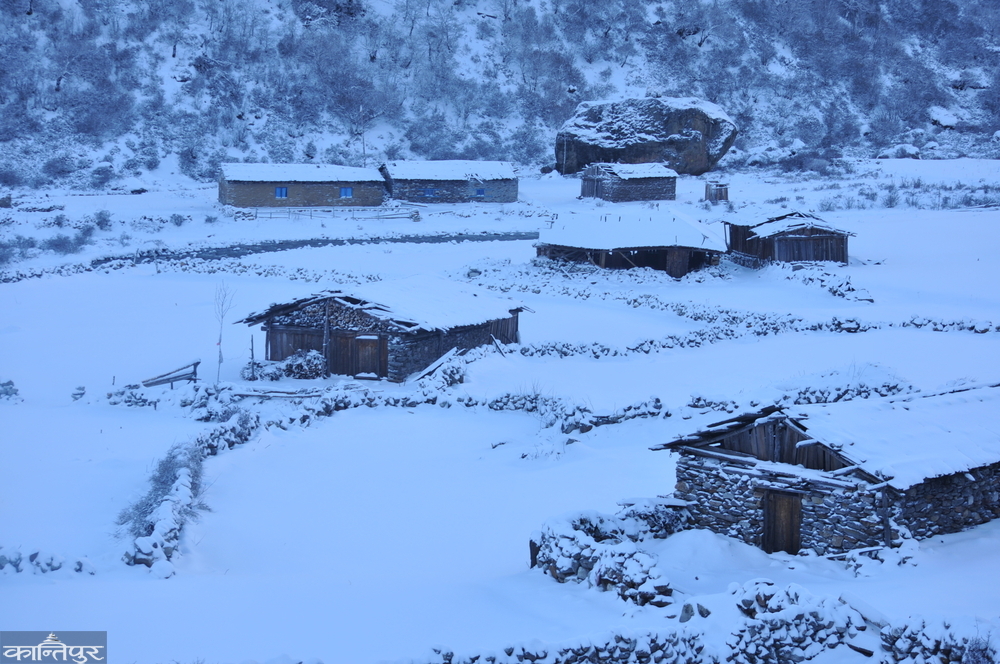
You can't go out when it's snowing. 'You shouldn't go out at such a time,' said Nupu. 'When the snowfall subsides, you should take care of your livestock.' According to Nupu, after snow falls, there is no green grass including Malingo, and if you try to pull it towards the forest and cliffs, there is a high chance of falling and dying.'
Three-month school holiday
The government has allowed community schools to have 45 days of leave in winter and rainy season. Five days of leave can be taken at the decision of the school management committee. This is called the Minpachas leave. Schools in rural areas take this leave for one month during the rainy season and between Dashain and Tihar and during the cold season.
In the Himalayan region, there is a three-month leave during the snowy winter season. This is how schools in Ghunsa, Olangchungola, Yangma, Phale, and Gyabla celebrate holidays. ‘Earlier, we used to celebrate holidays from Mangsir to Magh,’ said Singh Bahadur Singh, principal of Ghunsa Basic School. ‘This year too, we have already celebrated holidays for the younger students starting from Mangsir. We will celebrate holidays for the older students when people start walking from the village.’
Teachers say that students coming from outside Ghunsa should celebrate holidays on time as they suffer from problems like sore throats and headaches when the cold season begins. In recent years, it has been customary to celebrate holidays from the last week of Mangsir to the last week of Falgun. Parents say that schools will remain closed from Poush to Falgun as snow starts falling by Chaitra.
According to them, schools can be closed for up to four months in winter. Teachers at Ghunsa Basic School say that the cold is very difficult for children during the months of Poush-Magh, when the sun rises at 1 pm and sets at 3 pm. Avalanches can occur, making it difficult to move around during this time.

