The general public says, ”Nepal Telecom's towers are not working, there is no internet, the central electricity transmission line has not reached, water in small hydropower projects is not generating electricity, every citizen is unsafe in every way in the cold.”
We use Google Cloud Translation Services. Google requires we provide the following disclaimer relating to use of this service:
This service may contain translations powered by Google. Google disclaims all warranties related to the translations, expressed or implied, including any warranties of accuracy, reliability, and any implied warranties of merchantability, fitness for a particular purpose, and noninfringement.
As the heavy snowfall begins in the second week of Kartik, 86-year-old Karsang Ghale's heart begins to tremble with cold. She cannot leave her house due to the cold flowing from the mountains above and the Nar River below at the same time. The elderly in Nar village (4,200 meters) are starting to suffer from the cold more. And they start advising to go down to the valley.
Villagers resort to fire in the evening and morning to beat the cold . After finding it difficult to get through the day with the warmth of the fire, Ghale, along with her daughter and village friends, came to Kathmandu a few days ago . ‘We are going to Kathmandu . It has already rained, how will we climb uphill later ?’ she said when met in Narpa Bhumi Rural Municipality-2, Chhayajya. . There is no motorable road . We have to walk to Koto near the district headquarters, Chame .
Karsang Lama of Phu village (4,100 meters) came to Kathmandu with her husband, Lakpa Sonam Sherpa . ‘It is impossible to live in the village due to the cold . It is difficult to find firewood in winter . The water freezes and there is no drinking water . There is no road, nothing . What should I do if I get sick ? "It's better to just go to the city," she said. "The village schools and hotels are also closed. There is no one, everyone's houses are locked."
Fu village, located on the way to Himlung Himal (7,126 meters), is about 2 days' journey from the border area of China's autonomous Tibet Autonomous Region. There is no farming in this village, which only grows barley and potatoes. All food has to be transported by mule. "All the livestock (yak, horse, sheep, and goats) are left in the pasture area around the village and moved down to the valley. Some shepherds live there," says Karsang's husband Lakpa, "There is no place to live in Fu village now. If there were any, they have all moved to Kathmandu."
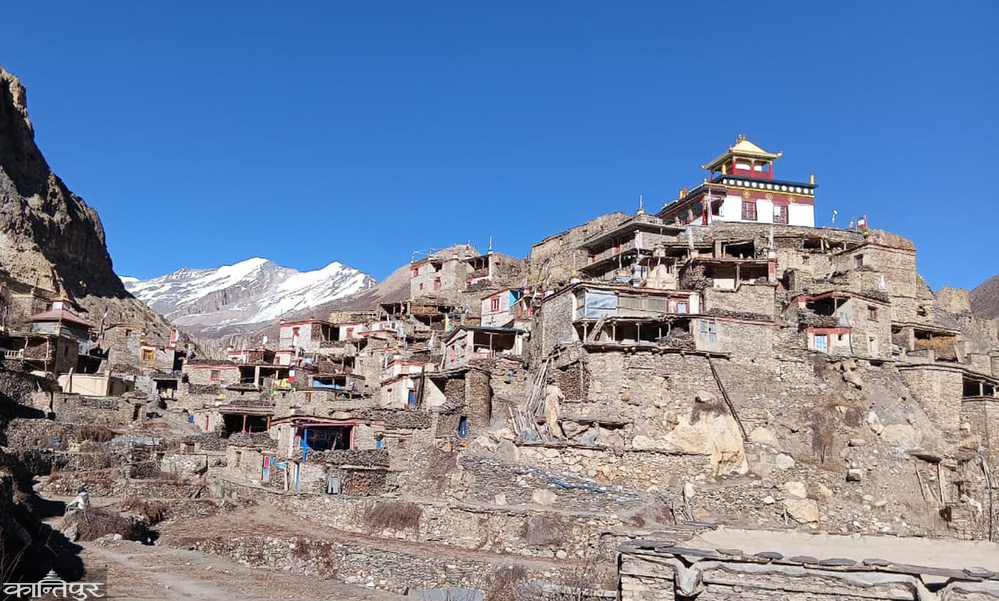
The former Nar and Fu villages have merged to form Narpa Bhumi Rural Municipality with the federal structure. According to the 2078 census, Nar village has 258 households in 90 households and Fu village has 138 households in 38 households, making the entire Narpa Bhumi rural municipality a population of 396 in 128 households. Narpa Bhumi rural municipality is the least populated local level in Nepal. The residents of Nar also live in Meta (3,600 meters) and Chyankhu (3,750 meters). The residents of Fu also live in Kyang (3,850 meters). Meta is a village near the crossroads to Nar and Fu. The citizens here leave their homes for about 4 months.
Meta and Chyankhu are a bit warmer when the sun is shining. Nar and Fu villages are not cold enough to live in. Those who cannot go to the city live in Kyang and Chyankhu. Some hoteliers also stay there. Otherwise, everyone will fall,' said the village head Konjo Tenzing Lama. The village head is in Chyankhu. Many people living here are residents of Nar.
The school in this place is cold all year round. Since it is cold and there is no school for a long time, many children have been sent to the city by their parents. 'Many have homes in Kathmandu. Those who do not have homes go to their children's homes. Some live with relatives. Some live in tents with relatives,' said the village head Lama.
They run the hotel business, raise yaks, and collect herbs like yarchagumbu to support their household expenses. Some have reached America and Europe. Lama estimates that about 80 percent of the population has moved to the city as the cold weather worsens. Even hoteliers move away after tourists stop visiting. For the school children of Narpa Bhumika, the rural municipality has prepared to operate a mobile school in Kathmandu.
Not only the residents of Narpa Bhumika but also the residents of Manang Ngisyang Rural Municipality have started coming to Kathmandu, Pokhara, and Besisahar due to the cold. Most of the citizens of Upper Pisang, Ghyaru, Ngawal, Tanki Manang, Bhraka, and Khangsar of Manang Ngisyang Rural Municipality in Upper Manang have now come to Kathmandu. Since there are hotel entrepreneurs in Dhikur Pokhari, Tallo Pisang, and Upper Manang villages, they come only in the last week of Mangsir or the first week of Poush. People are kept in hotels and houses to look after the animals. Shepherds are kept to look after the yaks, sheep, and horses.
The Nepal Telecom tower in Nar and Phu in Narpa Bhumika is not working. There is no internet. Most of the places are outside the telephone network area. The central transmission line of electricity has not reached . Water in the small hydropower project does not generate electricity . Every citizen is unsafe in every way in the cold, says Mengmar Funcho Lama, the vice-chairman of the rural municipality. ‘The citizens here have come to the city only to be safe . When the cold subsides and the snow stops falling, they return in Chaitra,’ he said.
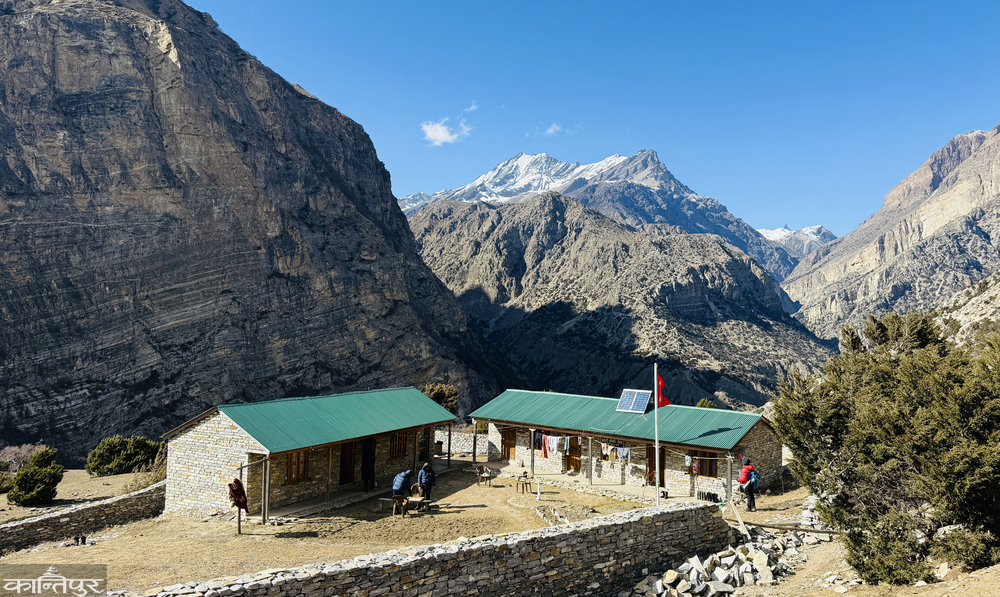
Former MP Polden Chhopang Gurung says that it has become a tradition for Manangis to come to the city due to the cold. There is no evidence to show when Manangis came to the city . After the Prithvi Highway connected Lamjung district headquarters Besisahar to the road network, Manangis started coming to Kathmandu in large numbers . Initially, they used to come to Lamjung in large numbers, then they stayed in Pokhara . Now, when the road reaches Upper Manang, they reach Kathmandu . A small number stay in Pokhara . Not many people stay in Besisahar .
According to the 2078 census, Manang Ngisyang Rural Municipality has a population of 1,595 people in 561 households. Tilicho Lake (4,919 meters) and Thorangla Bhanjyang (5,416 meters) in this municipality are famous in the world. Manangis move to the city after workers clean the hotels opened for tourists. Some stay in their hotels themselves.
Kanchha Ghale, the rural municipality chairman, said that about 50 percent of the citizens have moved to the city. He said that schools will be closed from 24 Mangsir and then students and teachers will also move. He said that the remaining citizens of Manang Ngisyang will move to the city in the last week of Mangsir and the first week of Poush.
Rural municipality office and police post moved
The Narpa Bhumi Rural Municipality Office has been moved due to extreme cold. Similarly, security personnel have also been withdrawn from two police posts in Narpa Bhumi Rural Municipality. The executive meeting was held and the employees left the village executive office to operate services from Koto near the district headquarters Chame during the extreme cold, said Sushil Lamsal, the rural municipality's chief administrative officer.
The executive meeting decided to provide all services that were being provided from the rural municipality center, Chyankhu, from 16 Mangsir to 15 Chaitra due to the extreme cold from Koto in the district headquarters Chame. 'As per the executive decision, we will work from Koto for 4 months. All of us employees have come here,' he said. He said that some of the necessary materials are in the office in Koto and some were brought from the rural municipality center.
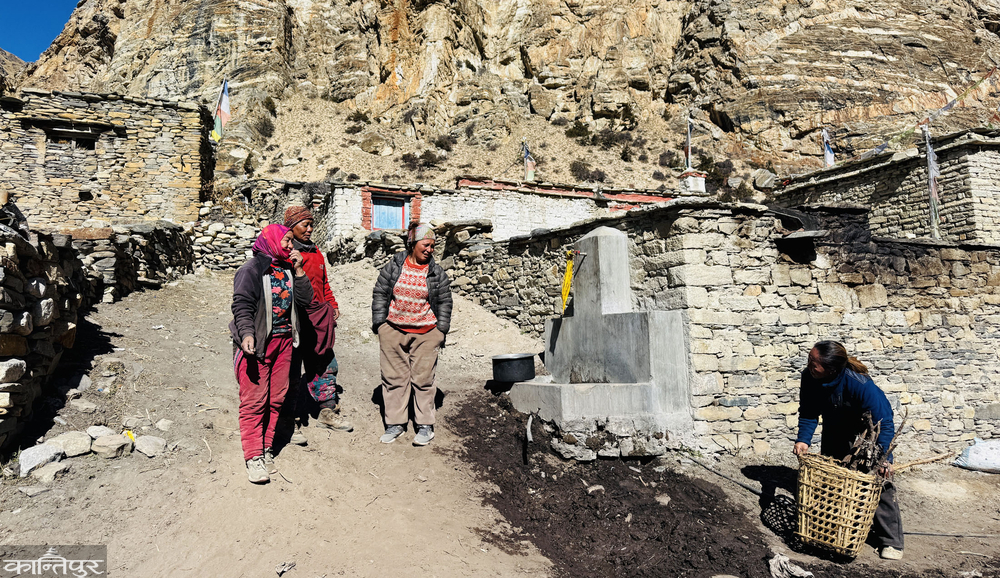
Since there were no people in the village due to the cold, the employees could not work even if they stayed. Rural municipality chair Konjo Tenzing Lama said that services were provided from Koto because it would be easier to travel to Chame from Kathmandu if necessary. The office of the people's representative and ward employees is carried in a bag. 'Whenever necessary, we have been providing services by taking out documents from our bags in mutual coordination,' he said.
He said that he has arranged a flat in his own office to provide services from Kathmandu as well. He said that when the employees and people's representatives were in Kathmandu, they used to provide services from Kathmandu. 'Everyone came to Kathmandu. All the people's representatives are in Kathmandu. In the past, when necessary, we had also called employees here and provided services from Kathmandu. We will provide them this year too,' he said.
In Narpa Bhumi Rural Municipality Center, Chyankhu, there were police with weapons under the command of an Assistant Inspector of Police (AIS) and in Meta, there were police officers under the command of a Senior Constable. The working police have left their workplaces and returned since 15 Chaitra. Some of the police officers working at the Chyankhu and Meta outposts have been managed at the District Police Office and some at other outposts.
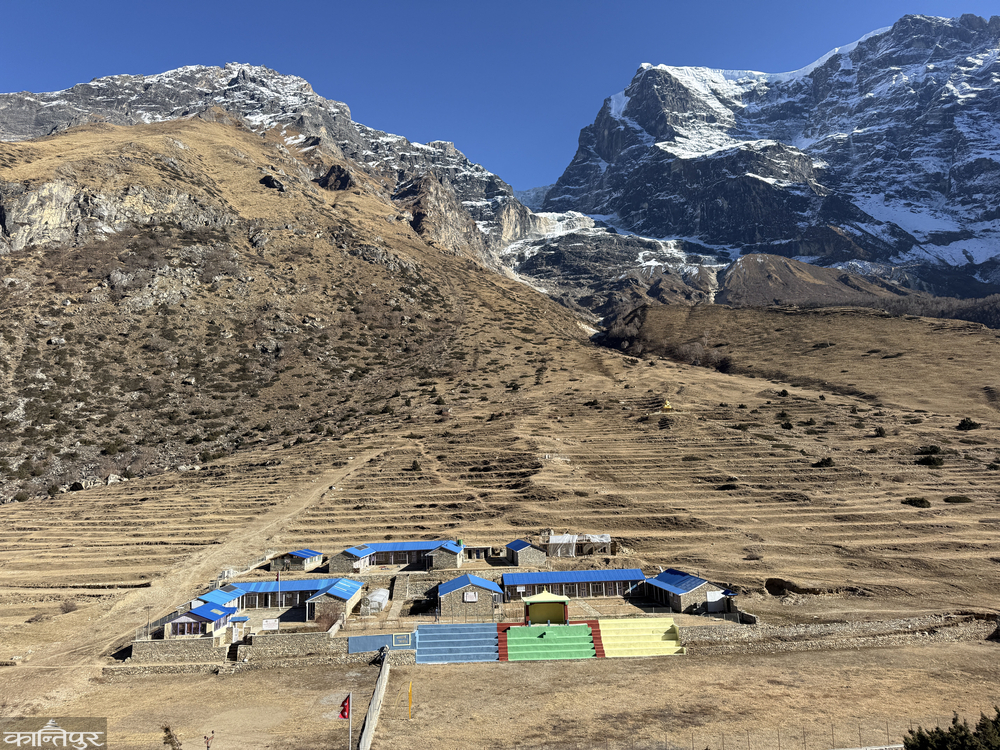
The employees of the Narpu branch of Nepal Bank in Narpa Bhumi Rural Municipality have not returned after leaving on 7 Ashoja. Despite the request of the rural municipality to return before the cold, they did not return. Chief District Officer Nawaraj Paudyal says that the cold has increased in the district headquarters Chame. As per the decision of the District Security Committee, the police officers working at the Chyankhu and Meta police outposts have been called back and placed at the District Police Office and subordinate outposts.
According to the 2078 census, the population of Manang is 5,658 people. Of these, most of the general public goes to Kathmandu, Pokhara, and Besisahar to escape the cold. However, there is no study on how many people go. After people go to the valley, the police patrol the surrounding areas. Except for the administration and security chiefs, the heads and employees of other offices go there on leave.

