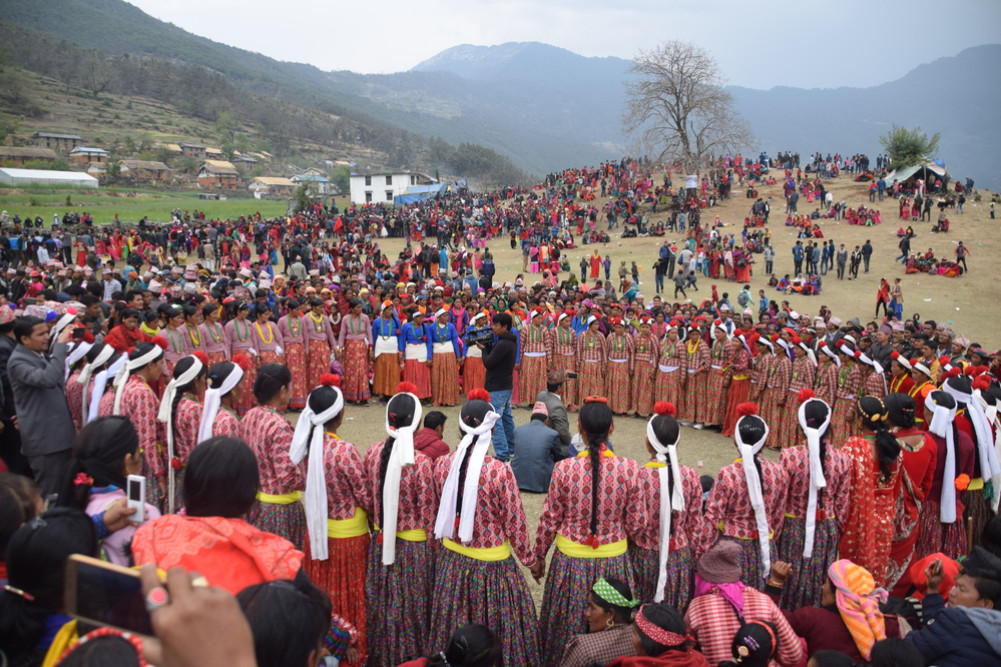
Beyond the Karnali, Bheri and beyond the Mahakali, India's Kumaon-Garhwal region is a link of social unity, brotherhood and harmony - Deuda
We use Google Cloud Translation Services. Google requires we provide the following disclaimer relating to use of this service:
This service may contain translations powered by Google. Google disclaims all warranties related to the translations, expressed or implied, including any warranties of accuracy, reliability, and any implied warranties of merchantability, fitness for a particular purpose, and noninfringement.
Deuda, which expresses the human and cultural sensibilities of Karnali West, the birthplace of the Khas civilization, occupies a special place in the traditional music of this region. Due to the combination of distinct sounds (sounds) and rhythms (rhythms), Deuda has a unique identity in Nepali music. The images and symbols of Deuda, which are mixed with the Navaras of literature, have multiple meanings.
Literary scholar Hemant Bivas, who is also a scholar of folk culture, says that until a few decades ago, Deuda was not only the music of this region but also the voice of philosophy of life and Hiya (heart). ‘Deuda was like an open school in the past, reflecting love, affection, harmony and brotherhood by making people sensitive,’ he says.
Whether it is the sounds of love and separation echoing through the plains of the Himalayan mountains and mountain gorges, grass, firewood and fairs, or the question and answer games played in the presence of hundreds, Deuda’s similes and metaphors carry interesting and profound stories of local life in remote geographies. From the charming depiction of nature to the philosophy of life, social relations, love, struggle, hope and despair, Deuda has become a strong medium for weaving feelings. The love of nature and love of the land of the people of this region shines through Deuda’s songs.
The sweetness of Deuda is not limited to music and dance alone. This tune is the life value, poetic creation and common identity of Sudur and Karnali. It contains the wounds of life, the sweetness of love and the light towards the future. Which has been echoing in the form of music for ages as the voice of Hiya. And, oral history has been formed in the villages.
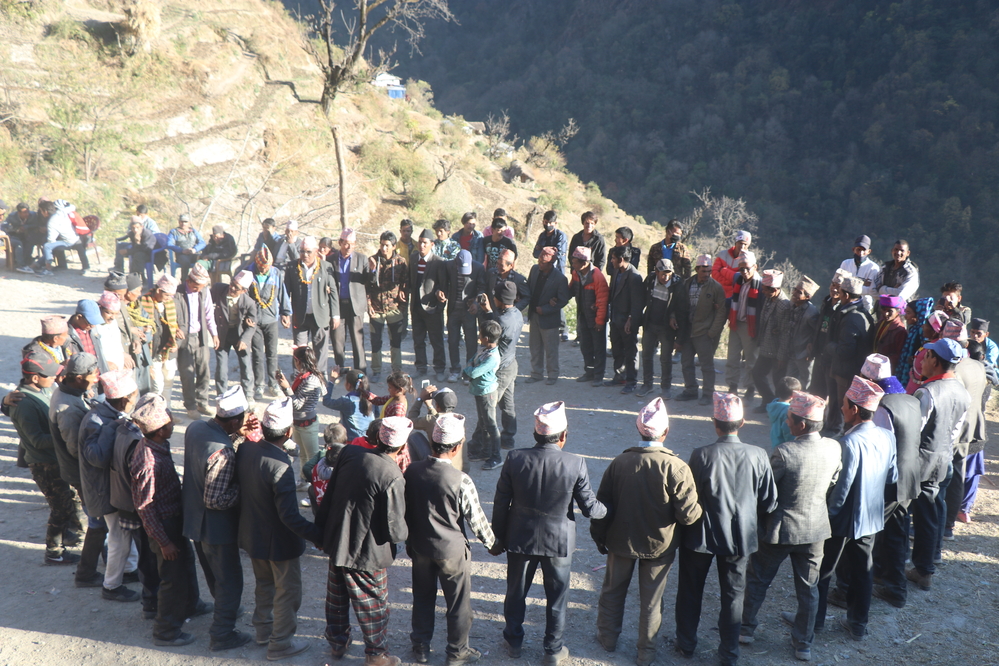
Depending on the place, Deuda, which is also pronounced as 'Deuda', is a music connected to the life of the people from Karnali to Bheri in Nepal and Mahakali to Kumaon-Garhwal in India. Deuda, which is sung singly in the forest, is also sung in dances with instruments sung at fairs, festivals, weddings and festivals, and in dances without bazaar.
This is played in groups of men-men, women-men or women-women. When playing in this way, the steps are combined and a circle is turned. When turning in this way, one step is taken completely and the next step is taken half. Since it is played by taking one and a half steps and turning it, it is also called Deuda.
Deuda also has different dialects and rhythms like Nyaulya, Su, Thadi. Similarly, Phag (auspicious song), Sagun, Mangal (auspicious song) sung on auspicious occasions like puja, marriage, and fast have different dialects and rhythms, while Athwali (song sung during the Gaura festival), Chabhai, Dhusko, Dhamari (sung during the Goddess's procession) have different rhythms and rhythms.
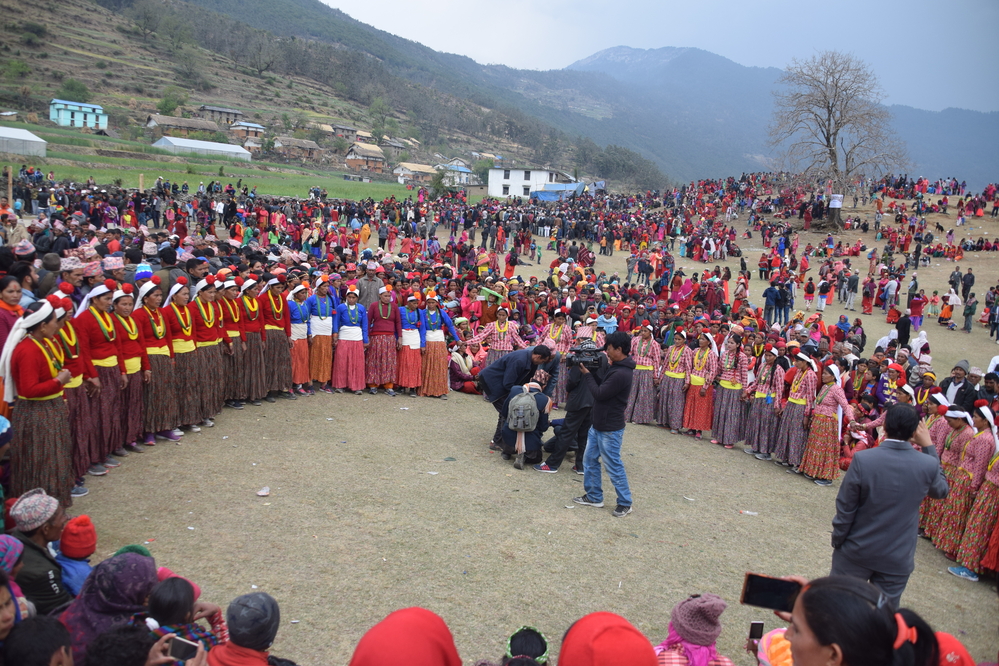
Jhimkeuda, Putala (a female-dominated song sung by daughters during the Bisu festival), Hudkeli (dance), Chanchari (song sung during planting), Jhoda (praise to God), Bhat Geet (song sung by the Bhat caste) have different music. Despite the diversity in rhythm, tone, and dialect, Deuda is not only the local music here, but also a link of social unity, brotherhood, and harmony.