Karputare Bhaka, or Lamjunge Thado Bhaka, is played with madal and mujura. It is exciting if both men and women participate in the singing. The dance moves are different from other songs.
We use Google Cloud Translation Services. Google requires we provide the following disclaimer relating to use of this service:
This service may contain translations powered by Google. Google disclaims all warranties related to the translations, expressed or implied, including any warranties of accuracy, reliability, and any implied warranties of merchantability, fitness for a particular purpose, and noninfringement.
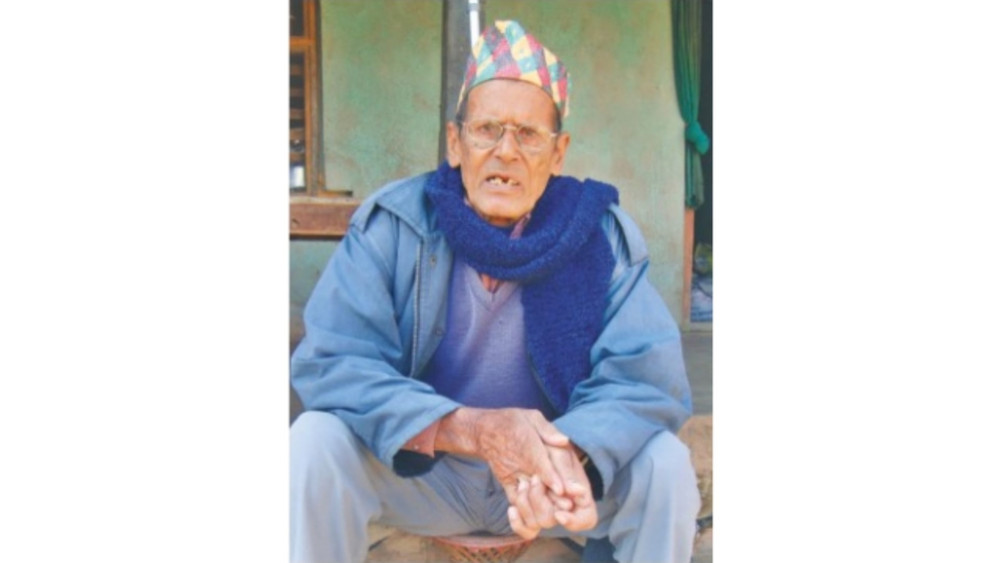
The birth name of Dikharke Sahinla is Dirgharaj Adhikari. Dirgharaj, the son of Balabhadra and Nanda Kumari Adhikari of Sildujure, Lamjung, was born on 31 Bhadra, 1990.
Having spent his life as an agricultural profession, he always enjoyed the garden of Nepali folk music. He passed away on 26 Bhadra 2074 at the age of 84.
For Bhedi Kharke Sahinla, Krishnacharitra, Ramayana, Mahabharata and Swasthani were the textbooks. Bhajans, Kirtans, Chudkas, Karputare Bhakas, etc. that resonated in the villages attracted his childish mentality.
As soon as he heard such songs being sung, he would go to those places and indulge himself in singing. Sometimes, he would even get scolded by his father and other guardians for engaging in singing. He indulged himself in singing due to the influence of folk bhajans and folk songs that resonated in the hills and villages.
Even after singing various genres of folk songs, Bhedi Kharke Sahinla gained fame by singing Karputare Bhaka, i.e. Lamjunge Thado Bhaka. Even now, when Karputare Bhaka is mentioned, his name comes to mind after Deubahadur Dura. Bhedi Kharke Sahinla, who sang from the age of nine, worshipped this song until the last moment of his life. That is why he has become revered in the Nepali folk music world.
Why was Dirgha Narayan called Bhedi Kharke Sahinlo? His father used to work in a sheep farm in Sildujure, Lamjung. Since he was the son of his father who raised sheep in that Bhedi Kharka, the villagers affectionately called him Bhedi Kharke Sahinlo.
One of the songs sung by Bhedi Kharke Sahinla is Karputare Bhaka. This song is called Dura Bhaka, Lamjunge Bhaka, Thado Bhaka, Lamjunge Thado Bhaka. It was called Dura Bhaka because it was sung and popularized by Deubahadur Dura, Fage Dura, Panche Subba, Bhakti Dura, etc. This song was sung for weeks by Dura and people of other castes every year on the occasion of Shivaratri in the premises of the Mahadev Temple in Karaputar, Lamjung. That is why it was called Karputare Bhaka. Since it is more popular in Lamjung district, it is also called Thado Bhaka because it is sung in Lamjunge Bhaka and Thado rhythm.
Bhedi Kharke Sahinla was impressed by hearing this song sung by Deubahadur Dura. When Deubahadur sang this song, he used to make the singing venue exciting. When he came to know that he sang this song, Bhedi Kharke would go to that place and listen to it with all his heart. After the death of Deubahadur, Bhedi Kharke made it popular through his voice and art. He won many people over by playing the dohori in this song. That is why no one dared to sing the dohori with this Bhedi Kharke in this song.
The main structure of the Karputare Bhaka song is found in two lines. The first line has 20 and the second line has 20 letters. Each line has a break in the sixth, twelfth and twentieth lines. Many rhymed details are added between these two lines. A paraphrase of this song sung by Bhedi Kharke Sahinla is as follows –
That Chaitu's wind, came dusty, dust fell on my eyes
Khar cut the needle
Aile malai khumne sarai dhokha thio
Dhobinile dhoyo
Even though it has been many years, Karputare bazaar
In the singing of this song, thego-level clauses like ‘Hey Dhansar is this Mayajaal’, ‘Ae toyo thikai bhaboda’ are repeated repeatedly. If men and women participate in the singing, the song becomes exciting. Madal and mujura instruments are played in the singing of this song. The dance routine in this song is different from others. It is known as a song with a new structure and form in the Nepali world.
If we look at the tradition of Karputare Bhaka i.e. Lamjunge Thado Bhaka folk song, it is found that the singing time of Deubahadur Dura has become one era, while another era has started when Bhedi Kharke Sahinla started singing.
Now, young people are also taking great interest in singing this song. When mentioning the names of famous singers of this song, we should not forget Khaje Dura, Deubahadur Dura, Bhakti Dura, Maniram Dura, Panche Subba, Ali Miyan, Bhedi Kharke Sahinlo, Gyanmaya Thapa, Uttam Gurung, Buddhimaya Gurung, Maya Gurung, Dhampu Dura, Gaumaya Dura, Shanti Dura, Sita Dura, Thula Swaraki Kanchhi, Raju Pariyar, Manju B.K., Ramesh Pariyar, Sandhya Pariyar, Shila Ale and others.
This song was initially sung and spread by the Dura caste as well as other castes, and later it was also sung and brought forward by various castes. Bhedi Kharke Sahinla sang this song in an era when Brahmins were not allowed to sing songs. The voices of folk talents including Gurung, Magar, Kshetri, Pariyar, Bishwakarma made this song popular in the Nepali world.
Folk singer Bhedi Kharke Sahinla, who sang Lamjung Thado Bhaka through various ups and downs of life, played an incomparable role in popularizing Karputare Bhaka. Realizing this importance, some people awarded him the title of Shiromani of Thado Bhaka. They paid tribute to him by making a statue of him in Lamjung.
Other singers add his name while singing this song to show their respect. The ‘Thado Bhaka Lokkala Pratishthan’ organization opened in Lamjung commemorates Deubahadur Dura and Bhedi Kharke by organizing programs from time to time. Training is also conducted on singing, playing and dancing of Karputare Bhaka. As a result, even students of 7th and 8th grade can now be heard singing this song.
Bhedi Kharke Sahinla is no longer in this world, but the songs he sang are still resonating in society. Singers and listeners have expressed their respect for the song. The wolf-like lizard is alive and immortal.