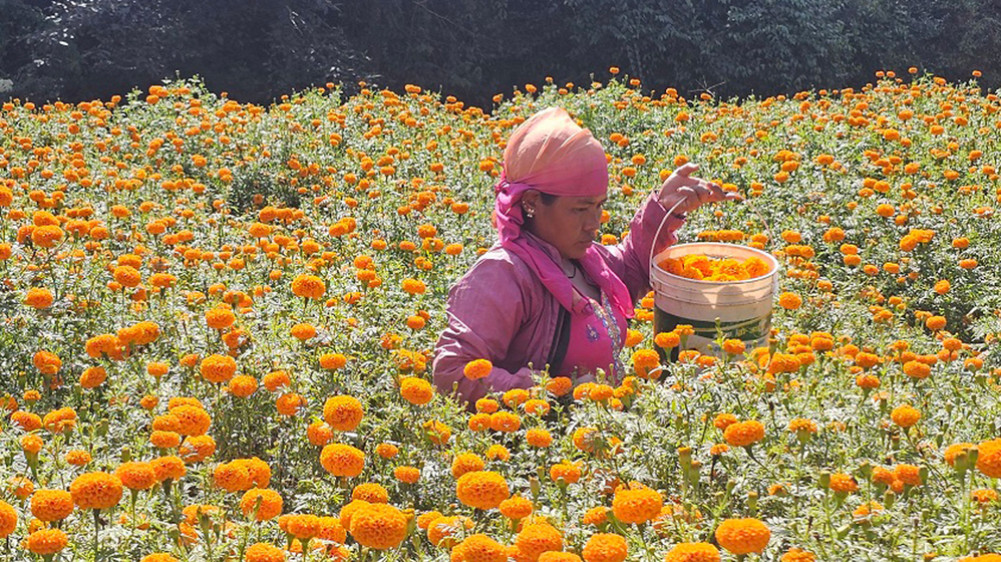
The marigold flower is believed to have originated in Mexico and Guatemala. It is also known as ‘marigold’ or ‘Mexican marigold’. The marigold has a history of entering Nepal via the trade route from Europe to India in the mid-20th century.
We use Google Cloud Translation Services. Google requires we provide the following disclaimer relating to use of this service:
This service may contain translations powered by Google. Google disclaims all warranties related to the translations, expressed or implied, including any warranties of accuracy, reliability, and any implied warranties of merchantability, fitness for a particular purpose, and noninfringement.
We are on the eve of Tihar. Tihar is the festival of flowers. What would Tihar be without flowers? The tradition of sisters giving garlands to their brothers after giving them tikka has enhanced the beauty of the festival. Flowers are a means of exchanging emotional bonds. They are a symbol of love, a means of expressing respect and courtesy. And, a gift in the form of prasad offered to the ‘gods’.
People are fascinated by the unique beauty of flowers. People are fragrant from flowers. People rush to drip a drop and apply it on their heads. People are eager to see flowers, go near them, touch them and enjoy their fragrance.
Cultural expert Govindaraj Tandon says, ‘Since the hundred-petal flower has hundreds of leaves, sisters wear a garland of hundred-petal flowers on Tihar to wish their brothers prosperity and a hundred years of life.’
The relationship and importance of Tihar, flowers and garlands is believed to have existed since ancient times. Senior botanist Tirtha Bahadur Shrestha says, ‘Festivals are related to seasons and weather. Velvet, hundred-petal and Godavari are not native flowers, but they have started being used on Tihar as they are symbols of harmony and longevity. Botanist Shrestha says, ‘In Newari tradition, the indispensable fruits are bee, walnut and katus, while the flowers are velvet.’
All the flowers used in Tihar are home-grown. These flowers are linked to agricultural production. Since they are part of the farming system, flowers are worn as garlands with respect during the Tihar festival, says botanist Shrestha.
According to a legend, in ancient times, Yamraj’s sister Yamuna invited her brother to her house and kept him at home throughout the Yama Panchak period and applied Saptarangi Tika. Then the Tihar festival began. During this festival, it is customary for sisters to apply Saptarangi Tika to their brother and also apply garlands of various types of fragrant flowers. The main attraction of Tihar is the garland of flowers.
The use of flowers is important every day in the Yama Panchak of Tihar. On the day of Lakshmi Puja, flowers are offered to the goddess and prayed for wealth and prosperity. It is customary to worship the goddess by garlanding her with flowers during Gai Tihar. Cows are also worshipped during Tihar. This reflects the importance and respect of cows in the agricultural Nepali society. Dogs and crows are also worshipped during this festival and flowers are also used during that time.
...
Velvet, Sayapatri and Godavari flowers are used more during Tihar. Since velvet does not dry out for a long time and lasts, it is considered a symbol of longevity and immortal love.
Cultural expert Tandon says, ‘There is a custom of garlanding dubo during Bhai Tika. Dubo is considered to be the one who never withers.’ When garlanding, it is also wished that life, like flowers, will be beautiful and never wither. It is said that the garland of flowers worn by sisters is also the fragrance of intimacy. Which is believed to play a role in sustaining the relationship between a daughter and a mother for years.
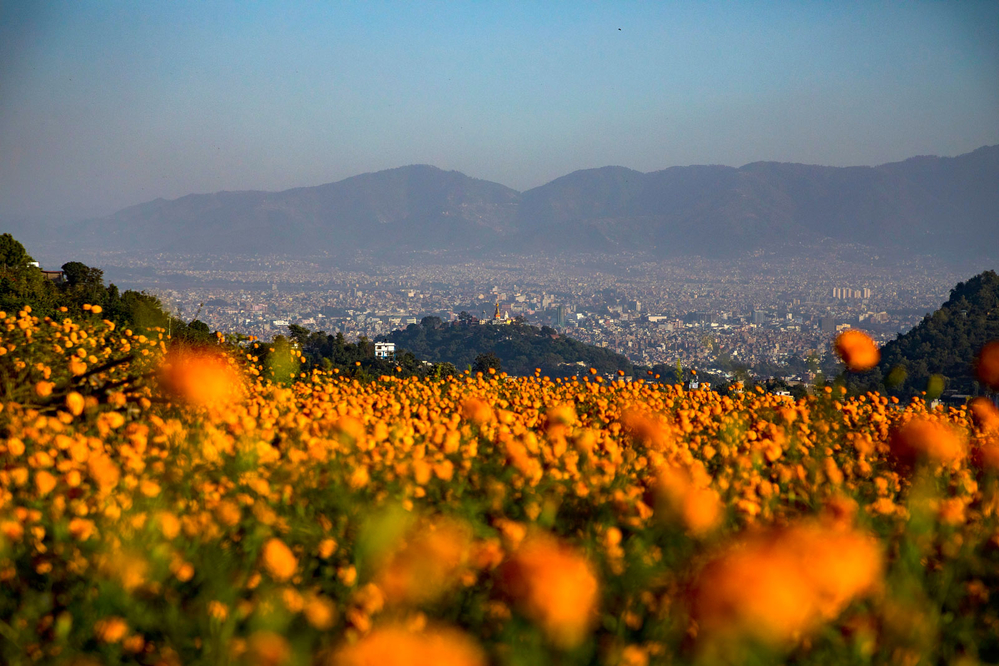
Kaushila Risal, a member of the Academic Council of Nepal Pragya Pratishthan, says, ‘A garland made of flowers is a symbolic form of unity and strength. It is a sign of affection and the vitality of emotional relationships in the family. Flowers are considered sacred in religious terms. An attempt is made to keep emotional relationships unbroken by putting up flower garlands during Tihar.’ Risal says that there is also a folk belief that death can be avoided with flower garlands, tika and diyas.
Flowers are also considered a symbol of beauty and auspicious signs. It is believed that offering flowers pleases the gods and goddesses and brings blessings. Flowers are also used to decorate homes and courtyards. The fact that the malakhi flower blooms only once a year during Tihar makes it more important in Nepali society.
Sanskrit scholar Rishiram Pokharel says, ‘The Tihar festival falls around Kartik. This is the time when many flowers bloom. The flowers that bloom at this time are considered auspicious for beauty, splendor and wealth. That is why these flowers are used during Tihar. Flowers are also used in Lakshmi Puja to bring Lakshmi to every household and to bring wealth. Cultural expert Pokharel says, “According to Hindu scriptures, the lotus flower emerges from the navel of Vishnu. Lord Brahma, who initiated the creation of the universe, sits on the lotus flower. That is why everyone finds flowers attractive.”
When flowers bloom in spring, the atmosphere becomes pleasant. The atmosphere is fragrant. There is a feeling of celebration. Flowers forget sorrow, reduce pain and inspire hope. People enjoy flowers, are happy to see flowers, and are cheerful. Flowers are also an important means of exchanging gifts.
A person is born, welcomed with flowers. A wedding is decorated with flowers. When a death occurs, flowers show respect. Flowers are used in birthdays, worship, religious rituals and festivals. Flowers are used in every phase of life. Sometimes as a celebration and sometimes as a memory. That is why the human-flower relationship is eternal.
The great poet Laxmi Prasad Devkota writes in his essay ‘Flowers’, ‘Man is also a flower bud, in which the color of feelings rises, the tenderness of the heart comes, beauty develops through the music of thought, and the fragrance within captivates the household.’
Nature does not speak, but flowers speak. They speak in color, they speak in fragrance, they speak in silence. Red roses tell the story of love, white lotuses give a message of peace. The main flowers found in Nepal are centaury, velvet, rose, jasmine, tarbare, Godavari, nutmeg, sunflower, lahure, and red-flowered lilies. In 1802, Francis Buchanan and Hamilton studied the plant species of Nepal. Since then, Nepal has discovered 1,658 flowering plant species, of which more than 300 are found only in Nepal.
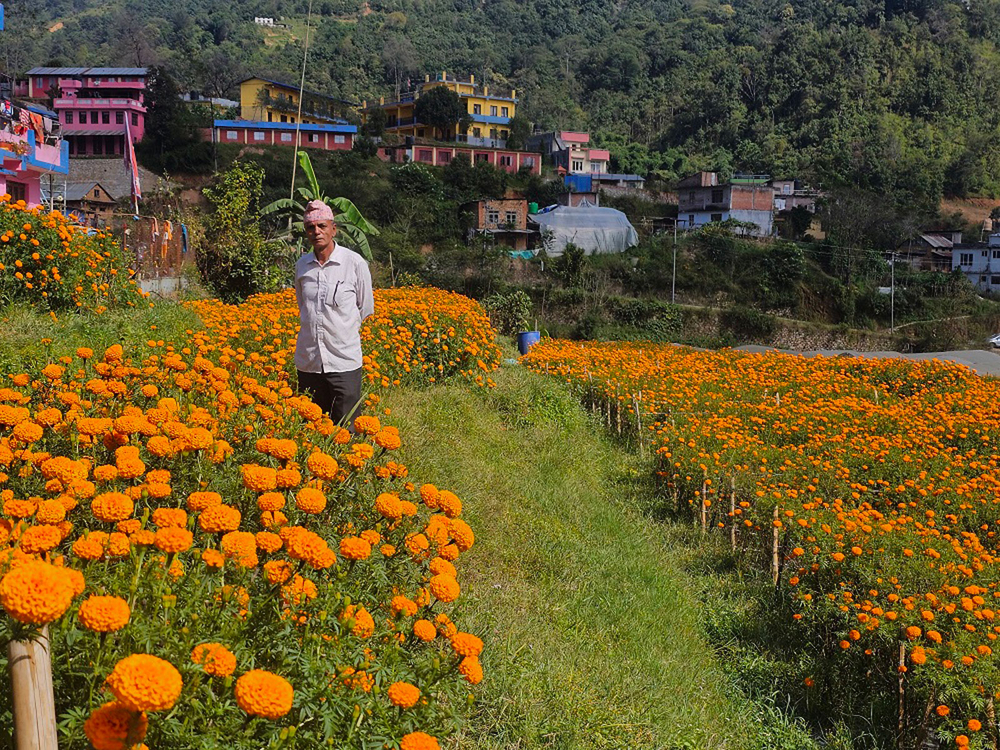
Whether living in the city or the countryside, Nepalese plant flowers in their homes and gardens. The trend of decorating rooftops and even rooms with flowers in city markets is increasing. It makes the house fragrant.
...
The marigold originated in the mountainous regions of Guatemala and Panama and reached us only in the middle of the 20th century. Since the 1950s-1960s, the marigold flower has been used in garlands worn on the day of Bhaitika during the Tihar festival. It came to South Asia through commercial and botanical relations during the British era. Then it was cultivated in botanical gardens and private gardens and spread.
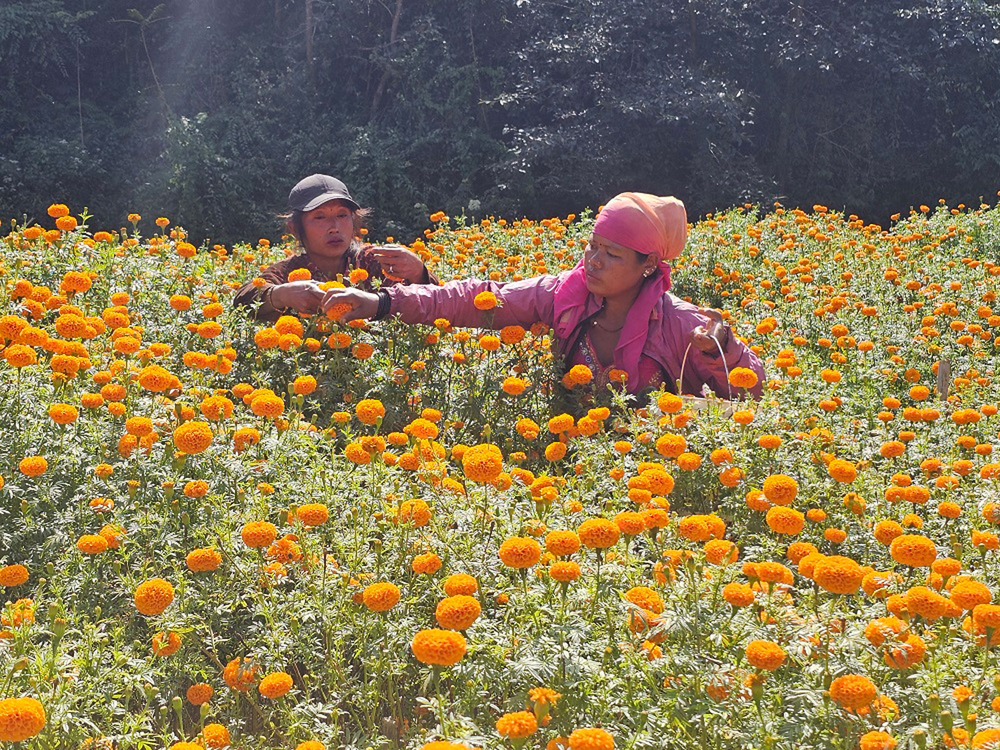
The marigold is believed to have originated in Mexico and Guatemala. It is also called ‘marigold’ or ‘Mexican marigold’. The centipede has a history of entering Nepal through the trade route from Europe to India in the mid-20th century. After this flower entered Nepal, it was used as a garland for worship, home decoration and as a garland for brother-in-law gifts during the Tihar festival, says botanist Shrestha.
...
After it started growing during the festival, the commercial cultivation of velvet and centipede flowers has increased. Commercial floriculture is carried out in 52 districts including Kathmandu, Bhaktapur, Lalitpur, Kavre. According to the Floriculture Association Nepal (FAN), flower entrepreneurs had a turnover of more than 3.68 billion rupees in the fiscal year 2080/081. The flowers produced here are exported to countries including Japan, Hong Kong, America, Australia, Britain, South Korea, Sri Lanka, Qatar, Germany, India. There is data that the annual export and trade of flowers in the world is about 10 billion dollars.