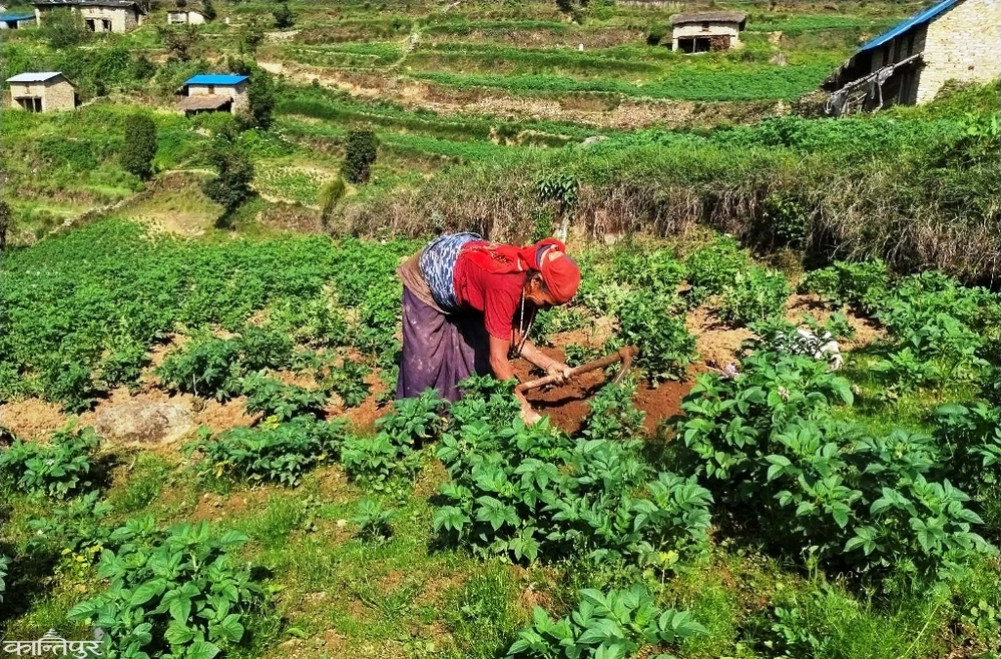
Potato farming helps Muthachaur farmers cover their kitchen and annual expenses
We use Google Cloud Translation Services. Google requires we provide the following disclaimer relating to use of this service:
This service may contain translations powered by Google. Google disclaims all warranties related to the translations, expressed or implied, including any warranties of accuracy, reliability, and any implied warranties of merchantability, fitness for a particular purpose, and noninfringement.
Maita Devi Rasaili of Muthachaur, Tamankhola Rural Municipality-2, cooks potato dishes in her kitchen every morning and evening. She also makes other dishes for guests from boiled, fried and baked potatoes. Potatoes are also cooked with wheat, barley and phapar roti in every house here.
Since it is at an altitude of 2,600 meters, rice and corn are not produced here. That is why potato dishes are cooked in everyone's kitchen. The locals eat potatoes grown in their fields for the whole year and sell them.
After planting potatoes last Falgun, those who came down from the valley, entered the market and went to the city to study and write also come to the village to dig potatoes. After finishing the class 12th examination in Pokhara, Rabina Rasaili of Bongadovhan has arrived in Muthachaur to dig potatoes. She has been in Muthachaur for a week after her mother Gaumati called her. They have cultivated potatoes on 25 ropanis of their own and rented land. They eat these potatoes all year round and also sell them for household expenses.
The farmers of Muthachaur, located at an altitude of 2,600 meters, have been earning money for food, festivals and household expenses throughout the year from potato farming. Local Maitadevi Rasaili said that she sells potatoes to bring in other food items. ‘There is no other farming here, we buy rice by selling potatoes,’ she said, ‘The money to eat salt and oil also depends on potatoes.’ Her husband Dhal Bahadur and her sons come to the village at regular intervals during potato digging and digging. 50 potatoes grow in her garden. She said that each potato sells for 1,000 to 1,500. She says that she uses it to bring rice and salt and oil for festivals. ‘Barley and wheat are enough to eat bread.’ When we sell half of the potatoes, we bring rice and salt for the festivals,' she said.
Potatoes grow well in years when there are no pests. After drying them for some time, they do not spoil. Traders from Burtiwang come to Muthachaur to buy potatoes and take them on tractors. Farmers here sell potatoes at a cheap price from the fields. That is why traders come directly.
Muthachaur, located at an altitude of 2,600 meters, is a famous place for potato production. Local varieties of potatoes are planted here. The locals make fertilizer from cow dung and sawdust (soyla) brought from the forest. Ward Chairman Narayan Sunar said that chemical fertilizers have not been used here yet. ‘There are many farmers who make a living from potatoes.’ That is why even those who have gone out to plant, dig and harvest potatoes come back,’ Sunar said, ‘The taste and quality of the potatoes here are also good.’
It has not been calculated how much potatoes are grown here. Most of the locals of Tamankhola-2 have land here. They grow potatoes for their own needs and also for sale. The rural municipality has also made arrangements to provide subsidies to farmers who make a living from potatoes. Since they ripen quickly and are sweet, the demand for potatoes here is very high.
The Agricultural Development Office, Baglung, has designated this area as a potato zone. Office chief Kumar Pun said that programs to promote eating potatoes will be held based on the needs and demands of farmers. According to Pun, there are statistics that 55,600 metric tons of potatoes are produced in Baglung annually. Farmers also sell these potatoes in urban areas. The food potato promotion program has been implemented to increase farmers' production by preserving the organic form of potatoes. 'No matter how much potato is produced, it is consumed,' said Pun, the center chief, 'the district can be made self-sufficient in food potatoes.' Potatoes are being sold from the district to places such as Butwal and Pokhara.
Sometimes potatoes from the Terai are also imported here. He said that if the production can be increased, it is possible to earn a lot of money from local potatoes because they are delicious. The provincial government and local levels have built more than a dozen stores in the district for storing potatoes. Some of these stores do not have electricity facilities.
Chairman Joklal Budha said that the potato storage center built in Tamankhola-4 could not be fully operational due to lack of electricity. He said that the Nepal Electricity Authority has been requested to extend the national transmission line up to here. Locals have been generating electricity from small hydropower here for years.