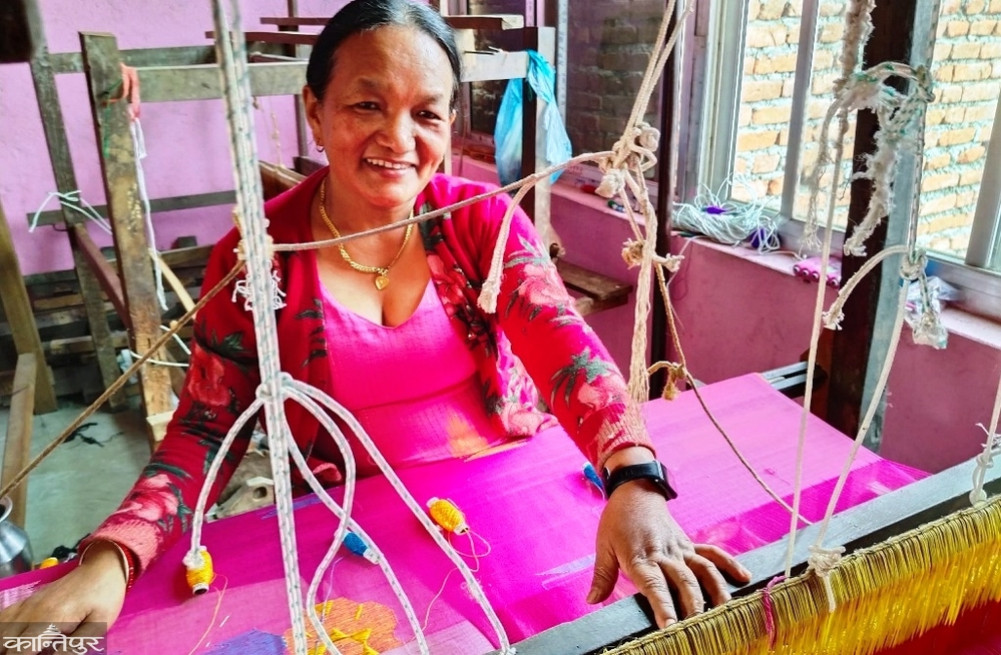
Yamkumari Thapa, who until a few years ago only made Dhaka goods for the local market, is now selling her hand-woven saris abroad as well.
We use Google Cloud Translation Services. Google requires we provide the following disclaimer relating to use of this service:
This service may contain translations powered by Google. Google disclaims all warranties related to the translations, expressed or implied, including any warranties of accuracy, reliability, and any implied warranties of merchantability, fitness for a particular purpose, and noninfringement.
Anita Pun, who is working in the UK, has called Yamkumari Thapa of Tarakhola and ordered three Dhaka saris to be made. She has chosen the color and the butta of her choice and has them made.
Yamkumari, a weaver from Dhaka, also had ready-made saris. But when Anita asked her to weave as per the order, Yamkumari is busy with work. She is found working at the loom all day with the aim of preparing three saris and delivering them within two weeks. Her hands are also found filling the butta in Dhaka at night.
Along with Thapa, Rudrakali Chantyal of Baramja, Myagdi also works. She comes and helps only during the day. Chantyal has woven another saris as per the order of Dilmaya Thapa, who has gone to study in Australia.
Yamkumari taught Chantyal the skills and put her to work. Even when talking to guests at home, their hands are busy weaving. ‘If the ordered goods cannot be delivered on time, the customers stop believing them,’ said Yamkumari, ‘I work in my spare time when there are no orders.’ Until a few years ago, she used to make Dhaka goods only for the local market. Now, people living abroad have started liking her products. According to Thapa, hand-woven Dhaka clothes are selling more abroad than in the local market.
She said that she has sent some goods by courier. Some others are ordered when relatives come to Nepal. It costs 700 to 1,000 to send a saree by courier. Courier service providers transport goods according to their weight. The Dhak sarees woven by Yamkumari Thapa of Bhakunde, Ward 10, Baglung Municipality are currently selling well in the US, UK, Japan and Australia.
Yamkumari sells Dhaka sarees for between 15,000 and 20,000. For that, she said she only needs to buy 3,500 rupees worth of yarn. ‘It takes 5 days to make a simple Dhaka saree, but 10 days to make one with an attractive butta,’ she said. ‘Only if you work all day and night can you make a good saree in a week.’ She said that by working all day on a wooden machine, you can make a profit of up to 3,000 rupees by selling a saree. Some people do not want to buy Dhaka goods because they are expensive compared to the goods in the market. Thapa has experience that those who wear traditional clothes and care about local products at public events seek Dhaka clothes even though they are expensive.
Earlier, she used to make Dhaka caps, bags and pachyaura and sell them in the local market. The price of these goods, which are prepared quickly, is also low. She said that weaving sarees is time-consuming, troublesome, and tedious. She has also set up a shop. Thapa's business, which pays more than 20,000 rupees per month for rent, was almost completely destroyed by the coronavirus. When the shop closed due to the coronavirus, she was confused. At the same time, people living in the US called her and ordered 5 sarees, 4 coats, and some handkerchiefs. This order gave her hope. After working regularly from home and preparing all the items in three months and sending them abroad through courier, she realized that she could now send her products abroad.
Thapa, who lives in the district headquarters, started weaving and selling Dhaka in 2067. Thapa, who used to sell plain sarees for 5,000 to 7,000 rupees, said that she has prepared butte sarees for 20,000 rupees and coats for 10,000 to 15,000 rupees. Orders for items other than saris and shawls come only sporadically. Women's items receive more orders than men's items, and prices are also available. In this way, she has the experience of working 12 to 14 hours a day and earning up to 40,000 per month by cutting down on investment and expenses.
Recently, people going abroad have started wearing traditional Nepali attire for weddings, gatherings, and festivals. Thapa has the experience of buying items woven on looms rather than those available in the market. 'Even when I show them that they are woven, many ask me to weave them using the thread of their choice,' said Thapa. She said that she buys fine and cotton threads from Kathmandu. She fills the holes with colored thread according to the color.
Gaumaya Roka of Tarakhola also said that these days she sends Dhaka goods abroad. Thapa has been working on orders for 15 years. ‘Those who ask from abroad should have good quality and finishing,’ said Thapa, ‘if you work hard, the goods will sell no matter how much.’ She said that since they are hand-woven, they cannot complete the work even after ordering a lot. Some people also order bhangros from Yamkumari, but she connects them to female entrepreneurs from Tarakhola for that. People who are looking for allo products also get calls from time to time. At that time, she said that she introduced them to entrepreneurs from Tarakhola and Jaimini.
Until two or three years ago, Yamkumari had six friends. She said that many people leave after marriage and cannot work after having children. She said that some people also leave the skills they had when their husbands went abroad and started sending money. ‘Sitting all day long causes back pain and eye problems,’ she said, ‘It takes a lot of room to keep the machines, and that too is expensive.’ Of the seven machines Yamkumari has, only four are currently in operation. She said that she has kept three machines open. She has experienced that the machines take up space and do not work, so she has to pay only rent.
A wooden hand machine costs 50 to 60 thousand rupees. In 2066 BS, she received a machine as a grant while undergoing 45 days of training through the Small Enterprise Development Program. The work she started with that has now made her everyone’s favorite entrepreneur. But so far, no one has respected her skills, work, and hard work. She has not even gone out to promote her work.
After her husband died in a car accident in 2059 BS, the responsibility of supporting the family fell on Yamkumari. Due to her family responsibilities, she had moved to the district headquarters with her three-year-old son in her arms with the goal of learning skills and working. With the earnings from dhaka weaving, she has educated her son Sandeep to be a software engineer. ‘My son has just finished his studies, it would be easier if he started earning,’ said Thapa, ‘It was my dhaka weaving skills that gave me the opportunity to spend lakhs to educate him.’ She said that she has also been helping family members living in the village. She said that she is currently earning up to 40,000 rupees per month.
Due to Yamkumari’s inspiration, 25 women in Bhakunde alone have learned the skill of dhaka weaving. Tarakhola Rural Municipality had trained more than 40 people with Yamkumari as a trainer for three months. Despite producing many as entrepreneurs, some people quit their jobs due to market problems and other constraints, said Bhadra Bahadur Gharti, Chairman of Tarakhola Rural Municipality-2. Yamkumari also has the experience of many entrepreneurs joining and leaving. Thapa says that the number of young entrepreneurs can be increased if the local level supports marketing.