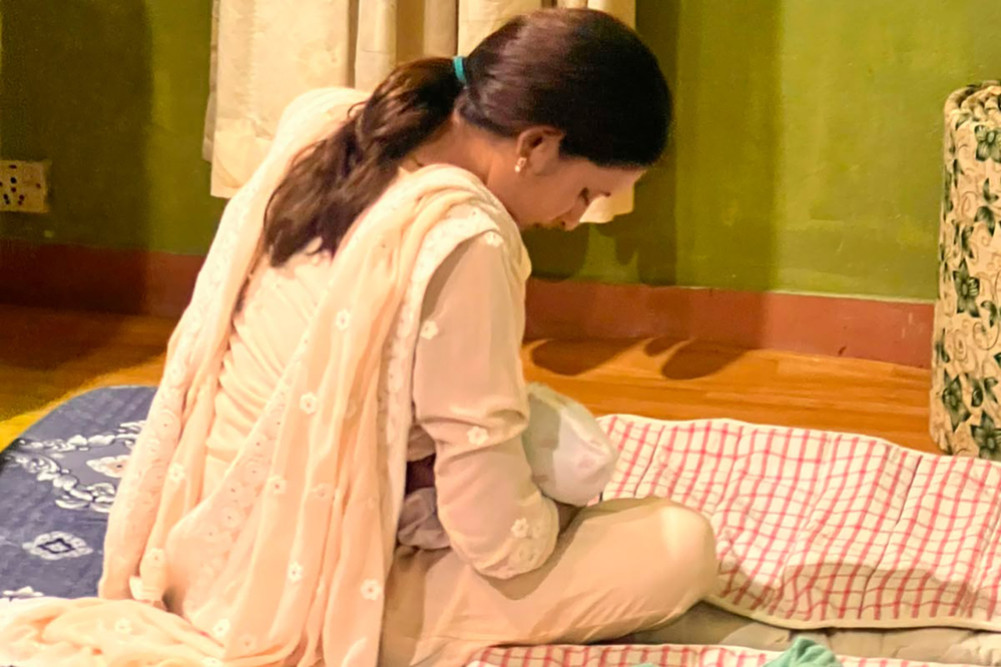
After a video of Minister Sita Wadi breastfeeding a rescued infant in her arms went viral, there has been widespread praise for her motherhood on social media.
We use Google Cloud Translation Services. Google requires we provide the following disclaimer relating to use of this service:
This service may contain translations powered by Google. Google disclaims all warranties related to the translations, expressed or implied, including any warranties of accuracy, reliability, and any implied warranties of merchantability, fitness for a particular purpose, and noninfringement.
Since Thursday evening, a video of Minister for Women and Children Sita Wadi breastfeeding a rescued infant has spread widely on social media. Many people posted emotional messages on social media after seeing the video.
When Minister Wadi herself goes to the ministry, she is often seen carrying her 19-month-old son in her arms. Whether attending various programs or during meetings at the ministry, her son sitting on her lap is never deprived of maternal affection.
The infant being breastfed in the viral video is a 17-day-old girl who was rescued from Nepal Children’s Organization on Saturday. “When I held her in my arms, I remembered my own child. Without realizing it, my eyes filled with tears,” Minister Wadi told Kantipur in an interview.
Having grown up in a children’s home since the age of 12, she is quickly touched by children’s issues. “I had never thought I would become a Member of Parliament or a minister in my life. Suddenly, I was given this responsibility. But I could relate closely to the ministry I was assigned,” said Minister Wadi.
The incident of Minister Wadi breastfeeding the infant took place last Sunday. On Saturday, under her direction, 20 children under the age of two were rescued from the children’s home at the central office of Nepal Children’s Organization in Naxal. Among them were 12 boys and 8 girls, ranging from 15 days to 2 years old.
The rescue team included members from the ministry’s secretariat, a ward committee member from Kathmandu Metropolitan City Ward No. 1, the coordinator of the Metropolitan Child Rescue Task Force, a member of the Metropolitan Child Rights Committee, and representatives from the Maligaun Police Circle.
Two weeks before the rescue. “Please come to see Nepal Children’s Organization during the rainy season, see what the situation is,” someone had commented on one of Minister Wadi’s posts one day. After the secretariat showed her the comment, the minister was startled. She then made plans to visit Nepal Children’s Organization to understand the situation of the children there.
On the day she went for monitoring, she was deeply moved by the condition of the children. “Seeing how the children were kept there, I became emotional. Their faces were covered in mucus and their clothes were dirty,” she said. “As soon as I returned, I gave written instructions to the management of the Children’s Organization to improve the situation.”
But suddenly, last week, Rasala Tandukar, a ward member from Kathmandu Metropolitan City Ward No. 1, posted a photo on social media. The picture showed the dire condition of children under the care of Nepal Children’s Organization. Along with the photo, she wrote, “The health of children at the Children’s Temple has been severely affected, and daily life has been disrupted.”
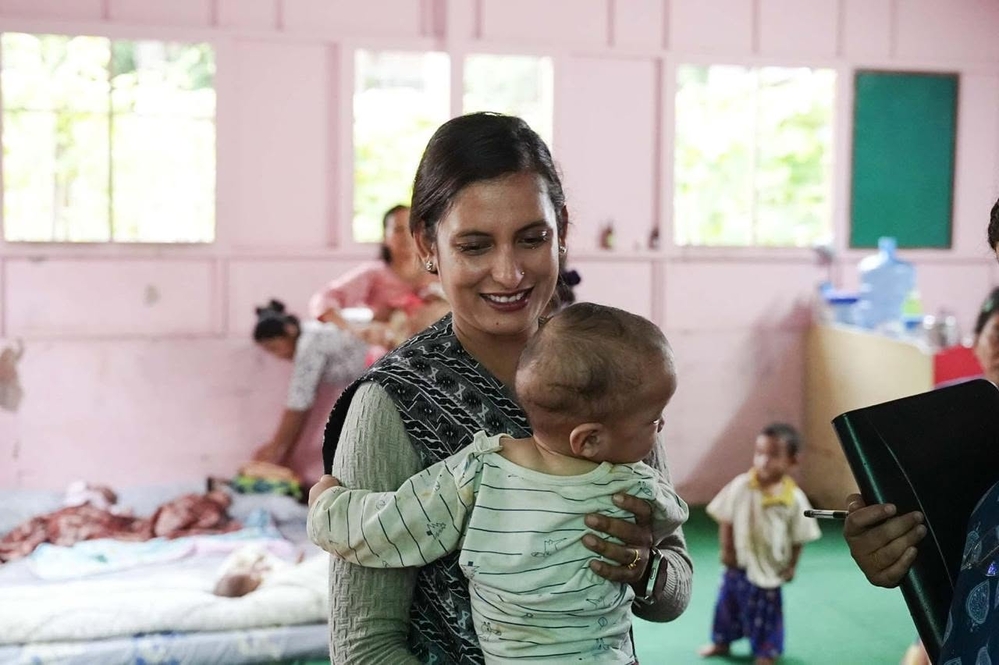
As soon as Minister Wadi saw the photo, she gave instructions for a rescue. It was pouring rain that day. Around 6 p.m., a rescue team set out for the children. “Sewage had entered the room where children under two were kept. They had been moved to an office room. Twenty infants were being made to sleep haphazardly on a single mat. Instant noodles were scattered for them as if feeding chickens,” said Soni Bhattarai, the minister’s personal secretary involved in the rescue. “I was also preparing to go for the rescue, but my own child was sick,” added Minister Wadi.
According to those involved in the rescue, Vidya Nyaupane, president of Nepal Children’s Organization, was not allowing the children to be taken from there. She accused the team of trying to shut down the organization. “But how could we leave the children in such a miserable state? When we rescued them, it felt like the children finally received justice,” said Ramesh Rokaya, another personal secretary to the minister involved in the rescue. As they were being taken away, two boys were happily sitting on his lap in the vehicle. He said he could not hold back his tears seeing that.
At the children’s home where the rescued children were kept, Minister Wadi called a meeting with the secretary and joint secretary to ensure there was no shortage of anything. Although she could not go for the rescue, the next evening she arrived at the children’s home with Dr. Ramji Ram’s medical team.
Some children had eye infections, some had skin problems. Some were suffering from cough. Dr. Ramji Ram’s team was conducting health checkups. The minister herself was busy cleaning the children’s feces and washing their bodies.
During that time, the 17-day-old infant kept crying continuously. No one could calm her down. The rescue team asked for milk for the baby. But there was no milk available. The minister went near the infant, took her in her arms, held her to her chest, and breastfed her. After that, the baby stopped crying. Seeing this, the minister’s personal secretary Soni said emotionally, “This baby probably hadn’t had milk since birth.” The minister replied, “Now I am her mother.”
Currently, five women have been assigned to care for the rescued children at the children’s home. Each of them will look after five children.
“We kept them without even deciding where their salaries would come from. This was an emergency situation. Now, there has been a lot of improvement among the children,” said Minister Wadi.
She breastfed the infant twice that day. “Seeing the minister breastfeeding while crying, we were also very emotional,” said Soni.
After rescuing the children, Minister Wadi was accused of trying to shut down the Children’s Organization. Regarding the accusation, she said, “We have no intention of shutting it down. We have no quarrel with anyone. We just want proper arrangements for the children here.”
She says that where the children are currently kept is a temporary shelter. “This is only temporary. Nepal Children’s Organization is on government land. If it had been properly utilized, there would have been no problem. This could have been done earlier,” she said.
She said they are concerned about the building under construction there. “It is said that it will be handed over in four months. Now I want to make it a model for children inside that building. At the very least, children without parents should not feel parentless,” she said.
Minister Wadi also has a plan regarding the Children’s Organization. She said, “If we set aside just one day’s salary of government employees per year, it would amount to about 1 billion rupees. With that money, this institution can be greatly improved. Excellent arrangements can be made for the children.” Many who grew up in children’s homes have citizenship problems. Minister Wadi said they are also working to solve that issue.
We also asked Vidya Nyaupane, central president of Nepal Children’s Organization, about the rescue carried out under the minister’s direction. She said that due to the old sewage system and mud from the building under construction, water had accumulated and caused problems. She explained that the repair and retrofitting work of the main building, which was supposed to be completed in 2078 BS, has not been finished due to delays by the contractor, causing the children to face such problems. However, she claimed that they had already moved the children to a safe place before the government team arrived for the rescue.
“During the crisis, before the government team arrived, we had already moved the children safely to the organization’s own office area and arranged for their meals. It is the government’s responsibility to ensure the safety of children. I take this step by the government positively,” she said.
Pravin Silwal, a member of the Metropolitan Child Rights Committee involved in the rescue, said that the Environment Department of the Metropolitan City and the office of Ward No. 1 had already worked several times on sewage drainage there.
“That day, additional problems arose due to the ongoing renovation work, and because it had been raining continuously for two days, the children were relocated from that place for safety reasons,” he said. Since both children’s homes of Bal Mandir Kathmandu fall within the metropolitan area, he said that necessary coordination is ongoing between the Metropolitan City and Nepal Children’s Organization to ensure compliance with the Standards for Operation and Management of Children’s Homes, 2079 BS.