Even after 7 years of the 'City Bird' declaration, the death rate of storks in Lumbini is increasing instead of decreasing, indicating that the municipality is indifferent to stork conservation, according to conservationists.
We use Google Cloud Translation Services. Google requires we provide the following disclaimer relating to use of this service:
This service may contain translations powered by Google. Google disclaims all warranties related to the translations, expressed or implied, including any warranties of accuracy, reliability, and any implied warranties of merchantability, fitness for a particular purpose, and noninfringement.
While celebrating World Migratory Bird Day, a protected stork was found dead in a field in Shivagadhiya Chowk, Lumbini Cultural Municipality-7 on Friday morning. The stork had fallen and got entangled in a bare electric wire while flying out of Gate No. 12 of the Lumbini Development Fund. The area had become foul-smelling when the Lumbini Cultural Municipality did not remove this 'city bird' for 3 days after it died.
Two months ago, an animal attacked and killed a GPS-equipped stork in a tomato field near Amagaun, Lumbini Cultural Municipality-12.
Recently, the number of protected storks dying due to accidents has been increasing in the Lumbini area. The storks have not only become unsafe since the municipality has not shown any interest in the necessary protection and promotion after the declaration of 'city bird'.
The stork was declared a city bird as a 'brand' to connect Lumbini, the birthplace of Buddha, to the world. The stork, considered a symbol of peace and love, is the tallest bird that can fly.
The municipality has been treating the stork as a mere paper city bird, said entrepreneur Lilamani Sharma, president of the Lumbini Hotel Association. 'People's representatives are busy squandering the budget to feed activists,' he said, 'The stork is in danger because they cannot hear the voice of the stork, which cannot speak.' He said that the existence of the stork in Lumbini is in danger due to municipal officials who do not understand the importance of birds, nature and the environment.
Kailash Jayaswal, a citizen scientist working on stork conservation around Lumbini, said that in 2081 and 2082, he found 8 storks electrocuted to death after they hit an electric wire. One or two have also died due to animal attacks. In the last 12 years, 42 storks have died due to getting entangled in electric wires around Lumbini alone, said Jaisawal.
On 11 Magh and 3 Poush, two storks died due to getting electrocuted after hitting an 11,000-volt electric wire near Jagdishpur Lake in Kapilvastu. The locals cremated the dead storks with religious rites. The first incident of this year took place last Friday.
The Lumbini Cultural Municipality had declared the storks as city birds on 2075 Mangsir 10 at Baby Buddha in Lumbini. Even after 7 years of the declaration of city birds, the killing of storks has not stopped. Conservationist Arjun Kurmi said that the municipality is showing disrespect by not making a budget and plan for the conservation of the bird it proudly declares as a city bird. He said that this shows how sensitive the municipality is towards the stork.
Kalpana Harijan, acting mayor of Lumbini Cultural Municipality, said that it is sad that despite declaring it a city bird, it is not working by allocating a budget for its conservation and promotion. She said that they will work by allocating a budget next year. 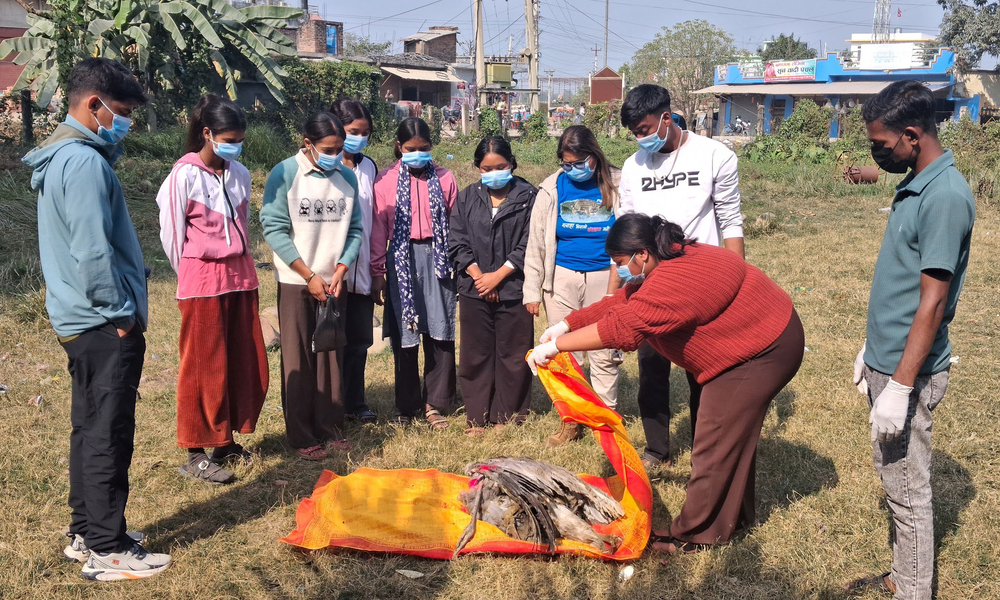
The largest number of storks in Nepal is found in the Greater Lumbini area. This area of Kapilvastu, Rupandehi and West Nawalparasi is considered a stork 'hot spot'. With the financial support of the International Crane Foundation (ICF) and the World Wildlife Fund Nepal, the Nepal Zoological Society and the Central Department of Zoology of Tribhuvan University found 690 storks during a study across the country in 2080. More than 80 percent of them were found in Rupandehi and Kapilvastu.
Senior ornithologist Dr. Hemsagar Baral says that the problem is caused by the hanging of bare electric wires in the stork 'hot spots'. 'The places where storks are found are not bird-friendly.' He said, 'They do not fly at high altitudes, they do not fly very far because they fly at low altitudes.' That is why they often collide with electric wires and high-tension lines.
Ornithologist Baral says that electric wires are the biggest enemy of storks. This bird especially likes to live near human settlements and farmlands.' However, electric transmission lines extend through these places.
According to citizen scientist Jaisawal, during the winter, when the fog covers the road, they cannot see the road and the new storks die when they cannot find the way.
Lumbini is home to the rarest storks in Nepal. ‘Two years ago, 98 storks were seen near the Danav River,’ said ornithologist Dinesh Giri. ‘I was surprised to see foreign visitors happy to see storks.’ Storks are another attraction of the birthplace of Buddha.
Storks are among the tallest birds in the world. Light brown feathers, a tightly packed smooth body. There is a red stripe on the head and neck. It looks very attractive with its pink legs. The stork, which weighs about 10 kg, is 5 and a half feet tall. If its wings on both sides are spread, it is 10 feet long.
The Lumbini region is becoming an excellent destination to enjoy watching the tall and attractive birds with their adorable chicks, said ornithologist Dr. Hemsagar Baral.
The stork is one of the 9 bird species protected by the Wildlife Conservation Act 029. It is considered illegal to harm, kill, destroy eggs or trade in the protected bird stork. There is a provision that anyone who does such a thing or causes someone to do so can be fined from 15,000 to 30,000 rupees or imprisoned for 3 to 9 months, or both.
The stork was listed as a rare bird in 2000 after it began to be seen less. The stork easily feeds on snakes. That is why there is no fear of snakes around the stork's habitat. Insects such as snails that damage crops are also the food of the stork. It gives advance warning of the arrival of wild animals such as leopards, tigers, and bears in the vicinity.
Jayaprakash Pandey, chairman of the Tilaurakot Partnership Forest Management Group, said that the arrival of storks in the fields during the summer indicates that it will rain. The sight of storks in the wetlands is a sign of healthy wetlands. Storks are also considered an inseparable pair. In some parts of India, it is customary to bless newlyweds with the idea of being like a pair of storks.
Out of the 15 species found in the world, 4 species of storks are found in Nepal. These include the stork, Laxman stork, Karyangkurung stork, and Kalikantha stork. Karyangkurung, Laxman, and Kalikantha storks are winter visitors. These storks migrate from the North Pole to Nepal in winter. Some go south, while others stay here.

