Through the brand 'Kriti', Mainali combines traditional handicrafts and contemporary design.
We use Google Cloud Translation Services. Google requires we provide the following disclaimer relating to use of this service:
This service may contain translations powered by Google. Google disclaims all warranties related to the translations, expressed or implied, including any warranties of accuracy, reliability, and any implied warranties of merchantability, fitness for a particular purpose, and noninfringement.
When it comes to fashion, fashion designer Kriti Mainali exudes a certain confidence. Kriti, who understands her profession and art intimately, believes, ‘I don’t just design clothes. Rather, I create clothes that have meaning, emotion, and identity hidden in them.’ She is the founder of the luxury fashion label
‘Kriti’ . For Kriti, fashion has never been just decoration. For her, it was a language. This belief has taken her from Kathmandu to Times Square’s ‘Sony Hall’ to the historic stage of Paris Fashion Week. As the global fashion landscape slowly makes room for South Asian voices and immigrant stories, Mainali is not waiting for someone to invite her and give her a place. She herself is making a strong presence on that stage through her creations. Growing up in Nepal, Mainali spent her childhood surrounded by South Asian fabrics, the softness of silk, the splendor of embroidery, and a single dupatta that could transform an entire outfit. Her affinity for design began with the smallest household items. As a child, she would sew beautiful clothes for her toy dolls by piecing together pieces of old kurtas.
After emigrating to America, Mainali's life moved between two cultural worlds. Like other first-generation immigrants, she initially chose the corporate path for stability and pursued her ambitions there. However, her creative hunger never died. Traveling to different countries sharpened her thinking. Every country she visited, the monuments she saw, and the folk arts she experienced became the language of her designs. Which was quietly evolving alongside her corporate life. She still sees herself as that little girl who was fascinated by travel, history and culture from the heart.
Her collection is based on Nepali symbols and crafts. It features hand-woven Dhaka cloths from the hills of eastern Nepal and Himalayan-inspired embroidery. She has transformed the fine lines and mythological stories of Mithila art into modern fashion. Nepal's national flower, the Laliguras, is seen blooming on the cholis along with pearls and crystal studs. Boudhanath Stupa and Buddha's eyes are hand-carved on wooden panels and brought to life on the garments. Each symbol in her designs has its own deep meaning, which Mainali presents in a way that can be understood globally.
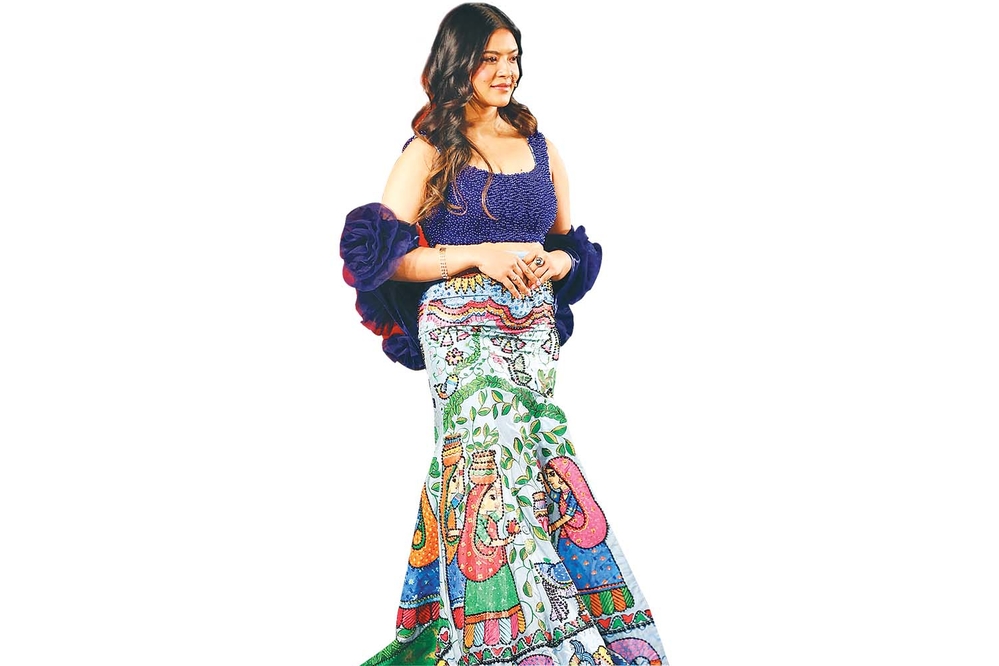
These symbols are not just for decoration. She says, ‘I transform those symbols into a modern and luxurious design language that can be embraced by people from all backgrounds.’ Mainali’s art is all about making something special universally loved.
Each piece in the ‘Kriti’ collection is crafted by skilled artisans from Nepal and India, most of whom are women who support their families through this craft. The pearls, stars, crystals and hand-woven fabrics reflect the patience of those who understand that quality comes with time.
Every designer has a turning point in their life that changes everything. For Mainali, that turning point was Dubai. The collection she presented at the ‘Emirates Fashion Week’ became a major breakthrough in her career. Inspired by the 'Palm Island' and created in collaboration with Ani Fashion LLC, the collection reflected the architecture of Dubai's famous buildings. She received immediate feedback from the international media.
Mainali did not let the opportunity slip away. The Dubai collection proved that her ability to transform any place and story into clothing is limited only to the Nepali environment. This success was not just a coincidence. It was the result of years of hard work, constant coordination with artisans from her country, and the experience she learned while handling all the management alone. 'Everything requires patience and coordination, I learned and grew from this,' she recalls.
In early 2026, Mainali made her international debut at 'Runway 7' of
New York Fashion Week . She showcased 10 outfits titled 'Heritage of Nepal' among 85 designers from 16 countries at the Sony Hall in Times Square. The eyes of Swayambhu, views of the Himalayas and traditional Nepali music echoing in the background, along with a digital view of Mount Everest, transported the audience to a different world. It was not just a display of clothes, but a cultural message. For Mainali, the moment was not just a personal achievement. Being one of the few Nepali designers to reach such a big stage also meant giving a strong proof of her identity and presence. 'When I reached that level, I wanted to start with my own story,' she says.
After the success in New York, she was invited to the 'Infinity Fashion Show 2026' in Paris, which further secured her place in the global fashion market. This journey from New York to Paris is not just a career, it is the story of a historically neglected immigrant community raising its voice.
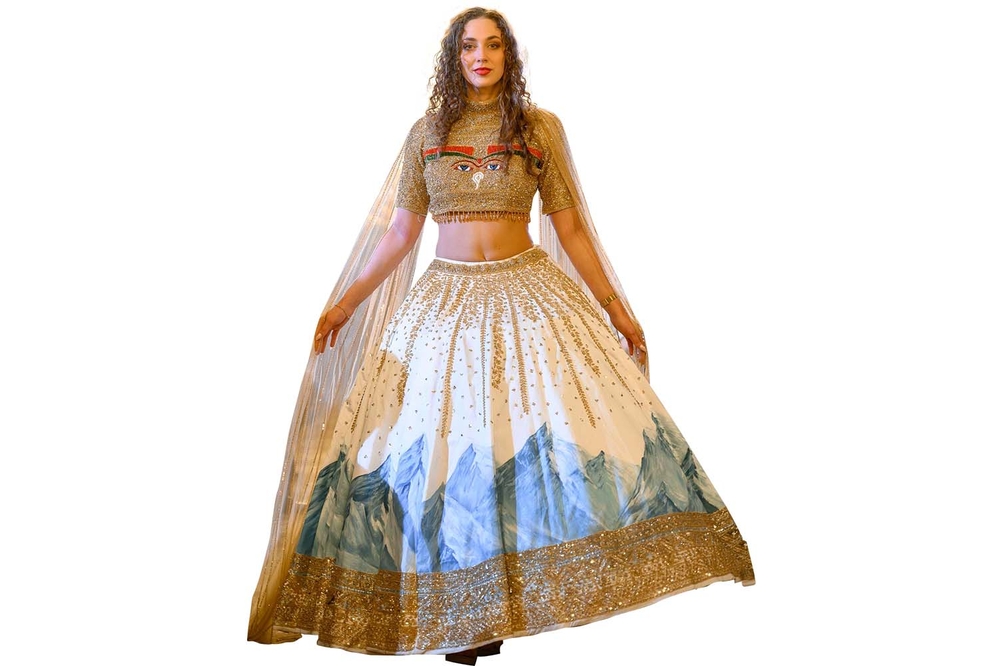
In addition, her main creative role in 'Miss Nepal North America' 2023 and 2024 has greatly helped to bring Nepali beauty and craftsmanship to a new generation and international audience.
Mainali's work begins with a journey, history or an image in her mind. Then comes the selection of fabrics, embroidery techniques and the selection of artisans. She wants people to understand the story of a garment before they even read the tag.
'I want people to understand the story of a design by looking at it,' she explains, 'without any explanation, they feel something - whether it's curiosity, emotion or admiration. This silent dialogue is very important to me.'
That's why balancing tradition and innovation is not a challenge for her, but rather a creative opportunity. She is aware of and respectful of the traditions she uses, but is not afraid to take them to new heights. 'Kriti' is creating a story that is never old, even more than the trends that change with the seasons. Nepal's artisans, landscapes and symbols are its timeless foundation.
Envisioning the future, she says, 'I want my designs to be not only visually great, but also emotionally great. I want to show how powerful and expressive fashion can be.'

