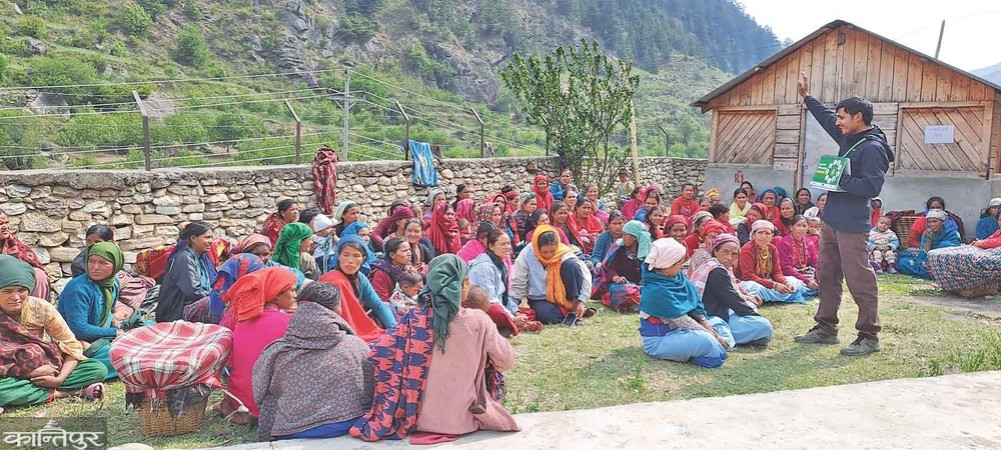
In Karnali, which has been suffering the death of mothers and children due to the compulsion to get pregnant after getting married at a young age, having to stop eating during childbirth, lack of nutritious food, lack of health care, the current generation is gradually improving.
We use Google Cloud Translation Services. Google requires we provide the following disclaimer relating to use of this service:
This service may contain translations powered by Google. Google disclaims all warranties related to the translations, expressed or implied, including any warranties of accuracy, reliability, and any implied warranties of merchantability, fitness for a particular purpose, and noninfringement.
48-year-old Sugani Damai of Rokaya Village, Adanchuli Rural Municipality-3, Humla was married at the age of five. She became a mother at the age of 16 and had to lose her first child. He was small at birth, getting weaker and weaker. A few months passed," Sugani recalled, "I lost my first child. Remembering that thing, I still shudder.
He just came to know that his son died of malnutrition. Then two sons were born to him. At the time of delivery, it is not customary to breastfeed the baby immediately after birth. It was not customary to feed the first milk immediately after birth. It was customary to take a bath after the birth of a child. I had a baby when it snowed. I remember bathing in snow water, she said.
She said that because it is a Himalayan district, there is a shortage of food. "We are mountain people, we couldn't get any food, they didn't let us eat because we thought it was grown on the ground," she said. She could only eat plain rice and dry bread, and that was enough to fill her stomach.' She said that the child may have been stillborn because she did not take care of herself during pregnancy. She said that even during pregnancy, you should eat and work as before. That's why I lost my last born daughter. Only the second and third children are alive,” she said. She said that she ate bear bile when there was no other option to prevent pregnancy. He has experienced a lot of suffering because there was no time to take care of health like now. She remembers that she always had to work whether she was pregnant or giving birth.
is now Sugani's daughter-in-law. She thinks her daughter-in-law is happier than herself. Daughter-in-law Kalpana got married at the age of 17. Kalpana said that after getting pregnant, she went to the health post and had regular check-ups. She gave birth to another child only after the first child grew up. Kalpana said that she did not suffer as she did during her mother-in-law's time.
"During pregnancy and after giving birth, I took care as the health workers said, I also looked for food and ate, I didn't starve," she said, "I ate as much as I could." I also fed the baby early. The baby was bathed only after 24 hours. She said that she eats as per the advice of the health workers and does not eat anything. She said that she tried to eat the food taught by the health workers and took care even while working. Stating that it was not in her time as in her mother-in-law's time, she said that now she will be more comfortable with her daughters.
Jaysara Neupane of Pachaljharna rural municipality-8 Nanikot of Kalikot was married 63 years ago at the age of 7. At that time, her husband was also a minor of 11 years. After 13 years of marriage, she gave birth to a child, when she was 20 years old. "After that, 13 children were born in a row," she said, "five of them passed away, only seven children survived."
She didn't even know what happened to the children. Some of the children had fever, some coughed and some vomited. She said that she did not know how it passed, nor was there a time like now. She said that she did not have the awareness that she should take care of her health when she was pregnant.
``We used to not be able to rest properly, apart from eating nutritious food,'' Jayasara said, ``We had to do all the housework. No one knew that you should take care of your stomach.' According to him, it was customary to eat vegetables, fruits, and milk curds, either when the child was in the womb or after delivery.
``There was no fish meat, even if it was found, it was not customary to give it to pregnant women. "Now I know not to eat what I should eat," she said. Jayasara now wonders if she would have lived if she had been able to eat well and take her children to the hospital. What happened to the food, there was no health post to treat sick children. That's why I couldn't save my children," she added, "If I could have been treated, I would have lived! As many as have survived, they also survived by luck!'
This story of Jayasara has been experienced by most of the women of her generation in Karnali. Now Jayasara is shocked to see the 'happiness' of her daughter-in-law. She said that today's women are 'happier' than before in many things, including not having to have many children, not having to do dhapedi while giving birth, and being able to eat nutritious food.
How times have changed, they have given birth to less children, they have gone to the hospital to have children. The doctor keeps checking. They keep telling you to eat healthy food,' she said, 'It doesn't take much to eat! Time has brought many improvements. In our time, there was neither food nor medicine.'' Her elder daughter-in-law suffered less than her. During his daughter-in-law's time, he started eating a little more than during his time. One child was born at home but the other was taken to the hospital. Tulsi, the younger daughter-in-law, has a different experience than her mother-in-law and brother-in-law.
Tulsi was 21 years old when she got married 10 years ago. She gave birth to only 2 children. She gave birth to her second child after giving birth and said that she did not experience the same pain as her mother-in-law. She is also a teacher. She says that she takes good care of her health during pregnancy and childbirth.
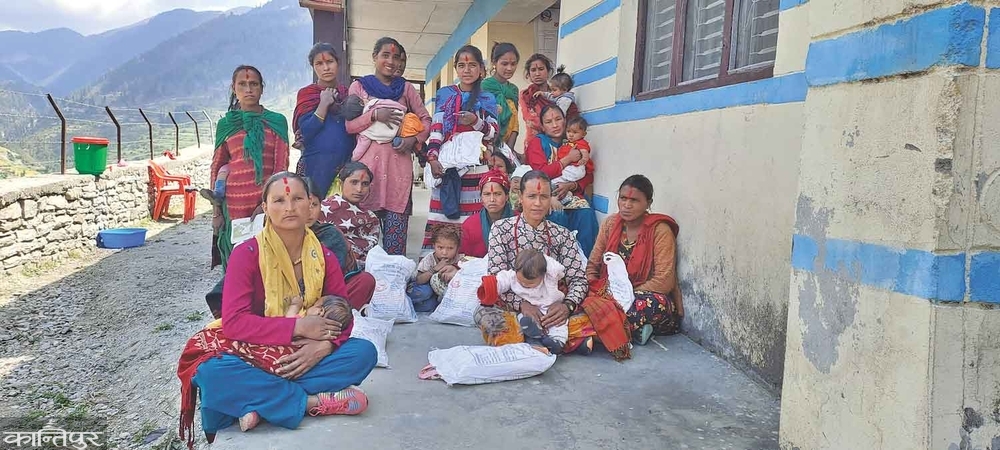
'It is surprising when the mothers-in-law and the elder brothers tell that a child was born while they were cutting grass in the middle of the day, and they walked home bleeding after suffering in the fields,' she said. We had regular check-ups during pregnancy. If there is any problem, we consult a health worker if not a doctor. We went to the health institution and gave birth. She said that she did not have to eat anything during pregnancy. Telling that she heard that her husband was not close to her during her mother-in-law's time, she also told that her husband used to take care of her.
71-year-old Goma Koirala of Narayanpur Municipality-1 in Dailekh is a mother of 5 children. He was married at the age of 18. Children were born the following year after the marriage. She became a mother of 5 children one after the other. Although Dailekh lives in the headquarters, Goma gave birth to all her children at home.
When she gave birth, it was not customary to go to a health institution like it is now. In our time, it was not customary to take them to the hospital. I gave birth to all my children at home," she said. "All my children were born while I was pounding, grinding, and working. There was a lot of grief,' she remembered. She told that it was customary to stop eating when she was pregnant.
How many nights were spent starving at a time when you should eat plenty of nutritious food. We couldn't eat vegetables, fish, meat, legumes', Goma shares her experience, 'How weak our bodies must have been, how we survived now makes me sad.' According to her, they were not even allowed to touch chicken meat because 'the caste is gone'.
A woman like Goma never thought of cutting straw to feed her mother. She considers herself lucky that she did not have to stay at home when Dhan gave birth. At that time, pregnant women also had to stay in a shelter like menstruating women. She told that her house did not have a barn or a shed, but the family kept it in a room in the house.
Goma still remembers that many women died during and after childbirth. At that time, many women died because they could not give birth. How many children died after birth, some in the womb," she said. We are alive as long as we are. Even now I am surprised to remember. It is only now that she has come to know that the health of the mother and child was bad because she was not able to eat food. His daughter-in-law Sangeeta Pandey got married at the age of 22. Sangeeta, who is currently doing business at the headquarters, has 2 children. "Both children were born in the district hospital, they did not have to suffer like mothers," said Sangeeta.
Even in Karnali's affluent and well-to-do families, women who were to become mothers could not afford to eat posilo even 20/30 years ago. Now, the mentioned example shows that they are getting proper care along with good nutrition during pregnancy and delivery. Anami Tulsi Shahi, who works at Pulu Health Chowki in Karmarong Rural Municipality-5 in Mugu, a remote district of Karnali, says that there has been a change in women's health services even in remote settlements here.
It was said that if you eat sour cream, your baby's stomach will get sick, if you eat legumes, you will feel sick. Currently, there is no custom of eating during pregnancy," she said, "Pregnant women now eat vegetables, legumes, and sour fruits." In her experience, the number of babies delivered in the hospital has increased compared to a few years ago. As soon as they know that they are pregnant, they go to the health institution for a check-up. "After going to the health institution, they give suggestions on how to take care during pregnancy," she said, "The health of pregnant women and new mothers is improving." In 2076/77, 21 women died during pregnancy and childbirth in Karnali province. Three years later, this number had dropped to 17 people. In 2076/77, 204 infants died within one year of birth, and three years later in 079/80, the number dropped to 168. In order to improve maternal and child health, the local government has also tried to increase access to nutritious food. They have arranged from nutritional allowances for pregnant and postpartum women to giving allowances to women who go for health check-up.
The number of women giving birth in Karnali is also decreasing every year according to the data of Directorate of Health Services Surkhet. In the last financial year, the number of deliveries in health institutions in all 10 districts of Karnali is 28 thousand 91. According to the directorate's data, 1238 women gave birth at home that year. In 079/80, there were 29 thousand 561 institutional deliveries and 488 home deliveries. In 078/79, 30 thousand 7 people gave birth in health institutions and 31 hundred 9 people gave birth at home. According to Navraj Kandel, information officer of the
directorate, the Karnali government has been providing 2,000 rupees for maternity nutrition. The federal government has given 3 thousand 800 rupees to those who have undergone four pregnancy tests under the mother safety program. Likewise, the program to distribute powdered flour in 5 Himalayan districts of Karnali Province is also going on.
Pediatrician Dr. Navraj KC of Karnali CARE International Hospital and Research Center Pvt. Ltd. says that although maternal and child health is improving in Karnali, more work needs to be done. Compared to before, mothers and children have become more aware of their health. There has been an improvement in the health index in Karnali province," he said. "It is not enough. There is no shortage of healthy food in Karnali, but there is a lack of awareness that it should be fed to pregnant women and new-borns.
He said that it is necessary to create a culturally women-friendly society. Menstruation and childbirth are still necessary. How much can a woman who cannot stay at home get to eat?' he said.