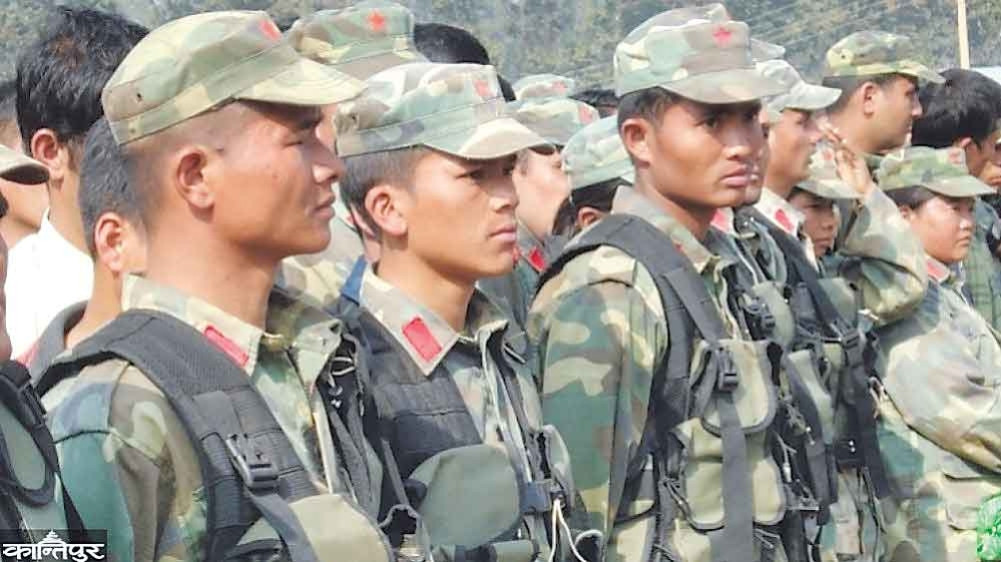
The combatants who were seriously injured in the war, disqualified from the camp, returned home on relief and were discharged are still in some kind of trouble.
We use Google Cloud Translation Services. Google requires we provide the following disclaimer relating to use of this service:
This service may contain translations powered by Google. Google disclaims all warranties related to the translations, expressed or implied, including any warranties of accuracy, reliability, and any implied warranties of merchantability, fitness for a particular purpose, and noninfringement.
About 21 billion has been spent by the state, the Maoist army's combat management is still incomplete. The combat management that started after the comprehensive peace agreement in November 2063 has not yet been concluded. The Transitional Justice Bill was passed by both parliaments and approved by President Ramchandra Poudel on August 13. But the Truth and Reconciliation and Disappearance Investigation Commission has been appointed and the work has not started according to the law.
Due to which, even though the peace process is about to be concluded with the amendment of the Act on Transitional Justice, the management of ex-combatants is still incomplete.
Most of the fighters who participated in Maoist's 10-year armed war with the dream of bringing a 'people's rule' to the country did not fulfill that dream, but recently their daily life has become difficult. Although the Maoists who fought armed struggle participated in the government many times, the task of managing the militants was left unfinished. Dissatisfaction is growing as their daily livelihood becomes difficult for those who have left the camps. The combatants who were seriously injured in the war, disqualified from the camp, returned home on relief and were discharged are still in some kind of trouble.
In October 2060, Lal Bahadur Oli lost both eyes in a clash with the armed police in Bhalubang, Dang. From that day, dark days began for those who went to war in search of the golden light. He returned to the village from the shelter in the camp while other fighters were being adjusted to the Nepalese army. Life was going on. When his wife Sita was diagnosed with cancer five years ago, another fierce battle began for him. which continues even now.
The cancer found in the wife's bones has spread to the stomach. Maybe now we won't be able to win the war against Cannes," he said. Currently living in Tulsipur-16 of Dang, he does not want to remember those days of war. He returned to the village with a relief of seven lakh rupees from the militant camp. "After the peace process, there is only darkness," he said. Currently, with the little help given by his friends, he is being treated for cancer that has spread to his stomach.
CP Sharma, who was injured in an attack on the barracks of the Nepali Army in March 2061 in Rukum's Khara, is unable to move both his legs. With the help of a walker, he can walk a little, he told that life is difficult not only for him, but also for an ordinary ex-combatant. "People's war warriors have neither respect nor facilities," he said.
Rukum Paschim Chowrzahari-6 Rudra Vick is a former fighter who left the fighter camp in Chitwan with five lakh rupees. He is currently working as a security guard in Malaysia. His dream was to participate in the armed war from an early age, to protect the country. He could not study because of the war. He took voluntary retirement without adjustment in the Nepali Army and worked for the party for some time. After that, he went to Malaysia after not being able to make daily living. It has been 6 years since he went to work abroad.
"I didn't want to go to war, I didn't want to stay in Malaysia," he said in a telephone conversation, "I became a people's army out of compulsion, I am doing the work I was brought up in Malaysia out of compulsion." Although there is no reliable data, most of the Gulf countries who took voluntary retirement from the Maoist war were forced to go to the Russia-Ukraine war from Malaysia.
When Dhan Bahadur Giri of Libang-10 of Rolpa was called to understand the current situation of the former militant, he was very upset. "I am now plastering the walls of the house to fill my stomach. "Don't make me angry by talking about people's war," he snapped, "Ask Prachand (Pushpakmal Dahal), Pasang (Nandkishore Pun), Krishna Bahadur Mahara, Varshman Pun." Let me do my work.'
Informing that he was working for the security of Maoist Chairman Pushpa Kamal Dahal for some time after coming to the peace process, ex-combatant Giri and his wife Asha Rana said that they are now living by working in Libang. "I left the Maoist after uncovering my head on the day of People's War," he added. Both had taken voluntary retirement from the Shaktikhor camp in Chitwan.
...
A detailed peace agreement was signed between the government and the Maoists in November 2063. It was decided to keep Maoist fighters in seven main and 21 subsidiary camps. The fighters were able to be filled in the camps designated in various districts from the east to the far west. The number of fighters that the Maoists had publicly said was the number of 'people's army' was not.
Therefore, the Maoists sent the news to the villages that the recruitment in the camp of the Janasena was open. The news was sent that those who come to the camp will get monthly salary and other facilities. According to a former commander of Maoist fighters, "ordinary citizens" from villages entered the camp carrying bags. "When we reached Dawan in Rolpa in November 2063, civilians were entering the camp from villages to become fighters," he said, "The situation in other camps of fighters was also the same." He started training the new fighters morning and evening. Since 28 camps were under the control of the Maoists, he could do whatever he wanted. The United Nations Mission in Nepal (UNMIN) started to monitor the camp only after the agreement between the government and the Maoists on the monitoring of weapons and army management was signed on 22 November 2063.
...
UNMIN registered 32,250 fighters in the camp on May 5, 2066, but only 19,622 fighters were confirmed. 2 thousand 973 infantrymen, 1 thousand 35 were disqualified by Anamin's verification method. 8 thousand 640 were absent in the verification despite staying in the camp.
Chairman Pushpa Kamal Dahal himself revealed the secret of the Maoists bringing the common people to the camp at the Shaktikhor camp in Chitwan. The secret was revealed in December 2014 when a secret video of him addressing a fighter commander was released. How long were you in the camp? To be honest, we were few. We had reached between seven and eight thousand. How much would this verification have left if it had been kept that much? Four thousand,' Dahal said, 'we took 35 thousand and kept it, it came to 20 thousand.' He said that initially it was difficult to verify the fighters and identify them correctly. "It was difficult how to confirm that the fighter verified by Anmin is the same," he said, "Initially, the identity card given was confusing." We started the adjustment by giving a new identity card again.
...
Even though the transitional justice law was passed, the problem of about 4,000 fighters disqualified by UNMIN has not been resolved yet. Former Maoist soldiers are still not satisfied with the TRC law. According to former 'Bal Sena' coordinator Lenin Bist, although there is a provision to give relief to child fighters who are disqualified by law, it is not enough.
'The Act does not cover the interests and concerns of the Children's Army. On the contrary, he has erased our identity,'' he said, 'The case demanding to address the child army by creating a separate mechanism is pending in the Supreme Court.'
"The Commission shall recommend the Government of Nepal to provide compensation with necessary relief and assistance to persons who have died, injured and disabled in any incident during the armed conflict or their family members and displaced persons," the amendment states, "When recommending to provide compensation with relief and assistance to displaced persons, it shall be recommended to provide compensation to displaced persons who have not received any relief, facility or concession from the Government of Nepal until the commencement of this section." It is mentioned that "excluded person" means a person who has not been properly registered in accordance with the Monitoring Agreement on Arms and Army Management 2063 between the government and the Maoists.
...
The then Chairman of the Council of Ministers Khilraj Regmi and Chief of Army Staff Gauravshamsher Jabara presented a tailor's badge to an officer who was transferred from a combatant to the Nepali Army in August 2070 at Military College Kharipati. The army decided to grant officer status to 71 people. One of them dropped out in the middle of training. It was decided to adjust 1 thousand 373 people in posts and other ranks besides officers.
The remaining 18,602 people opted for voluntary retirement. They returned home from the camp after 6 years with a relief package ranging from Rs 5 lakh to Rs 9 lakh depending on their rank. Most of the fighters who have been adjusted in the Nepali Army have no specific complaints. "We are adjusted by our own will. It is a pleasure to have the opportunity to serve in the armed insurgent war and the Nepali army," said retired Lt. Col. Vasudev Ghimire, who joined the Nepali army after being a fighter.
The Ministry of Peace and Reconstruction, which was entrusted with the management and sustenance of Maoist fighters, has been abolished in 2074. The fifty-third annual report of the Auditor General, 2072, has accounted for the expenditure on Maoist fighter management, sustenance, and voluntary retirement. According to the
report, it is mentioned that 20 billion 954 million rupees have been spent on the management of fighters by the said ministry. It is mentioned in the report that 58.87 billion 99 million has been disbursed and spent on the reconstruction of the structures destroyed in the armed war, relief and compensation to the conflict victims. This expenditure does not include the expenditure incurred by other agencies of the government, non-governmental organizations and development partners through other agencies.
...
After the return of Anamin from Nepal in January 2067, 19 thousand 602 fighters who were verified were reclassified by the Special Committee for the Supervision, Rehabilitation and Adjustment of Maoist Army, 2 thousand 456 fighters were found to be absent. On May 30, 2080, the UML Central Committee meeting demanded an investigation into the crores spent on the maintenance of the absent fighters.
A complaint was registered with the Authority in 2070 to investigate this. Although the authority started the investigation in August 2073, it has been postponed recently. On June 7, 2080, Maoist Vice President Krishna Bahadur Mahara said that the Auditor General had audited the expenses of the camp on June 19, 2069 by supporting, falsifying and omitting. On page 259 of the Annual Report of the Auditor General's Office, 2069, it is mentioned that the said audit has already been done.
In the report of the General Accountant, it is mentioned that out of the 553.623 thousand rupees provided to Mahara in 2063/64, 92.25 million 56 thousand rupees were distributed as allowances to fighters and the remaining 461.1 million 67 thousand rupees remained unclaimed and that too was decided under special circumstances. "From the decision of the Council of Ministers on 21st of Baisakh 2069, the expenditure support has been allowed and omitted based on the written submission from the Ministry," the report said.
...
Maoist militant deputy commander and former finance, home, energy, peace and reconstruction minister Janardan Sharma admitted that he could not properly manage the militants after his voluntary retirement. "During the war, the People's Liberation Army had a big dream, but they did not see it fulfilled after retirement," he said. They will suffer, the leader will get an opportunity.'' That's where the weakness happened.'
He said that because of conflicts within the party, it was not possible to accommodate them in Nepal and the Armed Police, so only a few fighters were accommodated in the Nepali Army. "Nepal Police and Armed Police said they would take over the Janmukti Sena," he added, "It didn't work because some leaders of the party didn't agree." The fighters, who were used to following the commander's orders during the war, admitted that the party did not pay attention to them because of the lack of personal management after returning home.
Former brigade commander of Maoist fighters, Prakash GM, said that he is currently saddened by the lack of respectable adjustments in the army, police and armed forces. The question is whether the adjustment in the Nepalese army is honorable or not. There is a complaint that the promotion is not as expected. So, as soon as the time comes, I am going to go on vacation,' he said, 'My friends who returned home from the camp and strengthened their financial situation are fine, friends whose financial situation is weak are disappointed. Even when the party is in government, the disappointed friends could not be given hope.' "The house is ruined when the friends go to war. Couldn't read. It is difficult to eat two meals now. It is also difficult to get normal treatment," he said. "Maoist went to the government time and again. Poorjanamukti Sena was not respected, nor was it easy to make daily living. The fire of this anger seems to increase.'
He said that there is no state policy to financially support ex-combatants. President Dahal and Dr. "This is the ground prepared by Bhattarai," he is angry. Now Purvajanmukti Sena is suffering. There is a danger that the Maoist movement will end tomorrow.' Coordinator of the Army Adjustment Technical Committee and retired Rathi Balanand Sharma of the Nepali Army says that the matter of giving relief to the ex-combatants is complicated.
It is now said that relief will be given to the outcast fighters. Both sides have said that they will provide relief to the war victims. How to find out? I can see that it will be difficult even now. Political consensus is the starting point, not the end. The peace process can be completed only if the TRC law is made right and the right people are elected to the commission. If we keep the appointment on political basis, it will not be decided. If it is to be finalized, a person with knowledge should be selected in TRC. The process had to be right, he said.