Time Firm, which started in 2054 with the production of 8 types of medicines, currently employs 360 people and has an annual turnover of 1 billion 150 million. It has also started exporting medicines by sending them to Hong Kong.
We use Google Cloud Translation Services. Google requires we provide the following disclaimer relating to use of this service:
This service may contain translations powered by Google. Google disclaims all warranties related to the translations, expressed or implied, including any warranties of accuracy, reliability, and any implied warranties of merchantability, fitness for a particular purpose, and noninfringement.
Time Pharmaceuticals, a drug manufacturing company, entered the market on November 2, 2054 with eight of its products. In a period of 28 years, TIME has reached the stage of producing 270 kinds of medicines. Its initial product is 'Cinex'.
It has become a habit to eat 'Sinex' for patients with asthma. Time's beginnings were not easy to expand the market and make a good impact across the country.
The founding chairman and current executive chairman of the company, G Narayan Bahadur Chhetri, tells us that time has been spread because of the fact that he has been moving forward by solving the problem. He is planning to expand the future size of Time. Time's team is preparing to become self-sufficient in drug production and export.
Ji Narayan Bahadur from Pyuthan went to Madras, India for his studies. After studying graduation in commerce from there, he started working as a market representative. "I started my career as a marketing representative (MR) for a pharmaceutical company," said Chhetri. He worked as an MR in India for one and a half years and after returning home in Kathmandu for 10 years. As he wandered across the country, Chitwan kept pulling him.
MR's job and income are attractive. But as I was working, I felt that I wanted to do something myself, not a job," said Chhetri. Many of his friends advised Chhetri, who is an MR of an Indian pharmaceutical company, to do business by importing medicines from there, but he decided to open a pharmaceutical industry.
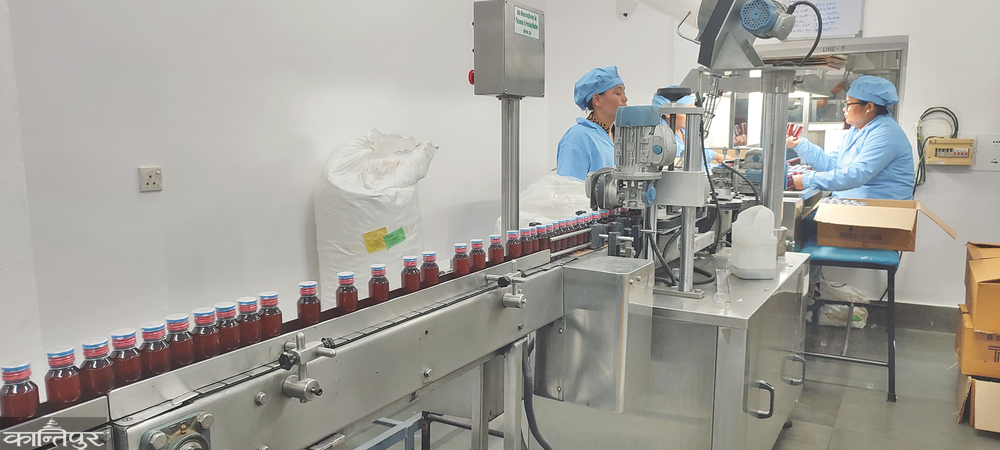
At that time, private drug manufacturing companies in Nepal could be counted on the fingers. One was a government pharmaceutical company. Most of the demand here was occupied by imported drugs. Seeing that, the thought arose that we should open an industry, not an import-based business,'' said Chhetri. Seeing the
demand, he reached the squeeze to open the pharmaceutical industry. The job gave him more experience in medicine. And thinking that it would be easy to move to all directions by placing the industry in the center of the country, Chitwan came down. In search of land, he reached Mukundpur Bhainsakhori in Nawalparasi, 13 km west of Narayangadh Bazar, a little beyond Chitwan. Currently this place belongs to Gaindakot Municipality-10. In 2053, it was not easy to buy land and start an industry. It was difficult to raise
capital. Chhetri said that he invested 10 million rupees at that time to open the industry. At that time, Nepal Industrial Development Corporation (NIDC) gave a loan of 54 lakh rupees. A total of seven partners, including two from Chitwan, raised an additional 54 lakhs.
'We bought land, started production by keeping building equipment. But for the initial three/four years, we also faced difficulties for operating expenses. There was a time when banks did not trust new entrepreneurs,” said Chhetri.
He said that it is getting easier as the medicines that have gone into the market are gaining trust. Chhetri claims that they have not compromised on quality and standards. He said that the Good Manufacturing Practice (GMP) of the World Health Organization (WHO) is being followed. He said that
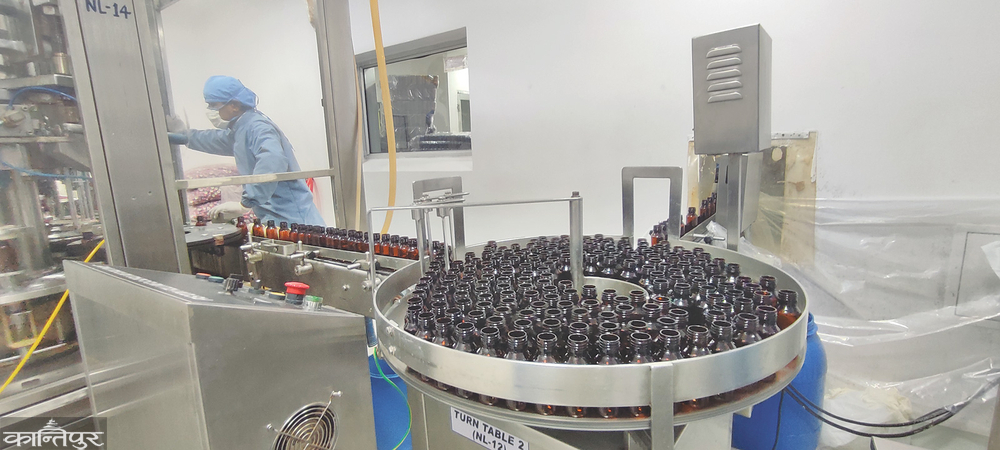
company got GMP recognition 20 years ago. As the company continued to increase the number of drugs, the consumers continued to support it.
We have started production with general medicine. Now medicines for heart and diabetes are produced. Apart from tablets, we also produce ointments, syrups, drops and dry syrups,” said Chhetri, who is also the executive chairman of the company. He said that apart from syringes and vaccines, many necessary medicines are produced in Nepal.
In the meantime, not only the time but also the Nepali pharmaceutical production sector has spread. Time started working in Chitwan, Nawalpur area when there were no pharmaceutical industries. Now there are 14 pharmaceutical industries in this region. There are about 80 drug manufacturing industries across the country.
He says that the capacity of Nepali pharmaceutical industries can meet the demand here to a large extent. But Nepali industries have not been able to run according to their capacity. "If the government provides policy support, Nepal's pharmaceutical companies are capable of producing many drugs right here. They have built that capability. There is no need to import medicines other than vaccines and some special medicines for cancer,” said Chhetri.
He became the joint secretary, general secretary, vice president, senior vice president of the Nepali Pharmaceutical Manufacturers Association and became the national president in 2020. Even now, 50 percent of medicines are imported in Nepal.
It is our demand that whatever medicine is produced in Nepal, we should not import it and let the industry produce it here. If this happens, the import will decrease and the industries here will continue to produce according to their capacity. It will benefit the country," he said. He said that the industry will boost the economy, increase employment and strengthen domestic income.
He said that the national policy to promote the indigenous industry will also motivate the industrialists. He wants Nepal to adopt this policy soon as Bangladesh has taken this policy in medicine production. He suggested that the drug administration department, the regulatory body, should be made agile.
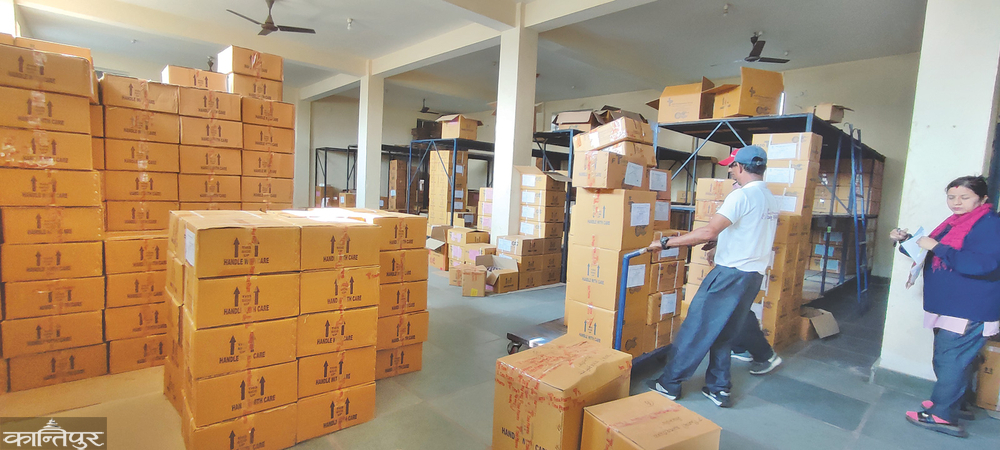
Many raw materials, machine tools and packaging materials have to be imported. "If the import policy is not taken care of, the pharmaceutical industry will be killed. The government should take care of this. It is necessary to discourage the import of prepared medicines, it is also necessary to think so that the import policy of raw materials does not affect the industry, he said. He also said that the industrialists are facing losses due to not making a policy regarding
pricing in a timely manner. Nepali pharmaceutical industries helped well to meet the demand during the corona crisis. The government has realized that these are the industries that are needed in a crisis. Therefore, the government had to protect the indigenous industry," said Chhetri. He said that although the
challenges are many, they are not discouraged. As Time Firma's production spread across the country, employment grew exponentially. Initially 25 people got employment, now there are 360 people. In the early years, drugs worth Rs 80 lakh were sold. Last year's turnover was one billion 150 million rupees. It involves the cooperation of many, the trust of consumers and our patience, perseverance and hard work," said Chhetri. The
industry partners reached 43 people. Currently, Time Pharmaceuticals has become a public limited company. Kshetri said that the IPO is being prepared soon. Time has started to export some amount of medicine during this period. He said that he had sent medicine to Hong Kong and was increasing the amount. He also said that the group of
time firm is preparing to make medicine from Nepali herbs Chutro and Lothsalla. Tonics and diabetes medicines are produced from Chutro and cancer medicines from Lothsalla. He said that they are preparing to produce the raw material of medicine.
We are doing something new. We will bring our products to the market in the coming days to send a message that Nepal is capable of doing such work. Our support will be there to make the country self-sufficient in medicine," said Chhetri. He appealed to the consumers to give priority to indigenous products as Nepali products are of good quality, as the wrong idea that Nepali medicines are not effective is spreading in the market.

