We use Google Cloud Translation Services. Google requires we provide the following disclaimer relating to use of this service:
This service may contain translations powered by Google. Google disclaims all warranties related to the translations, expressed or implied, including any warranties of accuracy, reliability, and any implied warranties of merchantability, fitness for a particular purpose, and noninfringement.
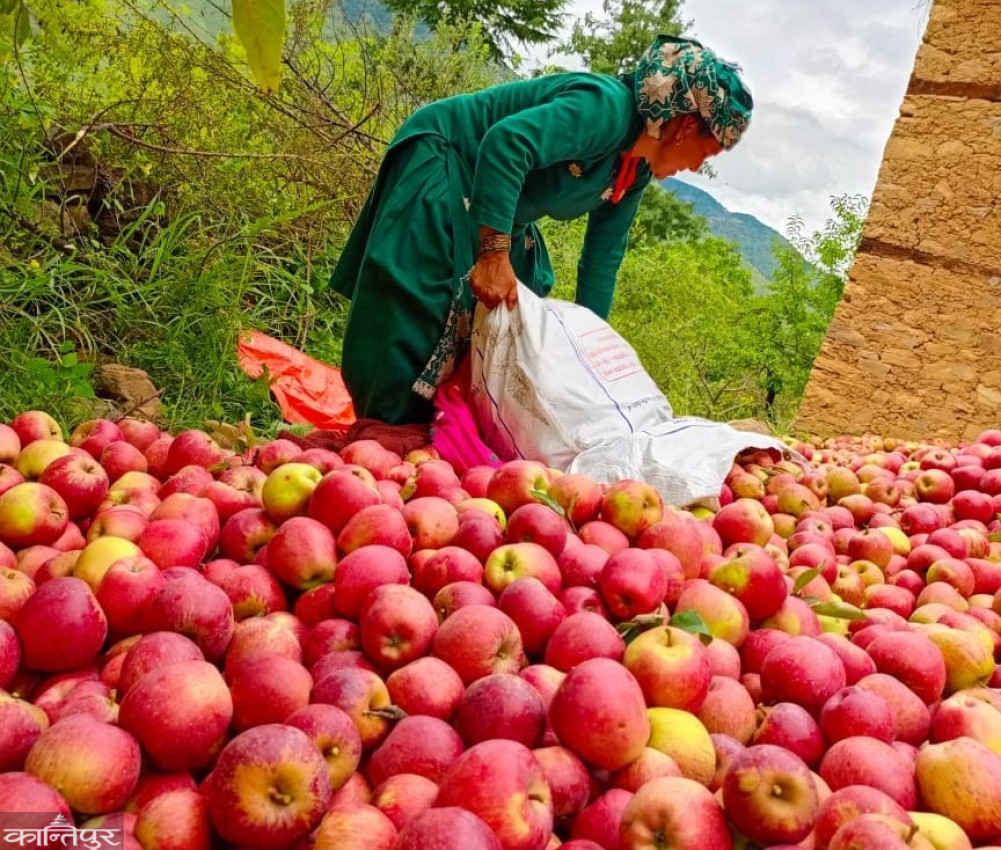
Apples have been cultivated on an area of about 518 hectares in all 7 rural villages including Simkot, the headquarters of Humla. Last year, 4,224 metric tons of apples were produced. But most of the apples did not find the market.
Even though the road reached Simkot, the headquarters in March last year, the Humli farmers were unable to send out apples this year as the transport service was stopped due to rain. "For us, it's just a matter of saying that the road has not been running for 3 months. If we carry it in Khachhad, the whole apple will rot," said Dasharath Rokaya of Simkot Rural Municipality-7 He who planted the saplings complained that the apples produced are rotting every year due to road inconvenience.
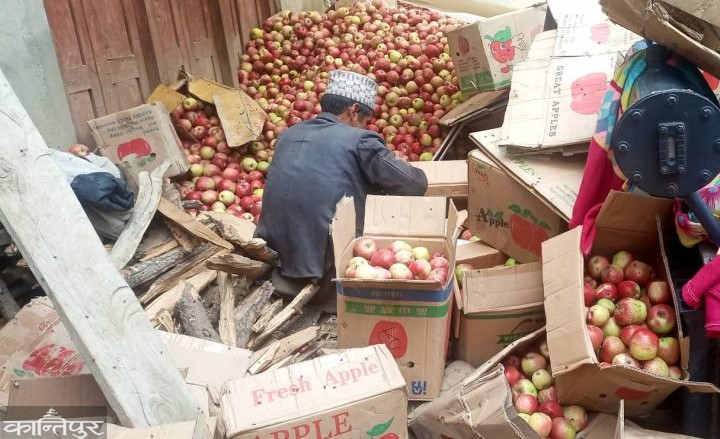
The air fare from Humla to Nepalgunj is Rs 130 per kg and Rs 120 per kg for Surkhet. Nimayangjum Lama of Simkot Rural Municipality-3 Bargauaki said that since there is no market, apples are stored by traditional method and kept for a maximum of 1 month. "No one comes to buy large quantities," she said, "even if they are stored, half of the apples are wasted." According to her, there are about 25 large apple farms operating in Simkot village alone. She said that apples are only sent as koseli to the relatives in the city with the passengers leaving the ship.
Apples are now being sold at Rs 5 to 10 per piece in Humla. Even if the apples produced in the district can be sent to the Chinese city of Tibet, Humli farmers will become independent from apples, said Namgyal Tamang, the former president of the Humla Industry and Commerce Association. Even in Dolpa, where apples are grown on 412 hectares, most of the apples are rotting. Ganesh Adhikari, head of Agricultural Development Office Dolpa, said that although apples were produced in 3,696 hectares last year, barely 500 quintals of apples found market. "There was a problem when the road was closed during the season of apples," he said.
There is a problem in delivering apples to the road even from the upper parts of Tilagufa municipality in Calikot. "Apples have grown well, but there is a problem in delivering them to the road," said Dhan Bahadur Shahi, a farmer from Chilkhaya. He said that this year only 300 quintals were produced due to hail damage. To carry the produced apples to the Karnali highway, the transporter has to pay 10 rupees per kg from here.
Farmers of Foimahadev, Chilkhaya, Rachuli, Juwitha, Chapre, Odanku of Mahavai, Gela, Mugraha, Sukatiya and Bharata of Subhkalikot have been doing commercial sugarcane farming for a few years now. Farmer Parek Bahadur Shahi of Juwitha expressed his grief that although the vehicle can reach the village in winter, the road is blocked during the apple season. "Traders come to Jumla with their cars, even here, all the apples go out after twelve months," he said, "we have the same problem in the market, it's hard to get a price." He complained. He says that apples are sold at 45 rupees per kg in the village. 5 thousand 860 tons of apples were grown last year in 605 hectares of apple cultivation in Kalikot.
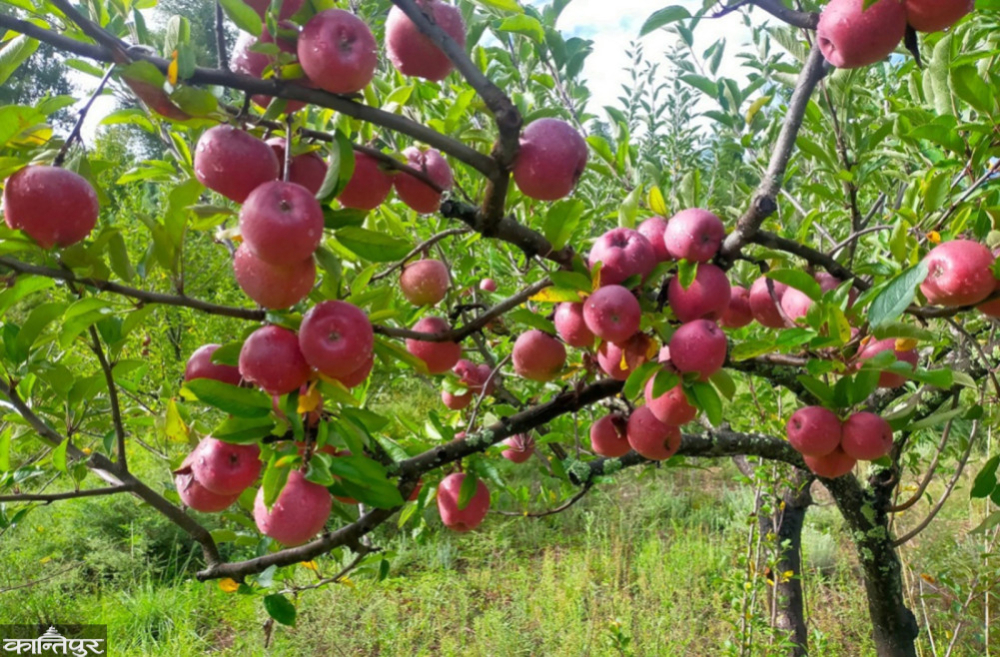
There is data from the Ministry of Land Management, Agriculture and Cooperatives that apples are being cultivated in an area of 3,419 hectares in all districts except Surkhet in Karnali. According to the ministry, 31 thousand 112 metric tons of apples were produced last year, and it is estimated that the production will be around the same this year, said Dhan Bahadur Kathayat, the spokesperson of the ministry. According to him, due to storage problems, lack of grading, road inconvenience, problems in packaging, there is a problem in getting Karnali apples to the market and getting a good price. Farmers As
, they have not been able to get the market and the price, the farmers sell apples at 50 rupees per kg, the price is up to 125 rupees in Surkhet and 250 rupees in Kathmandu,' he said, 'because of lack of systematic marketing, farmers are suffering from low prices and high prices to consumers. The benefit is only for wholesale traders and middlemen. Last year, when 1 thousand 181 metric tons of apples reached the market, there was a turnover of 33 million 15 million rupees. n
Trucks carrying food and construction materials from Surkhet and Nepalganj now return loaded with apples from Jumla, Mugu and Kalikot. Naveen Sharma, an agronomist, said that most apples of 'Royal Delicious', 'Red Delicious' and 'Golden Delicious' varieties are cultivated in Karnali. But he says that the farmers who have grown apples through hardships throughout the year are suffering due to lack of market, storage and packing problems. "Due to the transportation problem, the farmers did not get a good price, nor did the consumers get cheap apples," he said, "only the middlemen are taking the benefit."
For the past two weeks, Mugu farmers are also busy picking apples. Mahtara, who lived in Chaya Natharara Municipality-4, said that he was clearing the garden to send apples to the market for Dasain. He has sent 4 truckloads of apples to Surkhet and Nepalgunj for sale. So far, he has earned 160,000 rupees by selling apples at 50 rupees per kg, and he still has 2 truckloads of apples left. A truck carries 80 quintals of apples. Now he is not only Talch, Maitulek, Ghattalekh, Bam, Foipata,
Farmers of Darkhyalbada, Jhapagard, Mathitum, Pina, Jhayari, Kotila and other villages are busy picking apples. "After the road facility in the apple orchards, the transportation has become easier," said Bam Bahadur Mahatara, a farmer of Lalch, "The demand for apples for Dasain has increased, but still we have not been able to get a good price."
Some mango farmers had sent raw apples to the market since the last week of July, fearing that they would not be sold. Karna Bahadur Mahtara, a local farmer, said that even though juicy and sweet apples will be produced after August 15, fearing that the apples will not be sold, some apples have to be sent out in July. "Half of the apples were sent to the market raw," he said.
In Karnali, about 12,500 metric tons of apples are produced in an area of about 3100 hectares in Jumla. Now there is a wave of apple cultivation in the villages of Jumla. Meen Bahadur Bhandari of Guthichour rural municipality-5 of Jumla has built an apple orchard for 3 years with an investment of about 22 million rupees. Last year, 80 metric tons of apples were grown in his garden, where he planted about 48,000 seedlings. He said that traders used to go to orchards to buy apples. The farm aims to produce 200 metric tons of apples this year. Apples of Fuji, Gala, Kinrad, Golden varieties are being produced in his garden.
Tank Giri of Guthichaur-3 also built an apple orchard of 14,000 plants in 22 hectares with an investment of 7.5 crores. "Earlier there was no road, when apples could not be delivered to the market, it was cattle feed," he said. Owner Dharma Bhandari said that 2,800 plants have been planted in the garden, which was built with an investment of about 1 crore. According to him, there are 40 farmers in the group. According to the data of the District Agricultural Development Office, about 30 million rupees have been invested in these 3 gardens alone.
Jumla was declared an organic district in the year 2057 by the 14th District Council of the former District Development Committee. In the same year, the concept of 'One House : One Apple Orchard' was also introduced. In Jumla, out of 19,000 households, about 16,000 households are cultivating apples, according to the data of the District Agriculture Development Office. Farmer Manprasad Neupane said that now apples are being sold at 50 rupees per kg in Jumla. He complains that the importance of jumli apple is decreasing due to proper storage and management. "Jumli apple is the identity of Karnali," he said, "but the government did not help in marketing, storage and cultivation."
When the Karnali highway was repeatedly blocked, this year too, about 100 trucks carrying apples stopped on the road for 2 weeks. "The closure of the road is our destiny for years," said Karna Bahadur Budthapa, a businessman from Jumla, "even if the vehicle is stopped for 1 day, millions of apples rot." Now he is buying apples from farmers at Rs 50 per kg. Delivery to Surkhet and Nepalgunj including purchase of cartons and vehicle transportation will increase the cost by 20 rupees per kg.
He complained that he had to sell apples for 100 rupees even though he rented them at a cold store in Nepalgunj. He says that there is a problem because Indian apples are also being sold at Rs 120 per kg. According to him, Jumli apples, except those kept in cold storage, expire after Dasain-Tihar. Another businessman, Manoj Bohora, said that apples costing Rs 50 in Jumla are sold for up to Rs 250 in Kathmandu. "There is a difference of 200 rupees between the consumer and the farmer, 50 to 70 rupees are spent on transportation, packaging and grading," he said Tikaram Thapa, secretary of the Ministry of Agriculture of Karnali Province, said that 15 percent of the market is cultivated on an average. He says that Karnali apples are organic because no chemical fertilizers, chemical pesticides and any other chemicals are used. He says that if attention is paid to quality products, grading, labeling and packaging, the demand in the international market will also increase. He informed that there was a problem in the production due to the infection of Lykira, Zhusilkira and the disease caused by the disease in apples recently.