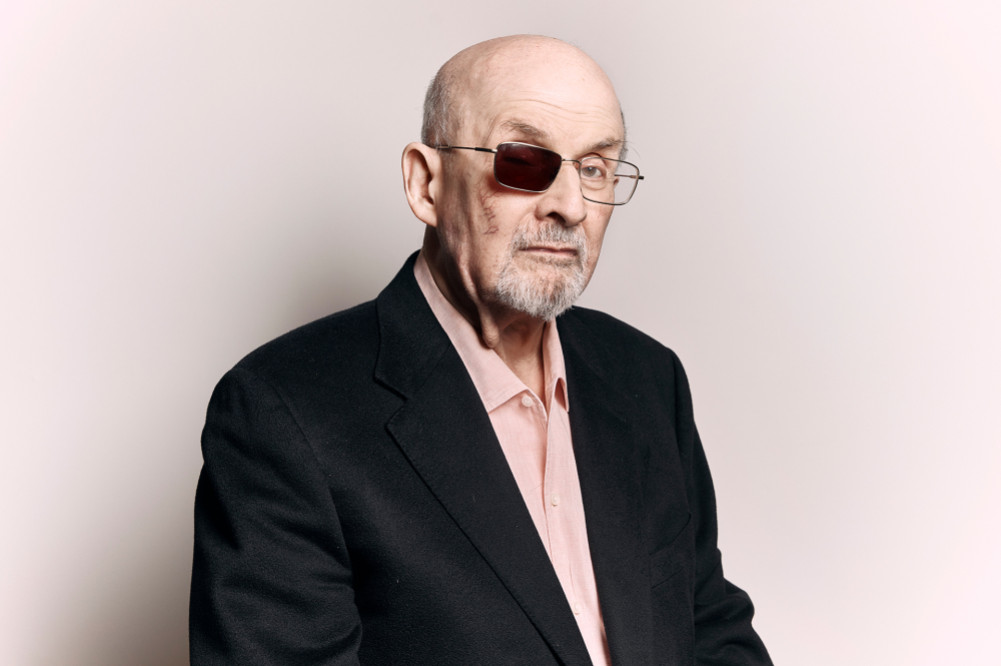
Author Salman Rushdie has released a book, Knife: Meditations after an Attempted Murder, about the attack on him two years ago, in which he writes about the knife attack and the ordeal that followed.
We use Google Cloud Translation Services. Google requires we provide the following disclaimer relating to use of this service:
This service may contain translations powered by Google. Google disclaims all warranties related to the translations, expressed or implied, including any warranties of accuracy, reliability, and any implied warranties of merchantability, fitness for a particular purpose, and noninfringement.
After the Iranian government set a price on his head for writing a novel, world-famous author Salman Rushdie went into hiding for years. After more than a decade of boring life, Rushdie thought one day, ``Oh, I have to live my own life.'' After that, his daily life changed. Gradually he became active in social activities.
And, appeared in the literary program confidently and without any security. The day of August 12, 2022 came to Rushdie's life very terribly, like a fleeting dream.
Rushdie stood on stage to speak at a literary event held in New York City, USA. He was on the show for an interview with Ralph Henry Ridge. But before the dialogue, there was a terrible attack on Rushdie. Hadi Matar, 24, from New Jersey, USA, stabbed Rushdie in the stomach and neck at least a dozen times with the intention of murder. Rushdie fell to the ground immediately after the
ing attack. He was immediately taken to a nearby hospital by helicopter after people present at the event reached the stage and picked him up. After a seven-hour long operation, information about his health condition was released. The news is not good. "Salman may lose one eye," said Rushdie's agent, Andrew Weil, "the veins in his arm have been severed and his liver has been damaged by stab wounds."
During the treatment, Rushdie spent 18 days in the hospital and three weeks in rehab. At that time, a surgeon told Rushdie, "You are actually lucky and unlucky." At that time, Rushdie asked - lucky in what sense? "The person who attacked you did not know how to kill a person with a knife.
As the doctor said, Rushdie was revived because he was lucky. But ironically ∕ Amet was forced to carry the wound. He lost the sight of his right eye due to a severe injury to his liver in the knife attack. One of his hands was unable to do any work. Matar, who was arrested by the police after the attack, has been charged with second-degree murder. After his recovery, Rushdie released his first novel, Victory City, in 2023. However, he was already preparing for writing the book. In the book, Rushdie tells the story of a woman who rules a city in the 14th century and challenges the patriarchal society.
Rushdie has recently launched a book on the life-threatening attacks of 2022. And, its name is, 'Knife: Meditations after an Attempted Murder'. In the book, Rushdie details the knife attack and the difficult days that followed. In particular, it is not limited to that. In it he wrote about his life. He raised the issue of his marriage and children. And, it mentions a new version of the life of Rushdie who survived the death.
Rushdie mentions the dialogue between himself and the attacker in 30 pages of the book. Rushdie says that the imaginative dialogue is the funnest part of the book. In the book, he did not write the name of the woman who stabbed him. He referred to the attacker as 'A'.
'He is only a 24-year-old person. He should have known he was going to ruin his life and mine. But he was ready to kill,' says Rushdie, 'he is a person with no criminal background and was not on any kind of terrorist watch list.' Rushdie said in an interview with the Guardian. But Rushdie says he changed his mind after studying the Paris knife attack.
At the end of the trial, Samuel Beckett, the victim of the incident, asked the assailant why he stabbed me. But the answer he got from the attacker was, 'I don't know. But please forgive me.' Then Rushdie says that he thought it would be appropriate to imagine and write the dialogue.
The attacker Matar gave an interview to the American newspaper New York Times from prison. In it, he claimed that 'Rushdi is a person who attacks Islam'. Matar said that he was surprised that Rushdie managed to survive even after the attack.
Rushdie has nearly five decades of experience in literary writing. He was born on June 19, 1947 in Bombay (now Mumbai), India in a Kashmiri Muslim family. Ahmed Salman Rushdie, who came to Britain in 1964 to study, later became a British citizen. After becoming a British citizen, he renounced the rituals of the Muslim religion. Rushdie, who worked in advertising, also spent some time in campaigning. But after not much in the field of acting, he turned to literature.
brought the first book 'Grimus' to the market in 1975. But the book was not as successful as expected. However, in the eyes of critics, he was regarded as a 'potential writer'. Six years after writing the first book, his second work 'Midnight's Children' came out. It not only made him forget the failure of his first book, but also won him the Booker Prize. The book, which Rushdie spent five years preparing, sold more than one million copies in Britain alone at the time. After writing 'The Satanic Verses' in 1988, his life took a new turn. Several people associated with Islam threatened him with death for blasphemy in the book. Because of this, Rushdie's daily life changed.
The book caused an uproar around the world for disrespecting Islam. He was forced to stay underground for 9 years to save his life as the controversy and anger grew. The British government began keeping Rushdie under police protection. But as the controversy over the book intensified, the 'literary world' seemed to be divided into two lines. The Muslim world, which stood against Rushdie, began to react strongly to the author and the book. However, the West was in favor of Rushdie. Writers and intellectuals in the West protested against the threat posed by Muslim fundamentalists to Rushdie as a threat to freedom of expression. They claimed that the novel was ultra-realistic and postmodern and that it did not blaspheme.
Rushdie's life-threatening book 'The Satanic Verses' was published in September 1988. The Muslim community objected to the content raised in the book as anti-religious. As a result, Rushdie's native India was the first to ban the book. After that, various Muslim countries including Pakistan and South Africa also banned.
However, the novel was highly praised in Western countries and won the Whitbread Prize. This further angered the Muslim community and street protests began. Muslim clerics began to interpret it as an 'insult to Islam'. They objected to several themes mentioned in the book.
The Muslim community became very angry when the names of the two characters depicted as sex workers in the book coincided with the names of the two wives of the Islamic leader Prophet Muhammad. Similarly, the name of the book was associated with two verses that Muhammad had removed from the Koran because he thought he was influenced by demons. In 1989, the year after the
book was published, Iran's supreme leader, Ayatollah Ruhollah Khomeini, issued a fatwa to kill Rushdie. The fatwa called for the killing of all those involved in the publication of the book, while it was mentioned that those involved in the murder of Rushdie would be rewarded. Khomeini put a price on Rushdie's head at US$3 million. The book also caused strain in diplomatic relations between the West and Iran. There were attacks on the British embassy in Tehran, the capital of Iran. Britain and some Muslim leaders called for it to be amended. The US, France and other Western countries condemned the death threats against Rushdie. Some supported Iranian Supreme Leader Ruhollah.
In January 1989 in Bradford, UK, Muslims protested and burned a copy of the book. In the months that followed, several people died in protests against Rushdie. Muslims picketed the London office of book publisher Viking Penguin and sent death threats to the New York office. But the book became a bestseller in both countries. The country, which belongs to the European Economic Community (EEC), supported the protests against a response by Muslim extremists and even temporarily recalled its ambassador from Tehran.
Rushdie, who had been hiding with his wife, apologized deeply for the hurt caused to the Muslim community until then. Rushdie has denied the charges of blasphemy. Rushdie claims that his novel primarily deals with the immigrant experience. But Iranian leader Khomeini continued to call for Rushdie's assassination.
In February 1989, Muslims staged a massive protest against Rushdie in Mumbai. During the demonstration, 12 people were killed in police firing. More than three dozen were injured. Similarly, 3 people were killed in a clash with the police during a protest against the book in Indian-administered Kashmir. At least 100 people were injured.
Six people lost their lives in the violence outside the US Information Center in Islamabad, Pakistan. 83 people were injured in the incident. When Iran's Supreme Leader Ayatollah Khomeini called for Rushdie's assassination in 1989, Abdullah Bukhari, the Shahi Imam of Delhi's Jama Masjid, also supported him. Even when he later came to Mumbai in 2004, Muslims strongly opposed Rushdie.
Not only did author Rushdie face threats because of the content of 'The Satanic Verses', the book's Japanese translator, Hitoshi Igarashi, was found dead in July 1991 at the University of North East of Tokyo. Hitoshi, an assistant professor of culture, was stabbed several times and left. In 1991, Italian translator Ettore Crapiolo was also stabbed. But he managed to save his life.
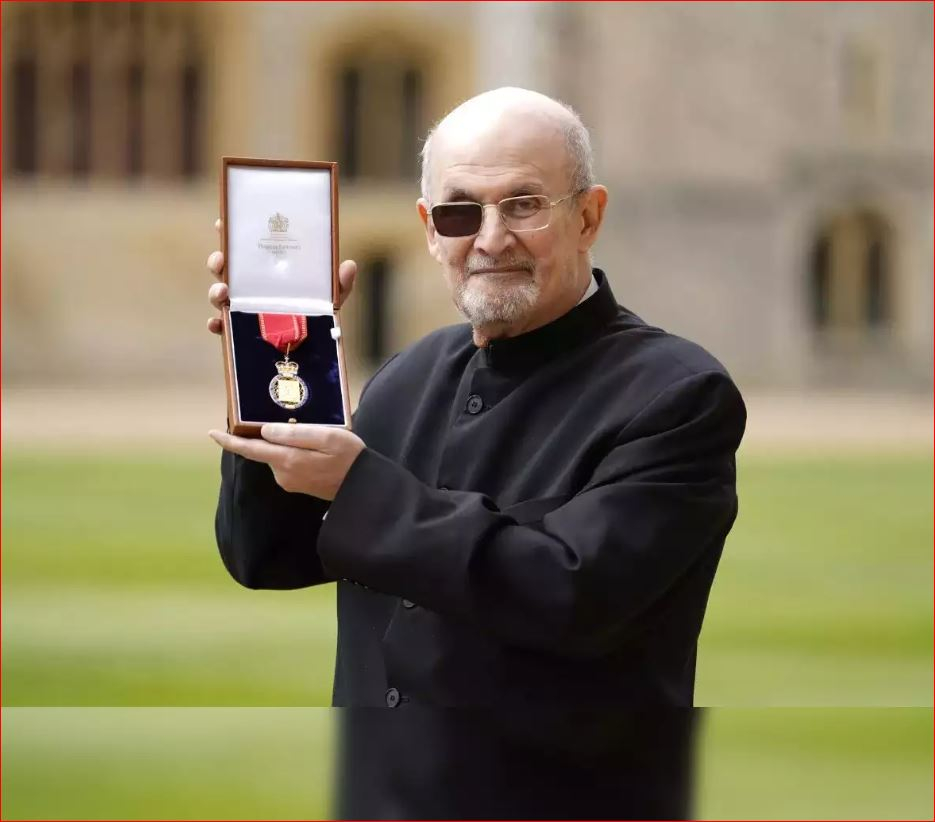
Rushdie has been married four times and has two children. He has been living in America since 2000. Rushdie has been knighted by the Queen for services to literature. Even when he was knighted in 2007, there were protests in Pakistan and Iran.
He has also written a memoir entitled 'Joseph Anton', focusing on the fatwa and controversy after the publication of 'The Satanic Verses'. Rushdie, who picked up the Indian story in 'Midnight's Children', wrote about Pakistan in his third novel 'Same'. Rushdie's 'Harun and the Sea of Stories', 'The Moor's Last Sai', 'The Ground Beneath Her Feet', 'Fury', 'Salimar the Clown', 'The Enchantress of Florence', 'Two Years at Months and Twenty' Eight Nights', 'The Golden House', 'Quixote' and other works have been published.

(with the help of agencies)