The growing trend of double entendre songs has sparked questions and debate about creative freedom, social responsibility, and the impact on the younger generation.
We use Google Cloud Translation Services. Google requires we provide the following disclaimer relating to use of this service:
This service may contain translations powered by Google. Google disclaims all warranties related to the translations, expressed or implied, including any warranties of accuracy, reliability, and any implied warranties of merchantability, fitness for a particular purpose, and noninfringement.
Nepali songs and music, which tell stories of society’s pain, love, struggle, and change, are now mostly caught up in the competition for views, virality, and market share. The use of double entendre, provocative presentations, and the race for cheap popularity have further intensified the debate between creative freedom and social responsibility.
Just a few days ago, Durgesh Thapa’s song ‘Masterni’ reached millions of viewers immediately after its release. The characters and double-meaning words used in it drew increasing criticism. Social media became divided into supporters and opponents. The Nepal Teachers’ Association even had to issue a statement, saying the song had harmed the dignity of female teachers.
After much controversy over the song, Durgesh apologized to the audience and removed the video from his YouTube channel. However, TikTok and Facebook users can still be seen making TikToks and reels using the same song.
This is just a representative example; in recent years, there has been a growing trend of such songs in Nepali music that society and families find hard to digest, with many becoming ‘viral’.
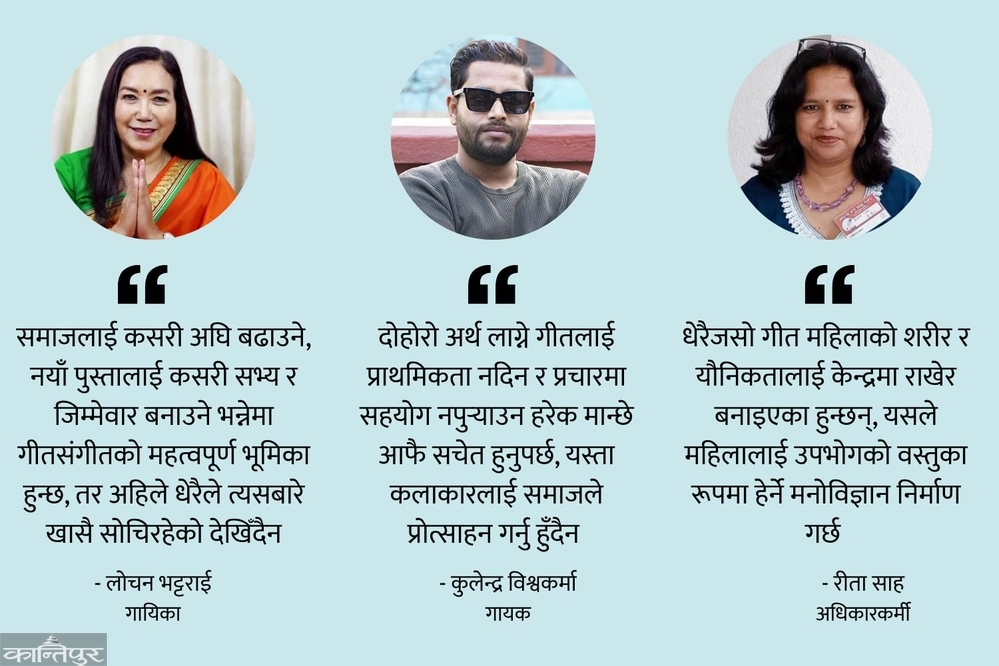
Singer Lochan Bhattarai says that some songs nowadays are made with a market-oriented approach and the aim of quickly gaining popularity. “In our time, songs were recorded only after devotion, practice, careful word selection, musical study, and hard work. Now, double-meaning words are being used more and more to gain quick popularity,” she said. “The main reasons are views, popularity, and money. Many people now want to go viral instantly and be recognized. We had a passion and interest for art. We didn’t care if everyone knew us.”
She feels that, under the pretext of momentary success, all kinds of creations are being made. “Music has a deep impact on society. It affects not just the artist but also social civility,” she said. “Music plays an important role in how to move society forward and how to make the new generation civilized and responsible. But nowadays, not many seem to be thinking about that.”
She believes that artists have the power to bring about change in society. “A song is not just a joke. Music and literature are the carriers of society. They can guide society on which path to take,” she said. “Art, literature, and music have the power to bring about change in thought and consciousness.”
She compares the impact of music to slow poison. She says that music can negatively affect children, increase social distortions, and even lead to a rise in violence against women.
According to musicians, this trend is not limited to a single artist or song. The competition to attract a large audience in a short time on digital platforms is changing the words, presentation, and themes of songs. But there is growing concern that its impact is not limited to popularity alone, but also affects society and the thinking of the new generation.
Singer Kulendra Bishwakarma says that the messages conveyed by music are of great importance for the coming generation. “The reason for the use of double meanings in some recent songs is the desire for quick popularity, YouTube views, and especially to make money,” he said. “Such songs have the most negative impact on the new generation and young children. We need to think about what kind of message songs with wrong meanings are giving.”
He says that everyone should be aware not to prioritize or help promote songs with double meanings. “But such songs are still getting space. It is unfortunate to further promote artists by associating them with big stages, platforms, and brands. This encourages negative trends and expands negative influence in society,” he said. “Therefore, society should not encourage such artists.”
He says that when creating songs, one must consider the impact they will have on society and many other factors. “Songs can express the pain, sorrow, love, affection, and real emotions of people’s lives. Such creations also convey messages and quickly reach the general public,” he said. “Excellent songs can be created in literary, dignified, and socially acceptable language as well.”
He says that since music is a medium that all family members can enjoy together, creators should use themes and language that people of all age groups can easily watch, listen to, and accept.
Along with the debate over the language of songs, questions are also being raised about the perspectives they create in society. Especially regarding the portrayal of women, depiction of gender roles, and double standards, activists have been raising their voices for a long time.
Women’s rights activist Rita Sah comments that patriarchal thinking is increasingly evident in today’s songs. “Our society, state, and family are influenced by patriarchal thinking, structures, and values. This is reflected in films, songs, and even jokes,” she said. “In films, women are presented as weak and in need of male protection, while most songs are made focusing on women’s bodies and sexuality. This creates a psychology of viewing women as objects of consumption.”
She says that double standards are applied to men and women in music as well. “In one song, if a man flirts with his sister-in-law despite having a wife, society easily accepts it,” she said. “But if a woman sings about her brother-in-law in the same style, she is called characterless. This very double standard shapes society’s attitude towards women.”
She says that, nowadays, there is a trend in music to focus more on the market and objectification of women rather than creative expression. “The trend of making songs centered on women’s bodies, making them go viral, and profiting financially is increasing,” she said. “The controversy over songs like ‘Masterni’ also shows this trend. Such content is being produced because of the belief that society likes it.”
She says that repeatedly listening to a song can make its message seem normal, and this risks normalizing violence and inequality in society. Sah says that the increasing objectification of women and provocative visuals in songs is a matter of concern.
Leaders in the music sector say that it is not enough to blame only the artists for the continued production of such songs. According to them, the digital market, commercial pressures, and lack of effective regulation have also encouraged this trend.
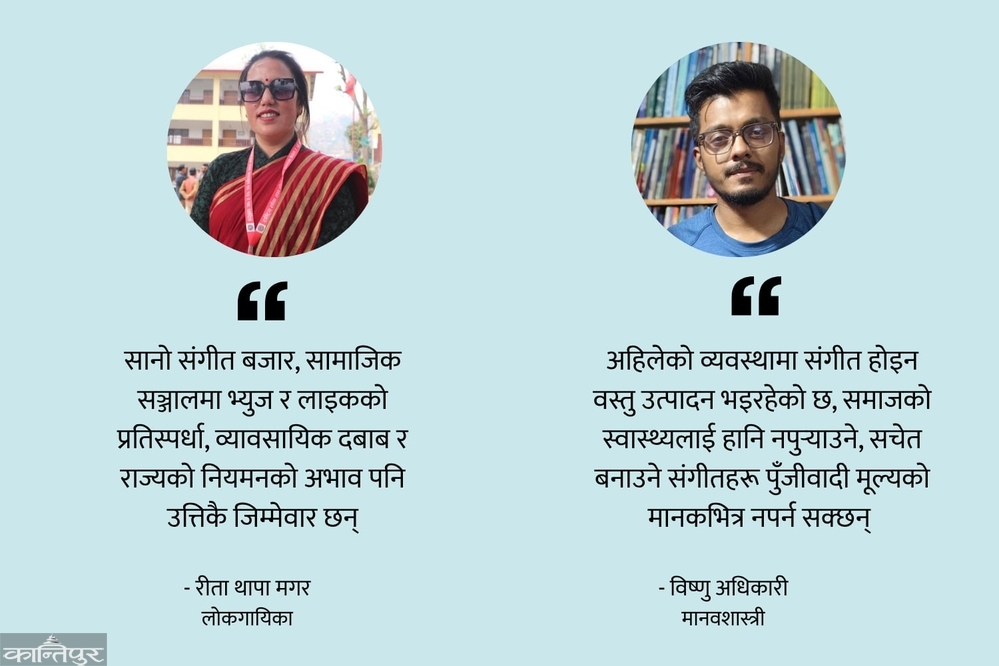
Rita Thapa Magar, president of the National Folk and Duet Song Academy, says that the lack of concrete state policy has led to arbitrariness in music. “The increase in double-meaning songs is not just because of the artists. The small music market, competition for views and likes on social media, commercial pressures, and lack of effective state regulation are equally responsible,” she said. “Artists want to sell and survive in the market, but losing originality and morality in the name of popularity is ultimately harmful for Nepali music. There is no concrete state policy to promote good creations, discourage distortions, and ensure effective regulation.”
She says the Academy has approached the government many times to control vulgar and obscene content seen on digital platforms and public stages. “The Academy has been coordinating with the Ministry of Home Affairs, Cyber Bureau, and Ministry of Culture, Tourism and Civil Aviation, demanding legal action against those who make obscene, vulgar, and sectarian songs,” she said. “We met with them and informed them about the opportunities, challenges, and overall situation of the Nepali folk and duet music sector.” She says that to save the future of Nepali music, equal responsibility is needed from artists, listeners, and the state.
Sociologists, however, do not see this change as a problem of music alone. According to them, music does not exist separately from society. The impact of changes in society, technology, and the market is naturally reflected in the themes, language, and presentation of songs.
Tribhuvan University sociologist Menuka KC says that today’s music has become a medium for momentary entertainment. She believes the new generation is becoming more self-centered than concerned about the impact of words on society. “Today’s society is more self-focused than upholding tradition, where the new generation prioritizes their own happiness,” she says. “To immediately grab the audience’s attention and go viral on social media, more songs with double meanings or teasing content are being made.”
She says that songs represent the society they come from. Therefore, making topics that society cannot easily accept, that are indigestible or send the wrong message, seem normal in the name of entertainment can especially affect the language, thinking, and behavior of the new generation. “The pain and struggle heard in old songs reflected the experiences of the generation from about 40 years ago. Since then, the field of education has expanded in society,” she said. “After the government adopted policies prioritizing women’s education, their awareness increased, which has also led to gradual changes in the themes of songs.” She says that in the past, when living in joint families, songs of sorrow were created due to the pressures daughters-in-law faced and the freedom they experienced only when visiting their parental home, but now songs of freedom are being played, which is positive.
Looking at the list of controversial songs in recent years, it is clear that this debate is not new. The difference is that with the expansion of social media, such songs now reach millions within hours, and both support and opposition are seen rapidly. This has made the debate between creative freedom, social responsibility, and market influence even more complex.
Last year, the song ‘Bistarale Polyo’ sung by Shantishree Pariyar also became controversial. Shantishree issued a statement apologizing to the audience and the Duet Song Academy. Kumar Basnet’s old song ‘Aama Bhanda Chhori Taruni’ is also frequently discussed. Although it was seen as entertainment and humor at the time, researchers say that as society has become more aware and stronger regarding identity, equality, and gender consciousness, those songs also need to be analyzed.
Anthropologist Bishnu Adhikari comments that creating music in the current system is like producing a commodity in the capitalist production cycle. “In the past, during the feudal system, songs praising kings and deities were mainstream, but in the current system, it is not music but commodities that are being produced.”
He says that although music is not completely separate but a part of our overall social system, the purpose and method of creating music differ in each system. “Here, the social, cultural, and aesthetic value of songs ends, and a new standard is set based on how much money and attention is gained through views, watch time, shares, etc.,” he said. “Creators make music for that value. For this, the use of vulgar and double-meaning words in songs has become an easy way.”
He is concerned about the irony that conscious songs are not discussed under capitalist values. “Creators are products of this very economic-political system,” he said. “But only politically conscious creators can produce music that does not harm society’s health, that raises awareness, and that inspires hope, but such songs may not fit within the standards of capitalist values.”

