The song included in the street play 'Batibato' has generated widespread debate and reaction on social media, along with the support of millions of viewers.
We use Google Cloud Translation Services. Google requires we provide the following disclaimer relating to use of this service:
This service may contain translations powered by Google. Google disclaims all warranties related to the translations, expressed or implied, including any warranties of accuracy, reliability, and any implied warranties of merchantability, fitness for a particular purpose, and noninfringement.
The group of playwright Akanksha Karki has not done plays before. For about 8 years, 'Katha Ghera' has continuously staged many plays on stories from the stage opened on the roof of Teku. However, when the group toured the Far West and Karnali with the traveling street play 'Batibato', this group became viral. The same song sung in the street play! This song also made the group famous on social media.
People have to go to the open air, to learn to swim
You can't go home until you cross the four walls
Before daughter, old woman, daughter-in-law, mother, goddess
Manche ho mahila, manche ho mahila…
The song containing the words that women are human beings sometimes brought Akanksha's group to the height of discussion, sometimes to the height of hatred. However, on this journey, Kausi had to listen to abusive words as she quickly gained the love of the audience.
According to Akanksha, this song came into the limelight from the show in Baitadi. 'I shot that video in Baitadi.' The video, which was shot on a regular mobile phone, got one million views,' Akanksha says. Then the video of the same song went viral on Facebook. Until then, when it received millions of views, the video was receiving praise. Some even accused it of being a 'religious preacher.'
The song has amused those who think that there is equality between men and women. Moreover, as soon as they came to know that this play was made under the 'Grape Two' project, they started criticizing the group by calling it a 'development play'. 'People are so disgusted with the development organization that it also spilled over into us.' But, that does not mean that the artists do not have creative freedom,' says Akanksha, 'We were free to make all the decisions of this play.' But we were bullied on social media as those who convert us to religion, Amen.'
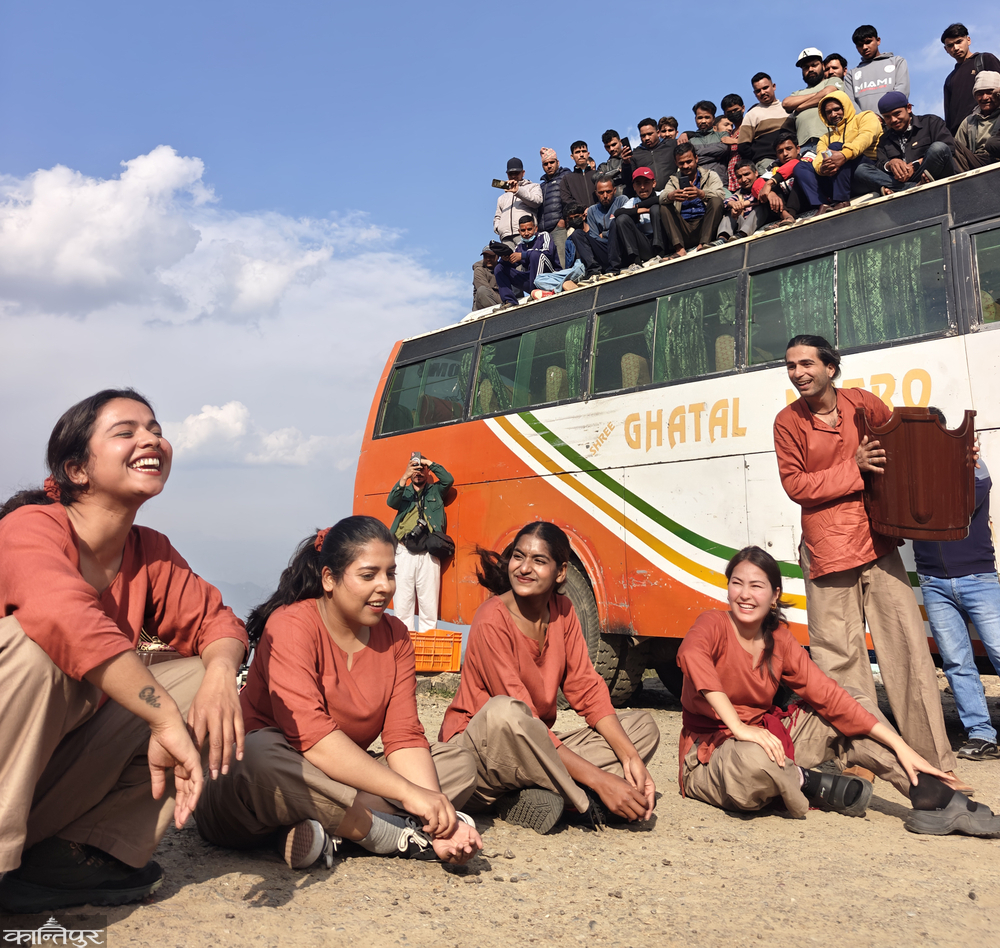
The insults that 'they came to break women' are all over the comments. 'They came to shatter women's civilization. Those who destroy Hindu religion, those who destroy heritage, what-not. They also insulted us as those who started Meetu.' We are not able to fight this group,' said Akanksha, who has just returned from a trip.
Akanksha does not find any rhyme in these insults. The reason is that their group purely wanted to do a play to raise public awareness about women's entrepreneurship and equal opportunities. Despite being a development project, the group has started its journey by turning women's issues into a play in an honest way. The group has returned to Kathmandu after completing the journey that started from Dhangadhi in Kailali to Salli Bazaar in Salyan since Chaitra 11. The group has started its journey by accepting the topic of making a play under the 'Grape Two' project.
The project leader under the 'Grape Two' project is Akanksha. Their group got this project by applying to the non-profit organization GIZ.
'Batibato' is directed by Sudam CK. This 1-hour play raises issues of women's entrepreneurship and empowerment. Many songs have been included to make the play enjoyable. Not only 'Kholi Tarawar', but also the song about making pickles is in the play.
Before including women's stories in 'Batibato', Sudam remembered his mother and sister many times. Sudam wrote the story of 'Batibato' by observing the stories of the female characters connected to his life, their experiences and strengths. Artist Venisa Acharya assisted in writing the story. Venisa collected the stories of women who are doing business in the corners of Nepal, whether they are women who make dunatapari or women who do pickle business. Then the story of the play was prepared by including women's issues and struggles. While telling the story of women in the play, director Sudam has understood the importance of such menial work done by women, which was previously considered normal. 'Neither in the family nor in society, there is talk about the work done by women.' That is why sometimes we ignore those works, said Sudam. Sudam has also seen women's struggles and the fight for coexistence up close.
When the women-led Katha Ghera (Kaushi Theatre) was opened, the male-dominated theatre did not accept Akanksha's presence for a long time. Sudam had seen the work and effort Akanksha did to prove her existence every time. How many times did Akanksha burn with anger when she had to prove herself all the time. 'How angry are you?' When her own friends kept saying this, Sudam wondered how this society would have viewed a man who was angry like this? Society cannot see a woman who is angry!
'In a way, this is how I came to understand women's issues and patriarchal thinking. The same topic is in Liars, in every way,' Sudam said.
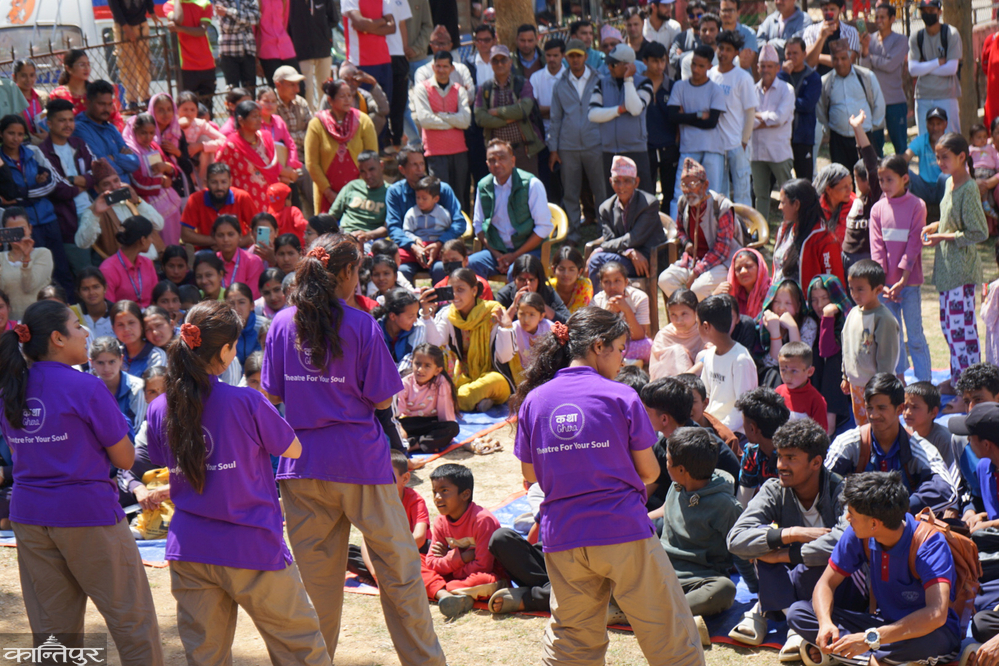
The crowd of spectators gathered at the clock tower in Surkhet to watch this play of 'Batibato' has not yet left Sudam's mind . People had come from different villages to watch the play . In such a large crowd, the voice of the artist would not reach all the audience . At such a time, he learned that the journey should be started with technical preparation . 'I don't think I am the right director to tell such a women's issue . Because it takes time to understand women's issues . I knew that I was not the right storyteller to tell the story of the MeToo movement, this women's struggle over time . But, I had to direct,' Sudam said, 'The project head was a woman, Vanessa also helped in the story . That's why I told the story .'
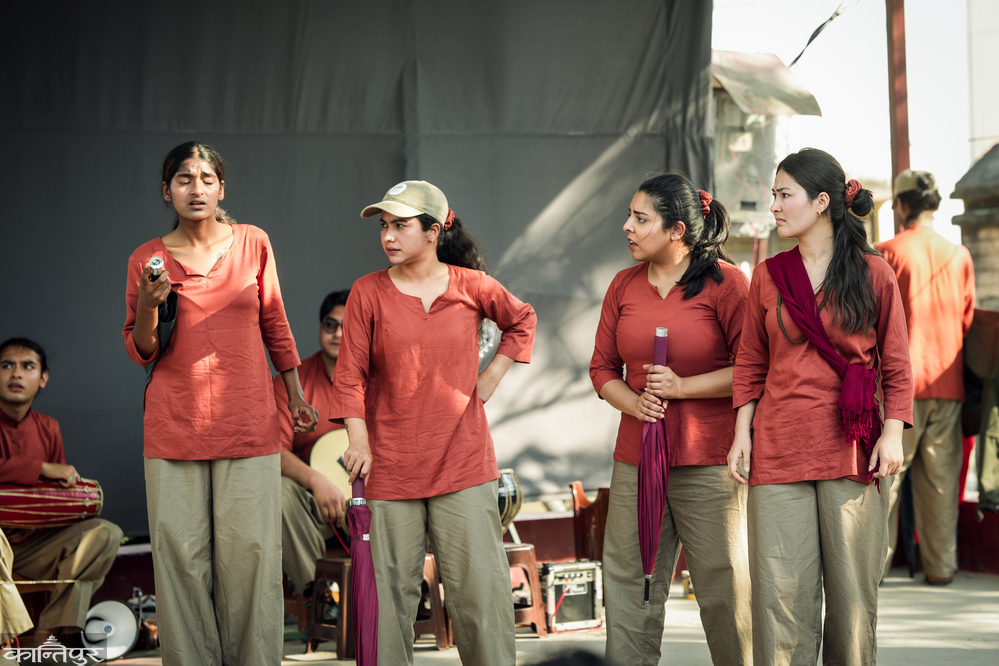
The topic of entrepreneurship has not been forced into this play to give a message . The play was made with the aim of 'celebrating' women's struggle, their hard work and business . Initially, different stories were written for Karnali and Sudurpaschim. However, project head Akanksha advised to combine both stories. Accordingly, the story was created with a female character who started tea and became an entrepreneur at the center. There is no main character in this play. All are choruses. The same artist has acted in different characters.
Sudam did not want to do a traditional street play. So, thinking of telling the story in a different way, he did a street play through chorus and music. 'Kshitij, Mukti added songs to the play. We did not need just songs. We needed music, sound, movement,' said Sudam.
The chorus in this play was made by artist Sevita Adhikari. Along with her, 7 other artists act in the play. Along with these artists, 12 members including musicians, director, coordinator and manager had traveled on the journey. Along with Sevita, Venisa Acharya, Nebika Siladhar, Sushmita Kunwar, Jeevan Dhakal, Vijay Nepal, Prasun Kumar Khatri, Robitmuni Tuladhar acted in the play.
Sevita, who started her acting journey from Parivartan Theater in Jhapa, had acted on more than a thousand streets before 'Batibato'. However, Sevita gained a very different experience in the street play of Katha Ghera. 'A play was done for 6 months at that time. At that time, I thought I was made for street plays,' Sevita shared her experience, 'In the past, dialogues were spoken in those plays - messages were spoken when giving messages.' However, this play gives a message to the audience in a style that does not bore them through music, props, and dialogue.'
Sevita was in charge of 'props' throughout the journey. The same props were used in different ways in the play. Sometimes the hat was used as a ghee, the umbrella as a cafe. There is no traditional dress in the play. Everyone wears the same dress. Sometimes the maid would be a character drinking tea in the play, and sometimes a goat. The goat also speaks in the play. 'When we were goats, the woman used to give us grass. But, when the elder brother of the house gives us grass, we tease him. Earlier, Parvati didi used to give us grass. Why did you give it to didi?' Quoting a dialogue in the play, Sebita says, 'If such a message had been given by a human, it would not have been heard. But, when an animal spoke, the audience would have listened to it with pleasure.'
Sebita says that the story of how women can become empowered even by selling pickles has inspired many women. This play tells the story of a woman who runs a tea shop and pickles. During this journey, Sevita did not get to sit with the audience and listen to their reactions up close. The reason was that as soon as the play ended, her attention would shift to collecting props. However, Sevita's heart still flutters when she remembers the kind of energy that is communicated through the audience when they make eye contact while acting in the play. In one scene, after his wife starts working outside the house, the old character prays to God after seeing her happy. At that time, God hears her prayer and says - Now you should learn to cook, you should share the work. At that time, the character says in surprise - Sir!
The mother and sisters applauded loudly in every dialogue of that scene. At that time, Sevita felt that the topic she was trying to say had reached the audience. 'At that time, I felt that the play hit the spot. This is what we thought we were trying to say,' said Sevita.
Venisa, who wrote the song 'Manchhe Ho Mahila' for the play, also had a similar experience. 'That's what I wanted to say. But I thought everyone was experiencing the same thing,' Venisa said.
She wrote this song with Rajat Thapa. She wrote the song while having tea in the morning, and Rajat also wrote the words while brushing her teeth. The words mixed with Balan's style. And then it came out - Manchhe Ho Mahila. The last line of the song is equally unique.
It's enough to understand that people are like you.
There is no need to bow down, no need to worship.
Women's hearts and words are made easy for women.
The atmosphere is pleasant, the country is strong...

