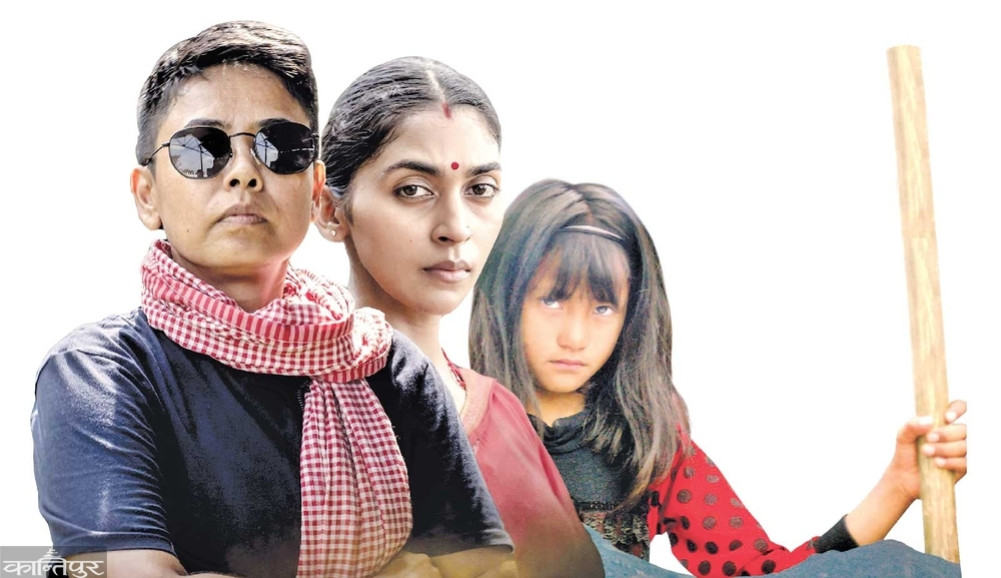
The name Pooja is repeated in the films of Deepak Rauniyar, these Poojas are such women of Nepali society, which are rarely shown in mainstream films, in his films, female characters are found strong, independent and fearless, they also expose the weak aspects of their characters, but they are not shown to be weak on the basis of women.
We use Google Cloud Translation Services. Google requires we provide the following disclaimer relating to use of this service:
This service may contain translations powered by Google. Google disclaims all warranties related to the translations, expressed or implied, including any warranties of accuracy, reliability, and any implied warranties of merchantability, fitness for a particular purpose, and noninfringement.
Let's see the trailers of Nepali movies released on YouTube in the last few weeks! How is the female character portrayed in the majority? In particular, these trailers are only teasers of traditional character portrayals that mainstream films are embracing. Still, in Nepali films, women are portrayed as weak, helpless, second class.
Mainstream films have still forgotten the sensibility to be adopted in the portrayal of female characters, with the main characters being presented only as assistants/accomplices to men.
A study conducted a few years ago in collaboration with 'Plan International' and 'Dakskull' says - despite the increase in the number of Nepali films, the portrayal of female characters remains the same. From the opening films 'Aama', 'Maitighar' till now, even though this sector has completed five decades, there is no significant change in the portrayal of women. Art house films are seen in an attempt to break down traditional depictions. Be it Meen Bahadur Bham's latest film 'Shambala' or Naveen Subba's 'Numaphung'.
From Chiring Ritar Sherpa's Mukundo to young filmmaker Minso Limbu's short film Junko, there have been attempts to change the traditional portrayal of women. In these films that have reached various international markets, we meet those women of the society who break down the walls of problems and are determined to live for self-esteem and self-respect.
Director Deepak Rauniar's films also feature strong women. At a glance, Deepak's films, which are full of political sarcasm, depict female characters inappropriately. Deepak's film is aware of women, gender, caste, class and community, and the writing of the characters is written reaching that depth. In Deepak's films, the female characters are strong, independent and fearless. They also expose the weak aspects of the character but they are not shown as weak on the basis of women. Coincidentally, Pooja's name is repeated in Deepak's film.
These Poojas are the women of Nepalese society who are rarely shown in mainstream films. Visually, it is difficult to see a character who rises above a patriarchal, misogynistic perspective. Now let's talk about Sani Pooja.
Pooja (White Sun)
This young Pooja is very fond of her identity. He gets to know his father. So she is more curious about her father. She has heard that her father is in Pokhara, but she does not know if it is true or not. When the moon returns to the village, the hope of worship rises. She is looking for the identity of Moon father. Because someone has told Pooja that Chandra is her father. However, another character who comes along with Chandra causes confusion there. The child who entered the village with Chandra also recognizes Chandra as his father. Pooja wants to hear Chandra's truth, know her father. In the film 'Seto Surya', this character is searching for the identity of her father. It is the strongest character in the film, Durga (Asha Magrati).
Durga is no longer bound by worldly love. She is fighting for her rights. She herself is looking for a father for her daughter. When Chandra enters the forest, Durga takes care of the house. During the war, she faced difficult situations as a wife of a Maoist. Durga also had to fight her battle at that hour of war. What kind of battle did she have to fight as the daughter-in-law of two brothers who joined the army and the Maoists? What decision does this character take to survive? Other dimensions of this character are revealed in the
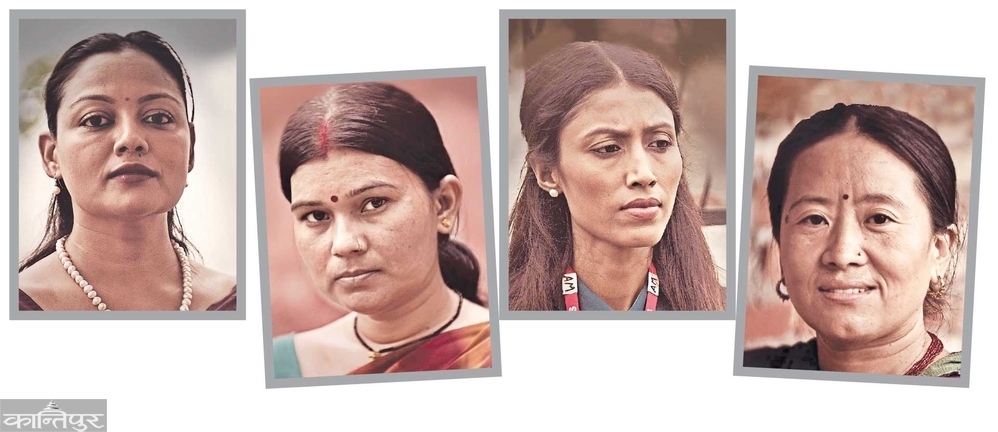
film. Through this character, director Rauniyar has raised the issue of taking citizenship in the mother's name. Durga speaks for her rights, lives for herself. The ex-husband left in the war has returned home. However, she no longer sees her future with her husband. She dreams of going to Pokhara for her daughter. She wants to teach her daughter in Pokhara, she works hard for that.
Durga chose her life when she had to live as the wife of a Maoist during the conflict. She can question, can't stand pressure. 'Does a woman touch the corpse?' asked Durga, who reached to catch the corpse when it was about to fall. She immediately replies, 'And ke jharn wale dinu ta?'Durga is portrayed as a woman with a strong voice. She can raise her voice for her rights, fight and imagine a beautiful future.
Pooja (Highway)
Pooja of 'Highway' is fondly called Moonmoon by lovers. However, Moonmoon's real name is Pooja. It seems that the little worship of White Sun has grown up now. Educated, she speaks English fluently. She reads a book, smokes a secret cigarette. She is secretly in love with Ronit. However, in the meantime, it is decided to marry a guy who has returned from America. She traveled to Kathmandu for marriage with her mother by bus. Why is she ready to marry her childhood benefactor who has returned from America even though she has a boyfriend Ronit? Different letters of this character are opened one by one as the bus makes its way to Kathmandu.
This journey speaks passionately about Puja's choice, choice and decision-making power. Looking at the flow of the story, it seems that maybe Pooja is ready for marriage with her family? If yes, did she choose her passion or family? One scene in the film leaves the answer. The change in worship during the journey to Kathmandu, the decision he takes shows how profoundly this character has been shaped. The story of this character, which ends in 'Open Ending', represents the women of Nepali society, who give up their family's wishes, aspirations, modesty and embrace their freedom and journey of dreams.
Pooja makes her own life decisions, solutions to problems. Not only Pooja, different dimensions, issues and relationships of women are presented in this film through other female characters. Nepali films still only show women as mothers, girlfriends and daughters-in-law. They are only shown to manage the house following the social values. But, the exact opposite is Radhika (Asha Magrati). Director Rauniyar has shown the complexity of this character on the screen beautifully.
Radhika and her husband have been childless for a long time. The husband is traveling to find a childless problem. At that time, Radhika gets close to another man. However, many Nepali films have been made showing women being attracted to other men with commentary showing them to be characterless. However, the portrayal of this character is completely different. The decision taken by the woman regarding the different parts of the extramarital relationship, her weaknesses, mental health and other aspects are shown in a sensitive manner in the film.
Another strong character portrayal like Radhika is Kavita (Richa Sharma). This character shows how a woman is raising her children through this business at a time when sex business is not yet considered a profession. Working through dark nights, how does Kavita create a bright dream for her daughters? Director Rauniyar has explored different dimensions of women through different women from different backgrounds.
Pooja sir (Rajaganj)
Pooja has made her new avatar by the time she reaches 'Rajaganj'. There are many such pujas in the society. However, such pujas were not seen in Nepali films, Deepak created them in 'Rajaganj'. Pooja is such a strong character in this female-dominated film that the male portrayals next to her are weak on her scale. Pooja's presence and portrayal is so prominent in this female-dominated film that other male characters are actually only supporting characters.
The story of 'Rajaganj', which satirizes mainstream films that show female characters in supporting roles in women-oriented films, proceeds from this character of female police officer Pooja (Inspector). Pooja is representative of sexual and minority community. The complex aspects of this character's identity are presented here. Pooja is a daughter to her father. He is like a son in the house. He is a powerful inspector like any other man. However, his identity is not accepted inside the house. He has another struggle to become an inspector. Others do not accept his same identity.
The main character of 'Rajaganj' is Pooja. Deepak narrates that many female characters associated with him are also given equal importance. Deepak has his own reasons behind repeating Pooja's name in his films. In Nepali society, women and daughters are worshiped. Which culture also sees the daughter-in-law as a place of worship. But, is that the case in practice? Still, a woman cannot give citizenship to children in her own name. But, that is not difficult for the sons.
Deepak has been naming a character Pooja in every film to satirize this disparity between children. It is said that three dimensions of any character should be shown. We try to make our characters as human as possible. No character is full of virtues or vices. We try to show that the characters in our films have both good and bad qualities," said Deepak. However, every character has equal importance in the film. In the same way, when showing the importance of each character, we insist that it should be portrayed in the same way.'
Why is the role of every character necessary in the story, not just the woman Deepak? They are very confused. The language the characters speak is what they want to bring to the dialogue. Not only literary language, Deepak and Asha have already been consciously working in the portrayal of women.
Since the short film 'Chaukathi', Deepak has started working seriously in writing, being conscious of portraying women in this way. While writing the characters, Deepak is bringing the characters on the screen based on what he has experienced, seen or researched. While writing the character of the woman, wife Asha adds a different dimension to it. I grew up as a man. While writing Pooja sir, we have collaborated with Asha in writing. When a female character was written as a man, it could not be written at that level. But, Asha adds a woman's point of view to it,' said Deepak.
When Deepak and Asha decide the characters of the film, they start looking for 'locations'. Interviews, research on related topics begin. While meeting with police inspectors, Pooja's sexuality was linked to sexuality and minorities. "We could not show the characters in the society. If we can't celebrate, what else can we do? In terms of filmmakers, we create such characters with the sense of responsibility to show and celebrate the characters in the society," Deepak said, "We have written the character of a female police officer because the time has come to celebrate the character of Pooja.