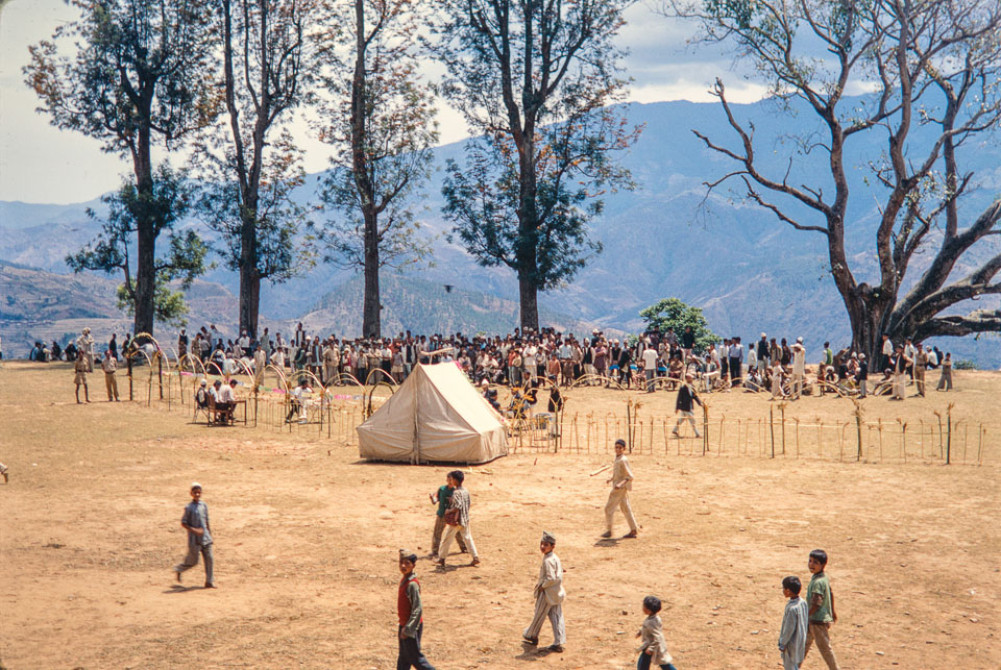
National Panchayat elections, which are non-partisan and devoid of political ideology, were held in 2019, 2026, 2035, 2038, and 2043. Local Panchayat elections were held in 2018, 2028, 2032, 2038, and 2042.
We use Google Cloud Translation Services. Google requires we provide the following disclaimer relating to use of this service:
This service may contain translations powered by Google. Google disclaims all warranties related to the translations, expressed or implied, including any warranties of accuracy, reliability, and any implied warranties of merchantability, fitness for a particular purpose, and noninfringement.
King Mahendra had initiated the non-party Panchayat system by overthrowing the first elected government led by BP Koirala on 1 Poush 2017. It was declared that the objective of the Panchayat system was to enhance the welfare of the people by creating a democratic, just, dynamic and exploitation-free society.
Although the word 'democratic' was written in the Panchayat constitution, in practice it was a personal-oriented system of governance. Only what the king wanted was done. Political parties were not allowed to do politics. Parties were banned.
The 2015 constitution, which adopted a government elected by the people and a constitutional monarchy, was repealed. On 1 Pus 2019, King Mahendra promulgated the constitution of the Panchayat system of governance. The new constitution provided for a non-partisan electoral system. The constitution provided for a national Panchayat as the national legislature. While promulgating the constitution, the king had announced that there would be a Panchayat system that would develop a decentralized governance system by involving the people at every level and delegating authority to each level.
While overthrowing the elected government, leaders who had contributed to democracy were taken into custody. Nepal had to show the world that democracy existed. For that, the then King Mahendra had arranged for representatives to be elected through elections at each level. The national panchayat was formed through village panchayats, city panchayats, district panchayats, and zonal assemblies.
In hilly areas, settlements with a population of 1,000 and in densely populated areas with a population of 2,000 were made village panchayats. At that time, there were 3,914 village panchayats. 9 wards were established within each village panchayat. There was a system of electing 5 village assembly members in each ward. Nepali citizens who had reached the age of 21 elected village assembly members from among themselves. There were 45 village assembly members in each village panchayat. Although the election of village assembly members was direct, the election of other positions was indirect. The 5 village assembly members elected from the ward would select one person from among themselves and send them to the village panchayat.
1 person from each ward would become 9 village panchayat members. In addition, the district committee of the National Campaign for Return to the Village would nominate and send 2 members to the village panchayat. In this way, the number of members in the village panchayat reached 11. They had a system of electing the Pradhan Panchayat and the Upa Pradhan Panchayat from among themselves. If there were no women among the members elected to the village panchayat, one of the two nominated by the District Committee for the National Campaign for the Village Reform had to be a woman.
An urban area with a population of at least 9,000 was declared a Nagar Panchayat. There was a provision for a Nagar Panchayat to have 9 to 33 wards. Like the village assembly, 5/5 members of the Nagar Panchayat were elected from each ward in the city. 1/1 member from each ward was elected as a Nagar Panchayat member. The National Campaign for the Village Reform would nominate 2 to 6 additional Nagar Panchayat members based on the population of the Nagar Panchayat and the number of wards. There was a system of nominating members by His Majesty's government without increasing the total number of members elected to the Nagar Panchayat. There was a provision for giving priority to women, social workers, intellectuals, minorities and backward classes in the nomination.
There was a legal provision for the members of the Nagar Panchayat to elect the Pradhan Panch and the Upa Pradhan Panch from among themselves by a two-thirds majority of the total number of members. In the event that no one could obtain a two-thirds majority, the National Campaign Committee for Returning to the Village could designate the Pradhan Panch or Upa Pradhan Panch from among the members of the Nagar Panchayat. The term of office of the Pradhan Panch, Upa Pradhan Panch, Nagar Panchayat members and members of the Nagar Sabha was 4 years. The term of office would end by the middle of Poush of the year when the 4 years were completed.
District Panchayats were formed in 75 districts. The District Assembly would elect the Nagar Panchayat members. The Pradhan Panch and Upa Pradhan Panch of the Village Panchayat, Nagar Panchayat within the district were ex-officio members of the District Assembly. The Pradhan Panch, Upa Pradhan Panch and Nagar Panchayat members could elect and send one-third of the number of wards in that city to the District Assembly from among themselves. If the number of members of the District Assembly was less than 20, the government had a provision to nominate the remaining members to bring it to 20.
The district was divided into 9 regional areas. One member of the District Assembly was elected as a District Panchayat member from among the members of the District Assembly within the area. The National Campaign for Village Repatriation Zonal Committee nominated 4 members to the District Panchayat. These 13 members of the District Panchayat elected the District Panchayat President and Vice President from among themselves. The group of all the members of the District Panchayats within the zone was called the ‘Zonal Assembly’.
The members of the Zonal Assembly elected the National Panchayat members from among themselves. The system of electing the National Panchayat members through direct voting by the general public has been in place only since 2038. In the 2019 constitution, the National Panchayat was called the highest level of the Panchayat system. 90 elected by the Zonal Assemblies, 15 elected by class and professional organizations, and 4 elected from among graduates reached the National Panchayat. The king had a provision to nominate 15 percent of the total number of elected members.
The number of members was determined differently according to the zone. Mechi had 4, Koshi had 5, Sagarmatha had 10, Janakpur had 9, Bagmati had 11, Narayani had 6, Gandaki had 9, Dhaulagiri had 4, Lumbini had 8, Karnali had 4, Rapti had 6, Bheri had 5, Seti had 5, and Mahakali had 4 members. Similarly, 4 members were elected from the Nepal Kisan Sangha, 4 from the Nepal Yuva Sangha, 3 from the Nepal Mahila Sangha, 2 from the Nepal Mazdoor Sangha, and 2 from the Nepal Ex-Servicemen's Sangha to the National Panchayat. Similarly, 4 members elected by them from among those who had obtained at least a Shastri or Bachelor's degree from a university or educational institution approved by the government were given a place in the Panchayat.
When the constitution was promulgated on 1 Poush 2019, the number of members specified in the constitution was later changed by amending the constitution. On 14 Magh 2023, Mahendra made the first amendment to the Panchayat Constitution. From there, the provision of having a Prime Minister in the Panchayat was introduced. There was a constitutional provision that at least one member should be elected from each district within the zone when elected and sent by the Zonal Assembly. One had to have completed 25 years to become a member of the National Panchayat. The constitution stipulated that the term of office of a member elected from the Zonal Assembly would be 6 years, and the term of office of those elected and nominated from among the class organizations and graduates would be 4 years. However, in the first-formed National Panchayat, there was a provision that one-third of the members elected from the Zonal Assembly would have a term of office of two years, and the term of office of another section would be four years. It was determined by lot who would have a term of two years or who would have a term of four years.
There was a constitutional provision that the king would appoint ministers from among the members of the National Panchayat and that the king could have a Council of Ministers under his own chairmanship or designate a minister as the chairman or vice-chairman of the Council of Ministers. The amendment to the constitution made it possible for the Zonal Assembly to consist only of members of the District Panchayats within the zone. Before that, the Zonal Assembly was formed by members of the District Assembly.
On 26 Mangsir 2032, King Birendra made the second amendment to the constitution and changed the number of National Panchayat members. All zones were divided into four groups for the election of members of all levels of the National Panchayat. It was arranged that elections would be held in the zones within one group every year. The term of office of the National Panchayat members was reduced to 4 years. The number of members elected to the National Panchayat was determined in the constitution according to the district within the respective zone. The number of members elected from 14 zones to the National Panchayat was increased to 112. There was a provision for the President, Vice President or District Panchayat member to be candidates in the election to become a member of the National Panchayat. Members of the Zonal Assembly and District Assembly were voters in the election of members of the National Panchayat.
The non-party system was victorious in the referendum held in 2037. Then, the King announced the third amendment to the Panchayat Constitution on 1 Poush 2037. It was arranged that the members of the National Panchayat would be elected on the basis of adult suffrage and the term of office of the members of the National Panchayat would be 5 years. A provision was made that people who had completed the age of 21 could register their names in the voter list. A provision was made for the King to appoint the Prime Minister on the recommendation of the National Panchayat. The Prime Minister required a proposal from at least 25 percent of the National Panchayat members and the support of 61 percent. The constitution included a provision for the appointment of Deputy Prime Ministers, Ministers, Ministers of State and Assistant Ministers on the recommendation of the Prime Minister.
The elections to the National Panchayat, which are free from political views, were held in 2019, 2026, 2035, 2038 and 2043. The elections to the local Panchayats were held in 2018, 2028, 2032, 2038 and 2042. Former Chief Election Commissioner Surya Prasad Shrestha, who conducted the 2043 National Panchayat elections, says that those elections were held to give legitimacy to the Panchayat system. ‘Although the elections at that time fulfilled a formality, there was a lack of real people’s representatives. Due to the lack of multi-party competition, it could not be considered a fully democratic exercise,’ he says. There was no opposition within the Panchayat.
Although the National Panchayat was formed to give the Panchayat a democratic form, giving it a glimpse of parliamentary practice, in practice the democratic system or method was not implemented. Surya Bahadur Thapa, who was a minister and prime minister in the Panchayat several times, has written about it in his book ‘Mero Nau Dashak’ – the king had the ‘supreme power’.
Nawaraj Subedi, who served as a minister several times during the Panchayat period and became the chairman of the National Panchayat after 2043 BS, states that no matter what provisions are made in the constitution, in the Panchayat system, the Prime Minister and the chairman of the National Panchayat are only those chosen by the king. After the people's movement of 2046 BS ended the 30-year Panchayat system, the country entered a democratic era again.