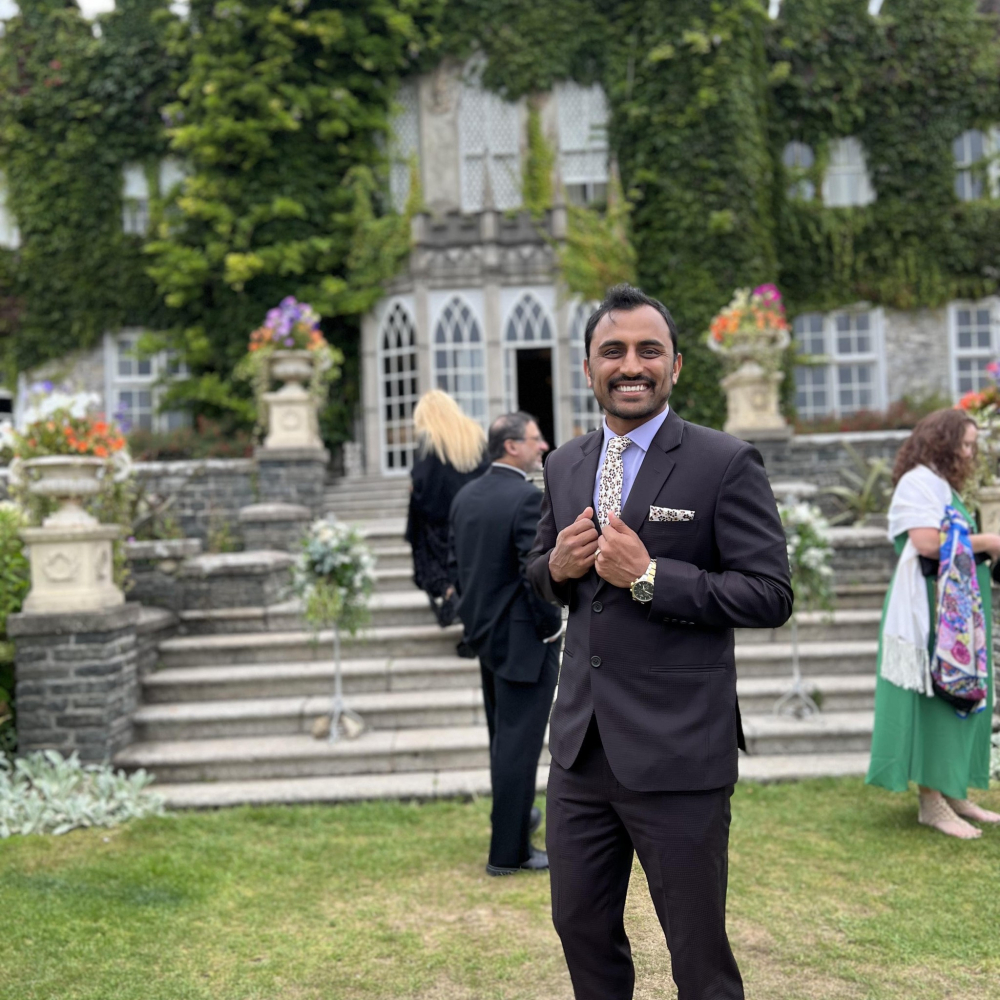
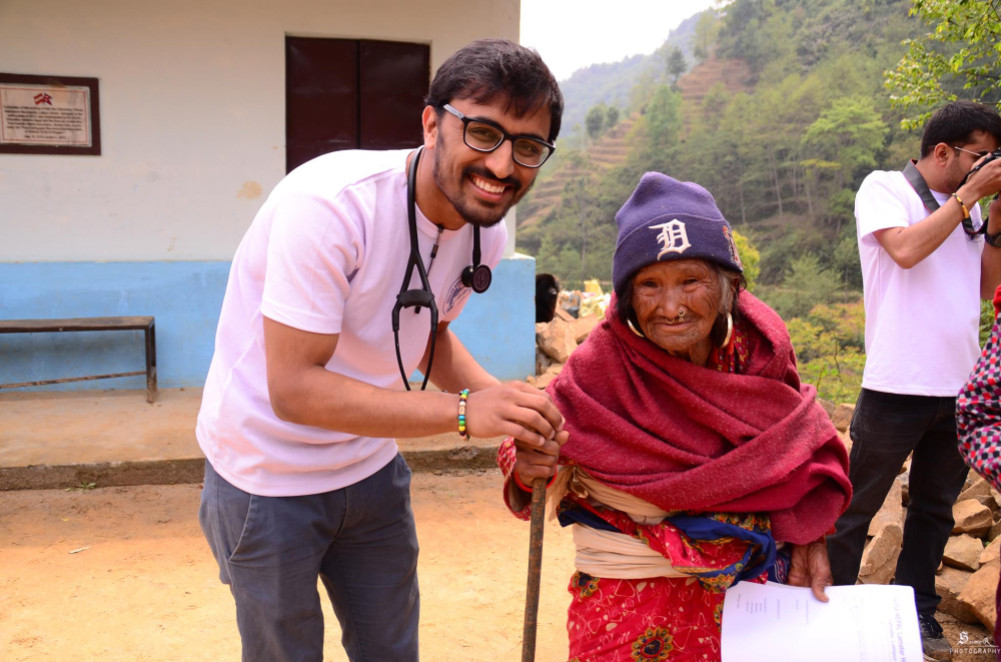
Ramu Kharel, an associate professor of emergency medicine at Brown University in the US, worked hard in the health sector during the 2072 earthquake and the Covid epidemic. Kharel, who was born in Ampchaur, Gulmi, has since then been very active in the campaign to improve rural health services in Nepal.
We use Google Cloud Translation Services. Google requires we provide the following disclaimer relating to use of this service:
This service may contain translations powered by Google. Google disclaims all warranties related to the translations, expressed or implied, including any warranties of accuracy, reliability, and any implied warranties of merchantability, fitness for a particular purpose, and noninfringement.
Ramu Kharel of Ampchaur in Gulmi was only seven years old at that time. It is the year 2053, the postman who was distributing letters in the village shouted, "Kharel, your father has received a DV." Now you too can go to America. Kharel had not even heard of America at that time, let alone DV. So he was not interested in postal matters.
Walking with friends, he reached home. His father was a secondary school teacher in Gulmi. School teachers then collectively filled the postal DV. His father went to America, but other family members could not go to America at that time due to not filling the details of family members. A year after his father left for America, Kharel's mother became very ill. Even after taking Palpa for treatment, she did not return.
Born in 2046 in Ampchaur, Kharel studied at Tamghas for some time. Later, after his father prepared to take the whole family to America, he came to Kathmandu and studied. Later he came to America and started studying in 9th grade. Kharel dreamed of becoming a doctor since childhood. Moreover, his father encouraged him to become a doctor from a young age. So he had to become a doctor anyway. After moving to America, it was very difficult for him to learn English at first. However, most of them went to college after finishing school. He also started learning English.
"Anyway, I entered the college with the intention of majoring in biology," he says, "but the subject of Urdu attracted me in such a way that I chose Urdu as the main subject." After studying Urdu, he again enrolled in medical science. While studying medicine, he took a break and completed his master's degree in public health from Harvard University. After that, he continued with medical science and completed his studies.
After completing the study, there was an earthquake in Nepal. Kharel's heart could not stay in America when his motherland was hurting. "After that I came to Nepal and joined the rescue of earthquake victims," he says, "since then I come to Nepal two/three times a year and work in the health sector." At the same time, he started a non-profit organization called "Hapsa Nepal". Even before the earthquake, he was active in Nepal's health sector. Houses in Tamang Basti of Ghumarchok village were destroyed by the earthquake above the Bajrayogini temple in Sankhu. Kharel started a hand washing campaign in the village two years before the earthquake. After reaching there, the team including Kharel assisted in relief and rehabilitation.
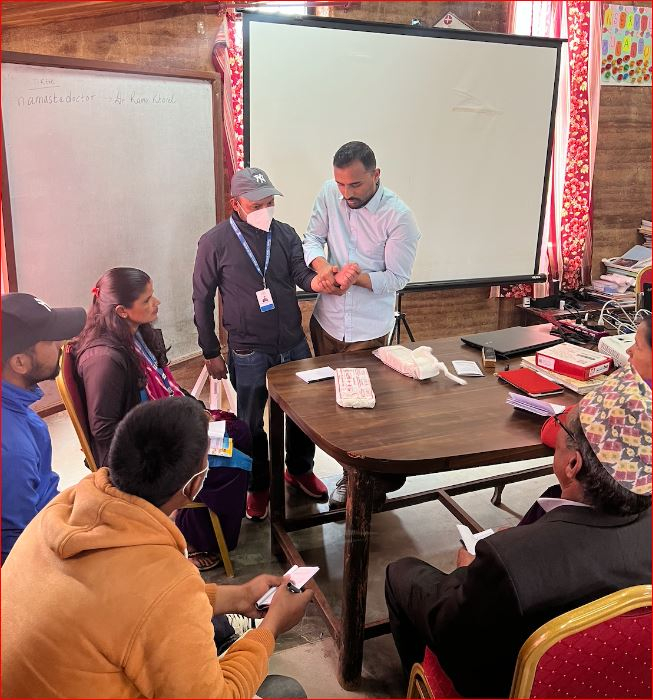
Even after the earthquake, his team led the locals in Lakurivanjang and did health improvement work. For about five years, he helped these two communities to run health centers and health development programs by collecting funds on his own initiative. Hapsa conducted programs like health camps, cataract surgery for the elderly. In addition, under the leadership of Kharel, the local community was involved in health care policy making.
According to Kharel, associate professor of emergency medicine at Brown University in Rhode Island, USA, disaster is also an opportunity. "Works that did not exist in the past can also be started in a new and systematic way," he says, "We also studied the health problems there before the earthquake and what they are now." There were no locals at the health post. It was able to be addressed. ×' Even during the Covid epidemic, Kharel was very upset. He was in Nepal as an emergency doctor during the third wave of covid. During the epidemic and lockdown, he was equally active in providing information on how to avoid Covid through the social network Tiktok in the name of 'Namaste Doctor'.
At that time, a team including Kharel and Sumana Shrestha (current Minister of Education) worked by forming 'Covid Alliance Nepal'. Apart from this, the team also collaborated with CCMCC and others. Kharel gave necessary training to the heads of various local governments, health service providers and community health volunteers on Covid-19 management. Kharel and Hapsa team actively supported communities all over Nepal during the time of covid. Not only in Nepal, but through his university, he trained health service chiefs of about 55 countries on various topics about Covid. At the same time, through Hapsa, he was also able to send home isolation kits to more than 30 municipalities of Nepal to the patients infected with Covid.
Kharel has been continuously working to improve the health sector of Nepal. He is especially active in improving the health conditions of remote villages. Some time ago, even when there was an earthquake in Jajarkot, he was engaged in relief and rehabilitation along with free health services. In general, Kharel is working for the improvement of health services in Nepal. Kharel said that the team including him is working in three ways, especially after Covid. During the covid epidemic, the hotline was launched by the team led by Kharel. "Instead of stopping it, there was a discussion about using it in some other area," said Kharel, "In Nepal, many people are dying due to the consumption of poison." Not much research has been done about this.'
After knowing that, they went to Nirkyol, which established a 'poison center' in Nepal. "After that, a hotline was established at the teaching hospital about two years ago," says Kharel Kharel said that information about the solution will be given. "Now we are running it with grants and support," he said, "but now I think the government should set aside the budget and proceed."
According to him, at least 30 lakh rupees are being spent annually for the operation of the center. Kharel says that if the government invests one crore rupees annually, its services will be very effective.
Along with 'Poison Centre', Kharel is equally active in rural health services. Various types of accidents are happening especially in the rural areas of Nepal. The death toll from those accidents is also very high. "Now we are working on how to minimize it," he says, "We have run a community health network in Achham."
Kharel says that this will be effective as it is not possible for the police and medical personnel to reach the accident site immediately. A study has also been conducted on this topic by teaching the locals at Bayalpata Hospital in Achham. According to the study, it has been found that 60 percent of the experiments carried out in the case of accidents, earthquakes, floods, landslides or other emergency situations have been successful.
"There is a plan to expand the work of teaching and mobilizing the local people to some rural municipalities and if it is successful, it will gradually start in other villages of the country," he said, "especially local political leaders can be mobilized."
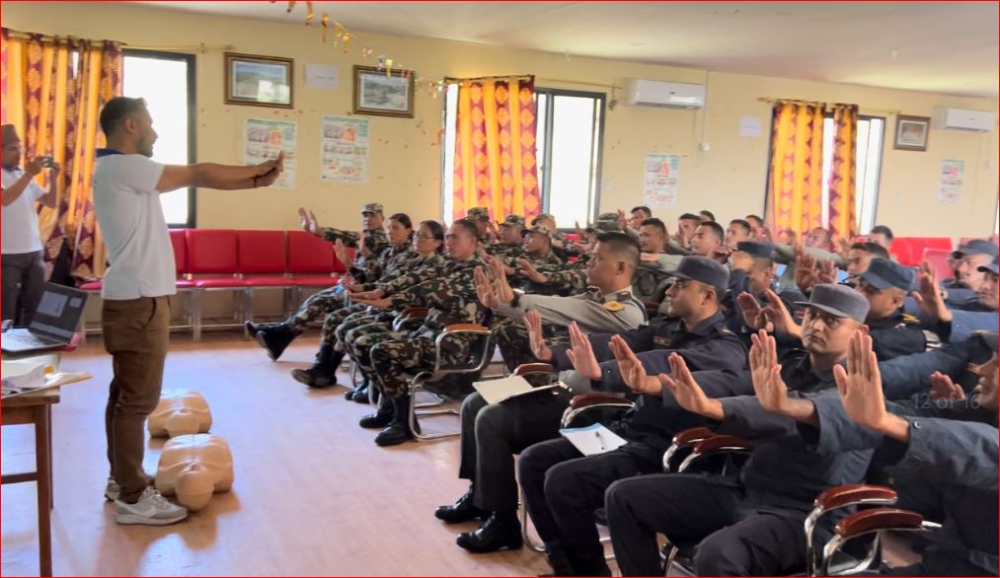
Similarly, Kharel is also active for 'Basic Life Support'. According to him, 'Basic Life Support' is very important to prevent 'brain death'. "If a person suffocates or collapses in front of you, it is important for all citizens to know how to save them and take them for further treatment," he says.
Hapsa Nepal recently partnered with the Nepal Police to provide training on these vital life-saving skills. According to Kharel, the army and police have been trained in this regard in Doti and this program has also started in Kathmandu Metropolitan City. He said that the Nepal Police should be informed about any emergency or accident first.
According to Kharel, according to the United Nations, Nepal ranks fourth in the world in terms of climate risk and eleventh in terms of earthquake risk. That is why it is necessary to improve emergency services in Nepal first.
Kharel, who has been active in health services abroad (especially America, Peru and Rwanda) and Nepal for a long time, how does he see the health care situation in Nepal? His direct answer is - there is a lot of discrimination in the service of Nepal. When the country is one, there should be one system to improve health problems wherever you are. But that is not happening. In particular, our effort is that everyone should have access to healthcare and it should be universally accessible.'