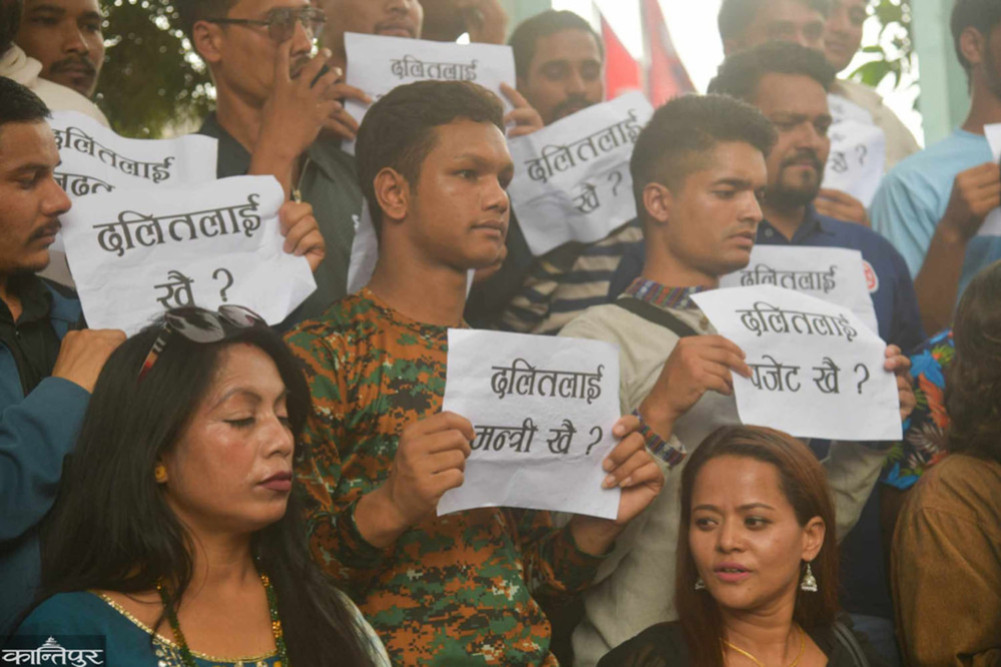
Rights activists and experts have commented that although the government has introduced relief-oriented programs through the budget, ranging from doubling the nutritional allowance for Dalit children to managing the landless, it has not paid attention to structural reforms.
We use Google Cloud Translation Services. Google requires we provide the following disclaimer relating to use of this service:
This service may contain translations powered by Google. Google disclaims all warranties related to the translations, expressed or implied, including any warranties of accuracy, reliability, and any implied warranties of merchantability, fitness for a particular purpose, and noninfringement.
The government has announced some relief programs targeting the Dalit community through the budget for the upcoming fiscal year 2083/84. The budget presented by Finance Minister Swarnim Wagle in the federal parliament covers issues ranging from doubling the nutritional allowance of Dalit children to managing the landless. However, experts have commented that the budget focuses more on cheap popularity (populist) than structural reforms.
The budget has increased the child nutrition allowance received by Dalit children under the age of five across the country from Rs 532 per month to Rs 1,000. The government has allocated Rs 3 billion for this. The government expects this arrangement to directly improve the health and food access of children from lower-class Dalit families.
Similarly, the budget schedule mentions the target of directly employing about 700 people next year for the economic empowerment of marginalized and Dalit women. The government has adopted a policy of increasing integrated investment to commercialize the traditional professions of the Dalit community by linking them with modern technology and giving priority to Dalits and target groups in concessional loans.
In addition, the social security allowance received by about 174,305 Dalit senior citizens who have reached the age of 60 has also been continued this year. Finance Minister Wagle has expressed his commitment to solve the problems of landless Dalits, squatters and unorganized settlements in a long-term manner within the next fiscal year. The budget has a concrete target of distributing land ownership certificates (Lalpurja) to 59,500 landless Dalits, squatters and unorganized settlers in the coming year.
In the previous fiscal year (2082/83), Rs 500 million was allocated for the preservation of traditional skills through the 'Bhagat Sarvajit Entrepreneurship Development Program'. While the previous budget had emphasized entrepreneurship and concessional loans, this year's budget has prioritized direct cash relief and land management.
Although the government has introduced some relief programs through the budget, Dalit rights activists and experts are not satisfied. Researcher JB Bishwakarma argues that the budget is more concerned with small-scale programs than structural and policy reforms.
'Increasing allowances alone will not solve the overall problems of the community, it seems that the budget is trying to be more populist,' he said. 'Unless there is a clear plan and blueprint for the economic transformation of marginalized communities, such small parts will not have a big impact.' The economy should prioritize the marginalized community first.' She believes that the current budget will provide benefits to the middle class and further exploit the marginalized.
Gaura Nepali, general secretary of the Dalit Women's Center, Nepal, also said that there is no fundamental difference in the budget compared to the previous government. 'Although including Dalits and the poor in the nutrition allowance is positive, nothing new and distinct has come in terms of policy for Dalits,' she said. 'Rather than uplifting those who really need state support, the budget seems to be focused only on cheap popularity and what will make the government popular.'
According to Dalit rights activist Hira Bishwakarma, the three-fold increase this time is a positive aspect, as in previous years, the budget allocation for the Dalit community was barely Rs 1 billion. However, she says that budget allocation alone is not an achievement based on past experience. 'It is not that the budget has not been received in the past, but the implementation situation is disappointing,' says Bishwakarma, 'Government employees and structures have a tendency to complete the budget in their own favor rather than the target community.'
He also complains that the state has not shown the slightest sensitivity to the incidents of murder, rape and discrimination against the Dalit community in the budget and policies and programs. He says that although political parties have included the Dalit issue in their manifestos, they have been missing from the budget and the government's official address.
Bishwakarma says, 'Even when so many incidents of discrimination are happening, the state has not mentioned a single word of apology in the budget or policy. Therefore, we suspect that this budget is a 'populist' program brought just for show.'