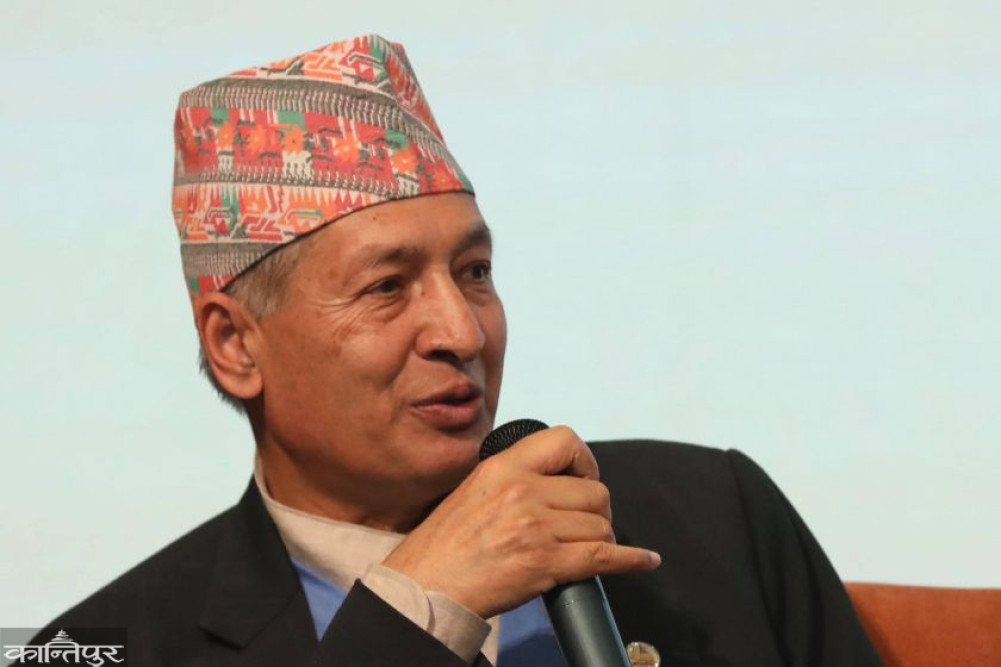
Former Finance Minister Yubaraj Khatiwada's reaction to the budget brought by the government is - This is a middle class-centric budget. The middle class has been looked at. Before that, the basic class has not been looked at.
We use Google Cloud Translation Services. Google requires we provide the following disclaimer relating to use of this service:
This service may contain translations powered by Google. Google disclaims all warranties related to the translations, expressed or implied, including any warranties of accuracy, reliability, and any implied warranties of merchantability, fitness for a particular purpose, and noninfringement.
There are some features of the budget. First, the expectations that were created in the public mind - high economic growth, upliftment of the middle class and progress towards prosperity. The Finance Minister was committed to advancing the path of development by giving concessions to the private sector. That is the path. Everyone may like that path or not. The reason is that the type of economic system through which development is being sought, whether that development and economic growth benefits everyone or not.
It remains to be seen how much tax exemptions, new arrangements in social security, or arrangements made to encourage the private sector will help to lift the common people to the top.
There are a lot of jargon in the budget. The first question is whether all these things can be implemented. Second, some arrangements have been made for the implementation of so many things, but the kind of transformation that has been talked about is not sufficient in itself.
If we look at the distribution of the budget, it is roughly the same. For example, the education budget is 10/11 percent no matter what. The health budget is between 4/5 percent. Yesterday, we said in the policy and program that we will extend free education up to the secondary level. This government has also said that. If we look at the distribution of the budget, it is roughly the same. For example, the education budget is 10/11 percent no matter what. The health budget is between 4/5 percent. Yesterday, we said in the policy and program that we will extend free education up to the secondary level. This government has also said this. We are ignoring basic fundamental rights. The Finance Minister has followed a model that economic growth will occur by driving the private sector. If there is economic growth, everything else will be solved, and employment will also be created. However, it seems that you have forgotten what we saw, experienced and analyzed while working with us in the 1990s - this is not enough for economic growth, poverty alleviation, proportional growth and coordinated growth. Anyone can say the word
. But there are two-three main things for its implementation. One, there are institutions. Create them. It is bureaucracy. You have encouraged a little, you have discouraged some. I will not comment on that.
The main thing is the economic aspect. No matter how much tax exemptions and facilities are provided, it is already clear that they will not generate about 1.5 trillion rupees in revenue. No matter how much you reform the customs and tax administration, there will be a loss of 1 to 1.5 trillion rupees in revenue. As soon as there is a loss of revenue, popular programs will have to be cut. It is the support of donor agencies. It has been said that foreign aid above 3 trillion rupees will be mobilized. No matter how hard you try, it is difficult to mobilize foreign aid above 2 trillion rupees. It will be 2.5 trillion rupees. The circle of 1 trillion rupees is in foreign aid. Its impact will be on internal debt. Internal debt should be raised as much as you think. But the 'norms' of around 5 percent of the gross domestic product have also been broken.
To make GDP 5 percent, both economic growth and internal debt have been increased to 7 percent and 6 percent, respectively. 6 percent inflation means that the average inflation is currently 2.5 percent. If we say that 6 percent inflation is continuing, which class will be affected by it? What will happen to its calculation and compensation for them? Taxpayers are fine, they get concessions. But what benefits do citizens who do not have to pay taxes and are below the absolute poverty line get? What has increased in social security? It has not increased. The
is the child maintenance allowance, which we had started. There was some relief for Dalits. But where did the matter of public housing go? There were public housing safe programs. More than one lakh families had benefited. Now there is talk of distributing houses by developing land. But housing is a fundamental right. It would have been better if we had said that we will build housing now to protect the right to housing. This is a middle class-centric budget. The middle class is being looked at. Before that, the basic class has not been considered. We have to answer how to protect the basic class. The budget is an economic and political document. Since there are some political agendas, political commitments, and things said in the manifesto, it is not a budget in terms of pure economics. A budget above 20 trillion is a political budget. If there was a budget below that, it would have been an arithmetic economist's budget. Therefore, political influence naturally affects the budget. The Finance Minister himself cannot sit on an island and make decisions. Perhaps the same thing has happened to him. When we formulate the budget, what will we give to the basic class? What will we give to farmers and workers? What will benefit those working in the service sector and the informal sector? That should be seen. Tax exemptions alone are not a surefire medicine when encouraging. Industrial safety, industrial environment, and ensuring a safe environment for businesses should also be seen. Only one thing happened - is it a matter of political level that the private sector benefits after giving tax exemptions and facilities and the lower class is protected after elevating the middle class? They have held their ground. We have seen it from our ground.
Economic growth cannot be achieved without encouraging the private sector. But economic growth is not an absolute condition for completely elevating that class, eliminating economic inequality and increasing employment. Some intervention is needed there. That can be through the upliftment of social security, labor market, informal sector, agriculture and other sectors. The way he has talked about transformation, it is also linked to technology. Now he has talked about AI and IT. But without transforming education, without developing technical human resources, that transformation will not be so easy. It will not be possible by not allocating budget to the basic level human resources and talking about transformation.
He has put 15 billion in health insurance. More than 16 billion is already due. And how will this program move forward and how will it be possible to create a situation where people are not deprived of their fundamental right to health care?
We talk about transformation in agriculture, but mechanization, commercialization and modernization in agriculture are limited. In the industrial sector, we talk about green industries, but not about small industries. There is no exemption for cottage industries. Is it just starting to focus on large industries? In industry, an investment of Rs. 10 lakhs in a small cottage industry provides employment to one person, while in large-investment industries, Rs. 10 crores provide employment to one person. Therefore, when it comes to employment, one should have gone to the basic level. That is, did they miss that level? The budget is popular. But it should be popular for everyone. There should not be a situation where it is popular for a particular class and ‘come-come’ for others. It should not be that one class takes advantage of the popular budget and the other class is left out.
In federalism, all three levels of government spend their budget on education. It does not include the expenditure on education from the provinces and local levels. The budget that went down from the equalization grant should have been created to invest more in education. We could not. It means that they could have. Could we have made a little leap in moving from general education to scientific education? Another thing is, the size of the budget could have been increased by about one percent. The same is true in health. You talked about restructuring insurance in the policy and program. You have allocated 15 billion for health insurance. More than 16 billion is already due. And how will this program move forward and how will the people not be deprived of their fundamental right to health care? Any finance minister has a resource limit. I think that when you keep saying that the previous ones did not do it, we will do it, the basket of resources is the same.
(Edited excerpt of former Finance Minister Khatiwada's response to Kantipur Television's program 'Budget Debate')