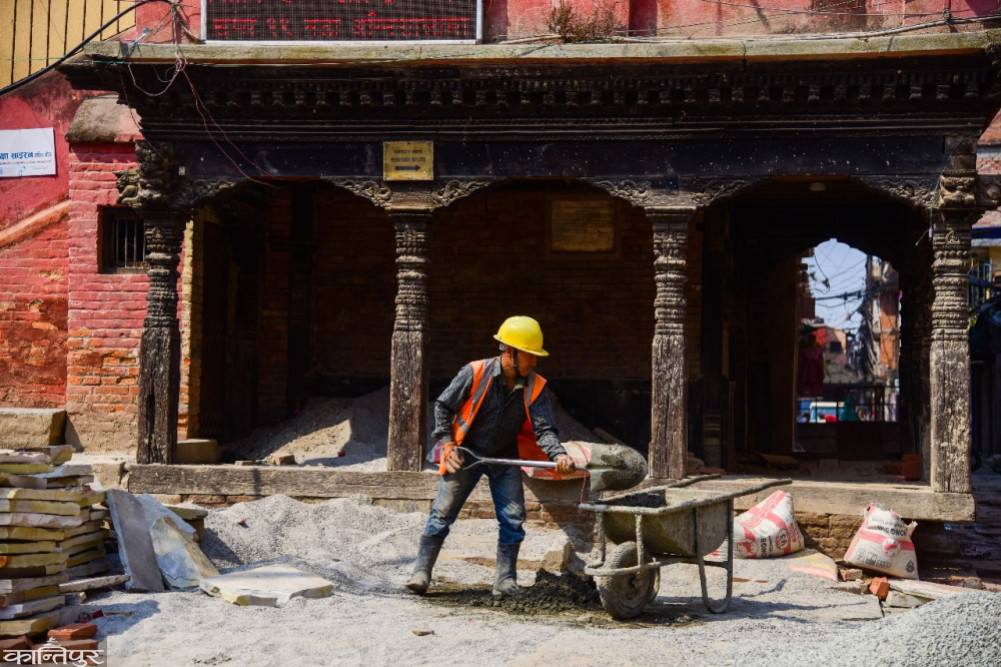
Finance Minister Wagle has announced that a special campaign will be launched to include workers working in the informal and unorganized sectors in the social security system.
We use Google Cloud Translation Services. Google requires we provide the following disclaimer relating to use of this service:
This service may contain translations powered by Google. Google disclaims all warranties related to the translations, expressed or implied, including any warranties of accuracy, reliability, and any implied warranties of merchantability, fitness for a particular purpose, and noninfringement.
The government is going to make it mandatory for workers and employers to be registered with the labor registry. Presenting the budget for the upcoming fiscal year 2083/84 on Friday, Finance Minister Swarnim Wagle said that significant improvements will be made in the rights and interests of workers.
The budget also mentions setting standards for services such as insurance, housing and digital complaint management to be provided by organizations licensed to supply construction, agriculture, hospitality, transportation and industrial workers, in addition to security guards and domestic workers.
He also said that written contracts, minimum wages, insurance, workplace safety standards and payment of wages through banks will be mandatory in the labor sector.
Finance Minister Wagle announced that arrangements will be made to make the mandatory compensation and insurance claim system for workplace accidents more effective.
The government has announced that it will develop a system to resolve labor disputes quickly through labor tribunals by mid-December and to bring contract violations, wage fraud and labor exploitation under the legal ambit of economic crimes.
Finance Minister Wagle also announced that a special campaign will be launched to include workers working in the informal and unorganized sectors in the social security system.
It is not clear whether the government will implement the provision that workers and employers must be included in the labor registry, said Laxman Basnet, general secretary of the South Asian Regional Trade Union Council.
‘Although there has been talk of making it mandatory for employers to be included in the labor registry, this issue has been limited to discussions for the past 20 years,’ he said. ‘It is not possible to say whether its implementation will be easy in the current political structure. Let us see.’
Basnet said that workers are being neglected due to the political structure. ‘It seems that workers are being neglected in the current political structure. Their rights are not protected. The current laws are more in favor of the workers than in favor of the workers,’ he said. ‘In the past 20 years, the economic growth of employees has increased by hundreds to thousands of times, but the condition of the workers remains the same.’ Despite the good performance of the employees, it seems that the workers are not getting the proper compensation for their livelihood.’
Basnet said that even if the salaries of civil servants increase, it will not provide much relief due to the high inflation in the market.
In addition, he said that the lives of workers are becoming more difficult due to price increases and inflation.
‘The condition of workers working in the private sector is even more miserable. It seems that they are being paid less than the prescribed minimum wage,’ he said, ‘Due to rising inflation, private sector workers are struggling to even maintain their basic living.
There is not much room for workers to get relief in the current political and economic structure.’
The government has presented a budget that is different from the expectations for the welfare of workers, said Nepal Trade Union General Secretary Bishnu Lamsal.
It is true that the government has increased the salaries of civil servants, but it has not said anything about the salary increase of workers in other labor sectors, Nepal Trade Union General Secretary Bishnu Lamsal expressed dissatisfaction. ‘It was seen that only the salaries of civil servants have increased.’ But there was no talk of increasing the salaries of workers working in other informal sectors. It seems that the state has made a unilateral and biased decision,’ he said, ‘We disagree with this. If the nation is to progress, the upliftment of those who actually work is the most important.’
He said that there is no equality in the budget.
‘The budget has come out exactly the opposite of what the people and workers expected that the government would make some changes,’ he said, ‘It is seen that this budget has not been able to bring equality for the workers.’