According to Finance Minister Wagle, the salary of employees, including grades, will now be maintained at around Rs 40,000 to over Rs 100,000.
We use Google Cloud Translation Services. Google requires we provide the following disclaimer relating to use of this service:
This service may contain translations powered by Google. Google disclaims all warranties related to the translations, expressed or implied, including any warranties of accuracy, reliability, and any implied warranties of merchantability, fitness for a particular purpose, and noninfringement.
The salary of employees has increased by about 21 percent. The government has increased the starting salary scale by 10 percent through the budget for the upcoming fiscal year. A 10 percent monthly incentive allowance of the new salary scale has also been arranged based on performance. Finance Minister Swarnim Wagle has said that this will increase the current salary by about 21 percent.
According to Finance Minister Wagle, now the salary of employees, including grades, will be maintained at around 40,000 to 100,000 rupees. The new salary scale will be implemented from 1st Shrawan. There has been no increase in the salary of employees for the last four years. The salary of employees was increased by 15 percent from the budget for 2079. The government has kept the monthly dearness allowance of Rs 5,000 that employees at all levels have been receiving.
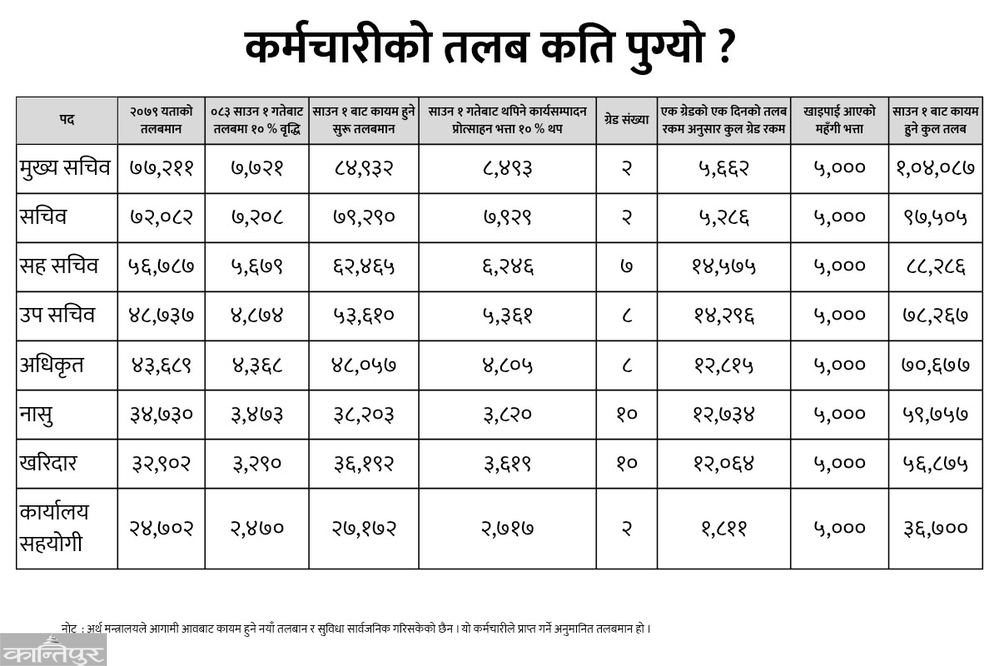
Finance Minister Wagle has said that the salary facilities have been reviewed for a dignified life as the price increase based on the price index is 17.3 percent. "With the aim of making the civil service capable of leading a dignified life, high-level performance, efficient and accountable, we have made arrangements to continuously increase the service facilities of civil servants, soldiers, police and teachers in a respectful manner," he said while presenting the budget in the parliament.
The exemption given in income tax will also increase the income of employees. The budget has doubled the income tax exemption limit to Rs 1 million for individuals.
The budget also announced to streamline the cumbersome organizational structure of the personnel administration. The number of federal ministries has been reduced from 22 to 18. Accordingly, the budget has adopted a policy of using the money saved from the reduction of departments, offices and posts to make the administration more efficient. It has been said that 31 bodies will be abolished, 6 bodies will be merged (adjusted), 6 bodies will be transferred and 18 bodies will be restructured.
The budget has emphasized on building a governance system that will produce results by ending policy confusion, delay, institutional capture and exploitation of state resources. Finance Minister Wagle has said that the government is committed to establishing good governance standards through reforms in laws, institutions, systems, processes, leadership and intentions. He said that general expenditure will be controlled while maintaining unprecedented frugality and efficiency in allocation.
Stating that the office operating expenses have been significantly reduced, Minister Wagle said that allocations for training expenses outside the training center, cameras, televisions and other equipment have been removed. He has also announced that the practice of providing facilities by setting up various funds has been discontinued. The discounts provided to the office bearers and employees of the corporation in the purchase of goods and services produced by the corporation have been removed. Funds have been withheld from those bodies until the work related to matching the posts of the merged and abolished bodies and liability management is completed. The initial estimate of savings of about 20 billion rupees has been made in the budget from such various steps.
The budget also contains a commitment to end policy-level corruption by formulating a law on conflict of interest for good governance. The 'Hello Government' mechanism will be developed as a platform for government-citizen dialogue and digital time cards will be implemented in government offices. Finance Minister Wagle has said that the national identity card will be developed as a basic identity card for public service delivery. The budget mentions that systems related to civil services such as land revenue, transport, passport, personal incident registration and social security management will be strengthened.
6 missions and offices abroad abolished
6 offices, including embassies, consulates general and embassy branches abroad, have been abolished. The Nepali embassies in Denmark, Brazil and South Africa have been abolished.
The budget announced the abolition of the embassy branch in Chengdu, China, San Francisco, USA and Visakhapatnam, India. The government aims to strengthen economic diplomacy to promote exports, capacity, bilateral trade and investment, and tourism by empowering Nepali missions abroad.
The budget states that the government will mobilize soft power for economic prosperity by strengthening balanced foreign relations based on mutual benefit, national self-respect and sovereign interests. The government has a policy to strengthen Nepal's role in the United Nations and other multilateral and regional forums. The budget statement states that it will advance a strong diplomacy for regional proximity. Finance Minister Wagle has said that the birthplace of Buddha, the highest peak of Mount Everest, the Himalayan range, yoga-meditation, cultural diversity, the image of a peaceful nation and participation in international missions will be promoted in order to expand Nepal's soft power.

