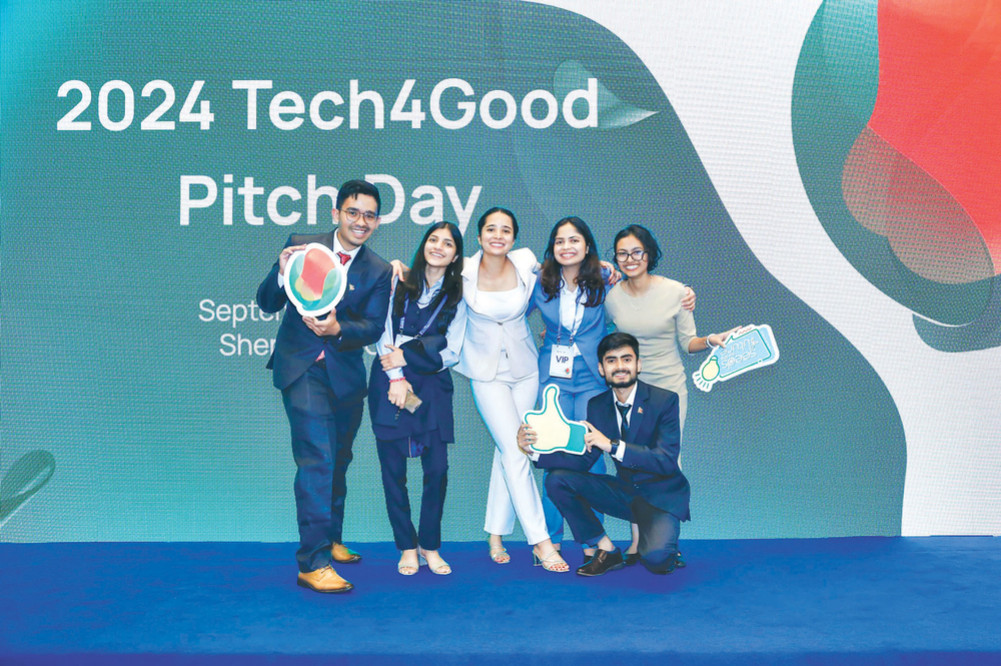
A team of 6 Nepalese students who created the 'Ultracare' project based on the concept of an AI technology-based device that helps in early diagnosis and treatment of pregnancy complications, won the 'People's Choice Award' by surpassing 300 competitors from 19 countries.
We use Google Cloud Translation Services. Google requires we provide the following disclaimer relating to use of this service:
This service may contain translations powered by Google. Google disclaims all warranties related to the translations, expressed or implied, including any warranties of accuracy, reliability, and any implied warranties of merchantability, fitness for a particular purpose, and noninfringement.
A group of students from Nepal has won an award in a competition held in China by presenting the concept of a device based on 'Artificial Intelligence' (AI) that helps in timely identification of complications during pregnancy.
A group of Nepalese students received the People's Choice Award in the 'Take for Good' competition held in Shenzhen city. The competition was held among more than 300 competitors from 19 countries. Last Saturday, Huawei Nepal held a program in Kathmandu and handed over the awards to the winners.
A project called 'Ultracare' presented by a team of Nepalese students won the award. Minister of Communications and Information Technology Prithvi Subba Gurung handed over the award to the team that became popular in Shenzhen by the name of 'Team Ultracare' at the Huawei Tower in Hattisar.
The group of winning students includes Priyanshu Sharma, Angelina Ghimire, Samriddhi Karki, Sadhana Panthi, Ashish Karki, Sameep Aryal, who are studying computer science, electronic engineering, computer engineering and other subjects at Kathmandu University and Pulchok Engineering Campus.
A Nepali group was praised by many when they presented their idea in the competition about an AI-based 'Ultracare device' that identifies pregnancy complications as soon as possible. They have designed a 'portable ultrasound' device that can be taken from one place to another based on AI technology and is operated by solar power.
It is easy to use because it also understands the local language, said Angelina, who is studying at the fourth level of Bachelor's degree in Computer Science at Kathmandu University. "I think we have won the award because it is a device that addresses the social problems of the rural areas," Angelina said, "The greater achievement than winning the award was the exposure we got there."
Ashish, another member of 'Team Ultracare', also believes that their project has received interest and support at the international level due to its ability to solve social problems in rural areas.
'A lot of investment is required to turn this project into a commercial product, although it is not possible for us as students to carry out such a project, we plan to make it a reality in the future,' he said. According to Ashish, out of the ideas presented in the competition, the winner was selected by the voting of 300 participants from 19 countries. According to Priyanshu, another member of
Ultracare, this device helps pregnant women to detect health complications early and treat them immediately. "In our rural areas, access to 'ultrasound' equipment is low, even where the equipment is available, many pregnant women have lost their lives due to the lack of experts in timely identification of complex problems," she added. '
After visiting information technology companies and electronic markets in cities like Nanning and Shenzhen in China, Priyanshu said that in Nepal too, society can be transformed through the use of technology.
"In a workshop, one person showed a photo of Guangzhou 40 years ago, that place looked exactly like our current Rukum," she said, "Now Guangzhou is very developed. An advanced form of information technology is seen. Our government should also invest in local innovation and human resources. Seeing that Google Notch has also developed a local technology like Baidu in China, Priyanshu believes that Nepal should learn from it.
'Skilled manpower is migrating abroad, it is not enough to tell them to stay here,' said Priyanshu, 'new innovation should be promoted in Nepal to stop brain drain. Working environment should be prepared for the youth. Invest in youth.'
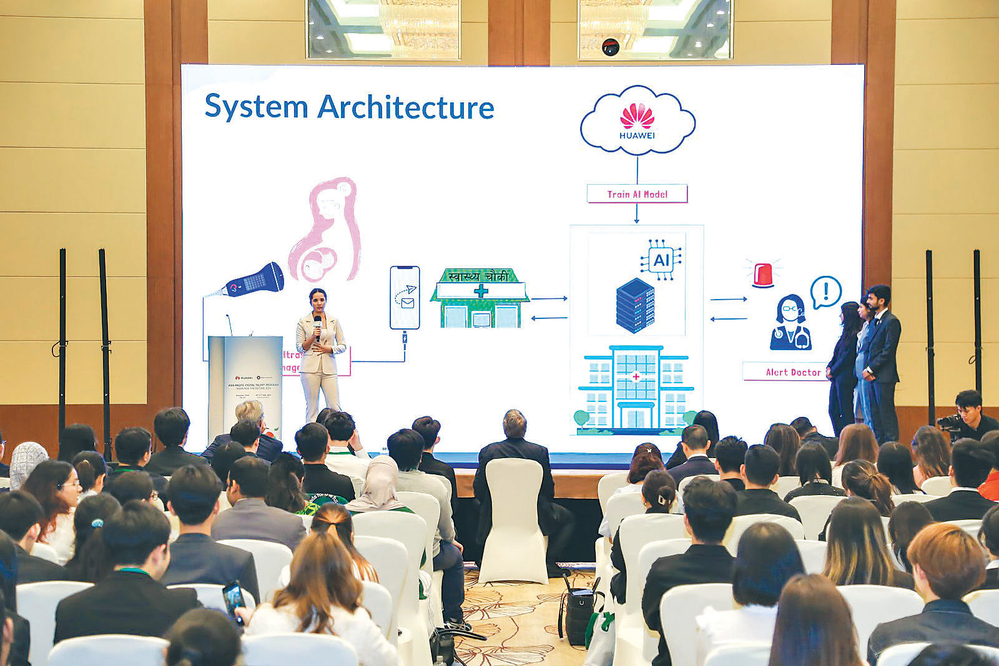
Angelina also shared the experience that China has come a long way in information technology. She said that she found the public electric vehicle, bullet train, electric market, and Huawei's R&D offices to be amazing.
Huawei Technologies has been operating in Nepal since 2019 as 'CID For the Future' program has been organized. The company said that the program is designed to encourage young students in the technology sector. Under this programme, students from different countries are given training in ICT, innovation and leadership development.
Some of the selected students will be sent to the 'Tech for Good' competition and the winners will get to participate in the 'Global Tech for Good'. Students participating in the competition have to prepare a technological project to solve social problems.