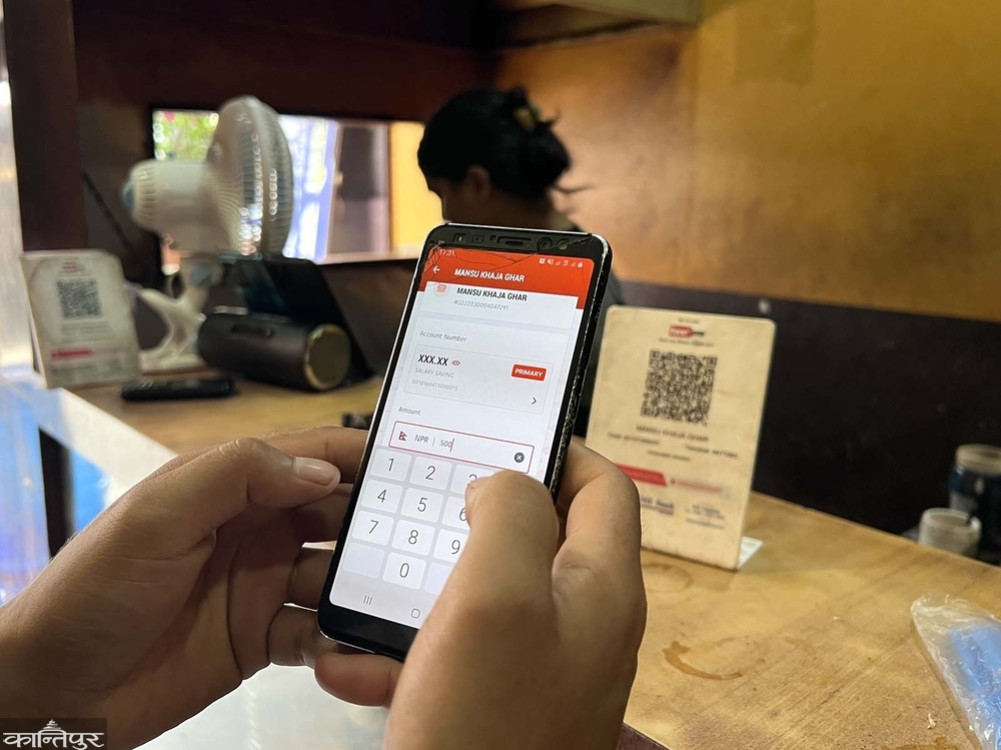
According to the data of Rashtra Bank, both the number and amount of people making payments through QR code and mobile banking are increasing significantly every year. This indicates the digital lifestyle that has entered Nepali society.
We use Google Cloud Translation Services. Google requires we provide the following disclaimer relating to use of this service:
This service may contain translations powered by Google. Google disclaims all warranties related to the translations, expressed or implied, including any warranties of accuracy, reliability, and any implied warranties of merchantability, fitness for a particular purpose, and noninfringement.
The scene of paying cash and buying goods is now not only seen in malls and marts, from grocery stores to vegetable stores and from paan shops to carts.
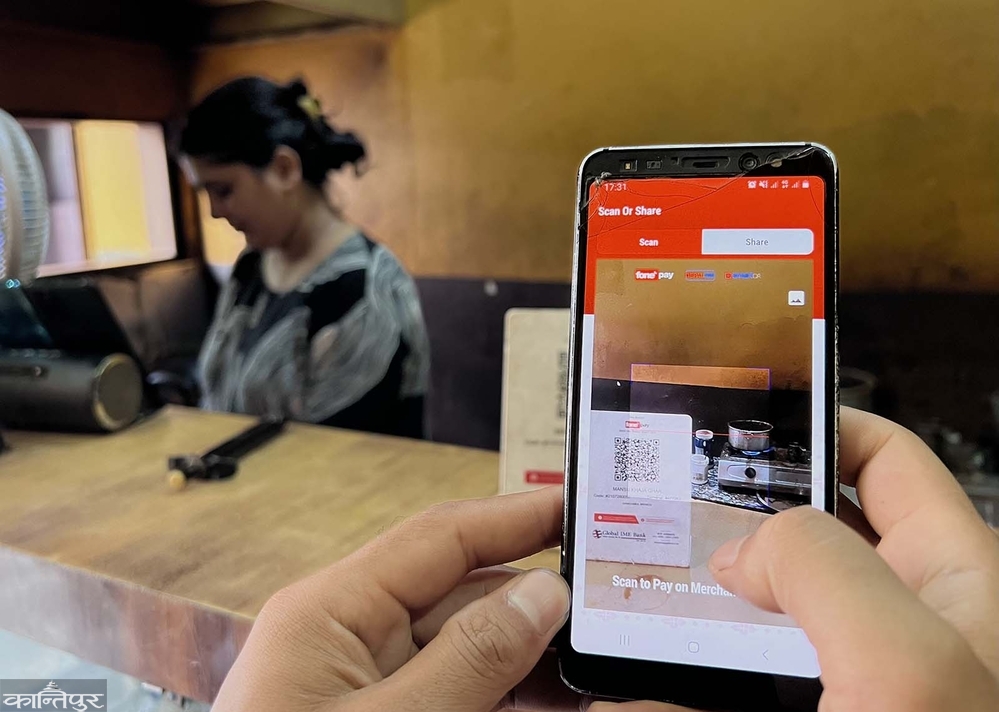
It has become common to see QR in small to big shops in the main cities of the country including Kathmandu. And after buying goods, the habit of putting the mobile before the wallet has also started to become common. According to the data of the National Bank, QR (Quick Response Code) based payments, which are considered convenient for small and retail payments, have increased at a high rate in recent months.
According to Rashtra Bank, transactions worth 93 billion 475 million rupees were made through QR code in 351 lakh 46 thousand 38 times last May. In May of last year, there was a transaction worth 53 billion 88 million 10 million rupees in 12 million 57 thousand times. These facts are enough to explain how rapidly the process of doing business through QR has increased. 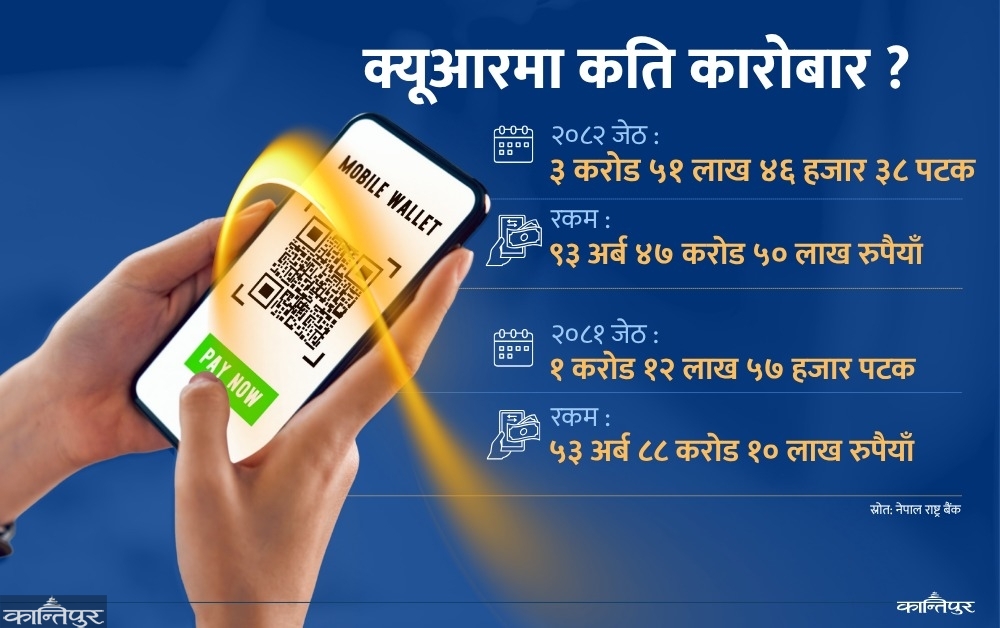
With the increasing use of mobile phones and increased access to the Internet, electronic payment transactions have increased significantly across the country in recent months. During this period, both the number and the amount of electronic payments increased, indicating that digital transactions have now become the lifestyle of Nepalis. In the monthly report of National Bank of May, it is said, "The electronic payment transaction is increasing due to the development in the electronic payment infrastructure, the incentives for electronic payment transactions and the increasing practice of using electronic payment devices by the general public." Compared to the previous financial year, the number of electronic payment services, IPS, connect IPS, prepaid cards, internet banking, mobile banking, wallet and payment through QR and the number of users have also increased.
Rastra Bank has prioritized that even the small transactions from daily living to meet the basic needs should be done through QR code, as transactions of large amounts of money are not always done by common people. "Households can use QR codes to purchase goods and services such as milk, vegetables, fruits, clothes, etc.," said Kiran Pandit, Spokesperson of Rashtra Bank and Head of Payment System Department. At the same time, Mahaprasad Adhikari, the former governor of Rashtra Bank, started QR code transactions in more than half a dozen places in Kathmandu Valley about four years ago. At present, it is said that this business has expanded to different places at the provincial level as well. This also confirms that the expansion of transactions based on QR codes is a priority of the National Bank. Rastra Bank has prepared a draft of the relevant standards to regulate payments through QR codes in electronic payments.
The 'Global Findex 2025' report published by the World Bank last week also mentioned that digital transactions are increasing in Nepal. In this report, while 58 percent of men use digital payment methods in Nepal, the number of female users is only 36 percent.
Let's talk about the touristic city of Pokhara. It has become a common sight to see digital payments being made not only here at Lakeside but also in the surrounding small markets. Ramesh Adhikari, who is selling trekking materials at Lakeside, says that sometimes there is no money in the store. But that doesn't mean he doesn't have business. He said, "50 to 60 percent of my transactions are done through mobile banking." Sometimes all transactions are done through mobile banking. There is no cash money here.'
As Ramesh said, digital business is growing rapidly in Pokhara. According to the annual report of Nepal Rastra Bank's Pokhara office for the financial year 080-81, there are 242,360 internet banking users in Gandaki.
In this period, there are 26 lakh 49 thousand 190 mobile banking users. According to Rashtra Bank, 140,690 internet banking and 104,836 mobile banking users have increased in the last 3 years. This data shows how fast digital transactions are growing .
The same scene as Pokhara is also in Lumbini province. It has been a long time since Sunita Aryal of Butwal sub-metropolitan city-11, who runs a beauty parlor, has not spent much money to buy goods. She started making online payments since the start of mobile banking service, she says, 'When you mix, it seems like you are moving according to the times.'
The report released recently by Rashtra Bank Bhairahawa branch also includes the data of mobile and internet and branchless banking in financial institutions till last December. Among the 12 districts of Lumbini, Rupandehi has the highest number of mobile banking transactions at 32.69 percent, while Rupandehi has the highest number of registered internet banking services, i.e. 46.23 percent. It has become a common sight to see small to big shops doing digital business.
From government services to private services and even paying service fees, the online payment system has become a part of lifestyle. Let's look at the example of Chitwan. There are 42 thousand customers in Bharatpur Water Management Board. According to Sanjay Baral, acting executive director of the board, 60 percent of the total customers pay online. There is a similar example of Nepal Electricity Authority Bharatpur branch. Nandaram Bista, information officer at the branch, said, "We have 63,000 customers." Those who pay fees online are 55 to 60 percent.
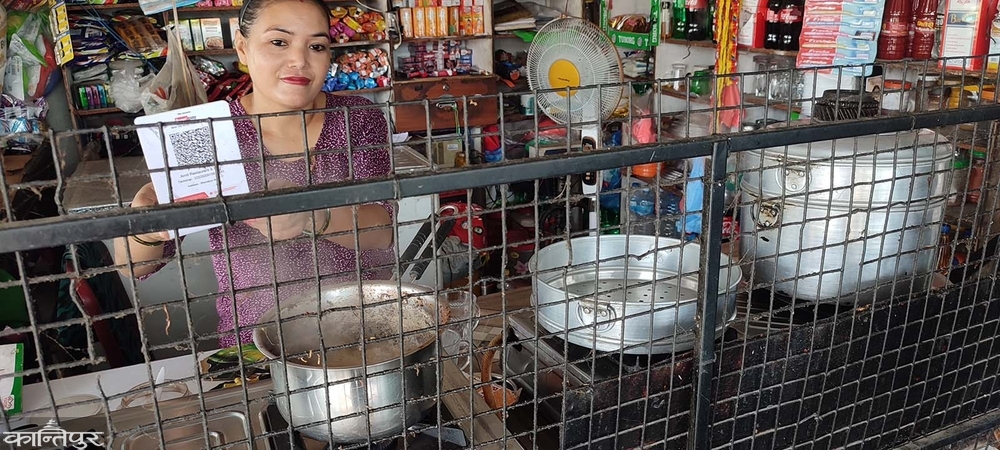
All these examples show that digital payments and online transactions are becoming part of the lifestyle from the federal capital Kathmandu to the main cities of the country.
Other related news
Pocket market
Digital Gandaki: QR is not cash