When Sapna (name changed) sits down to write an essay, she first opens ChatGPT in her browser. She types in a topic and starts writing based on the ideas that come from it.
We use Google Cloud Translation Services. Google requires we provide the following disclaimer relating to use of this service:
This service may contain translations powered by Google. Google disclaims all warranties related to the translations, expressed or implied, including any warranties of accuracy, reliability, and any implied warranties of merchantability, fitness for a particular purpose, and noninfringement.
When college student Sapna (name changed) sits down to write an essay, she first opens ChatGPT in her browser. She types in the topic and starts writing based on the ideas that come from it. Even after finishing the essay, she does not read it herself. Instead, she copies and pastes the prepared material back into ChatGPT and has it corrected. ChatGPT arranges the sentences, makes the language easy and makes the writing better. She uses ChatGPT whenever she needs to understand something. She said, “If I have to write something, I feel like I should ask ChatGPT first. Why not use it?”
Before learning about ChatGPT, Sapna used to read her writings over and over again. If I did not understand a topic in class, I would discuss it with my friends. But now that process has changed. Some time ago, after she found it difficult to understand the topic of ‘Hello Journalism’, she directly resorted to ChatGPT without taking the help of friends, library or teachers. Sapna uses AI not only for studying but also to satisfy her curiosity. A few days ago, she asked on ChatGPT, ‘What does it mean if tears come from only the left eye?’. Earlier, such questions used to make for interesting conversations with friends, but now, she said, the conversation ends when ChatGPT gives a direct answer.
 Sapna’s classmate Bidushi Thapa uses AI to reply to messages sent to friends. Now, students have started using AI like ChatGPT for writing essays, reading comprehension and even daily conversations. They are being attracted to AI due to its easy access and ease of use. Experts have expressed concern that the ease of AI may have long-term effects.
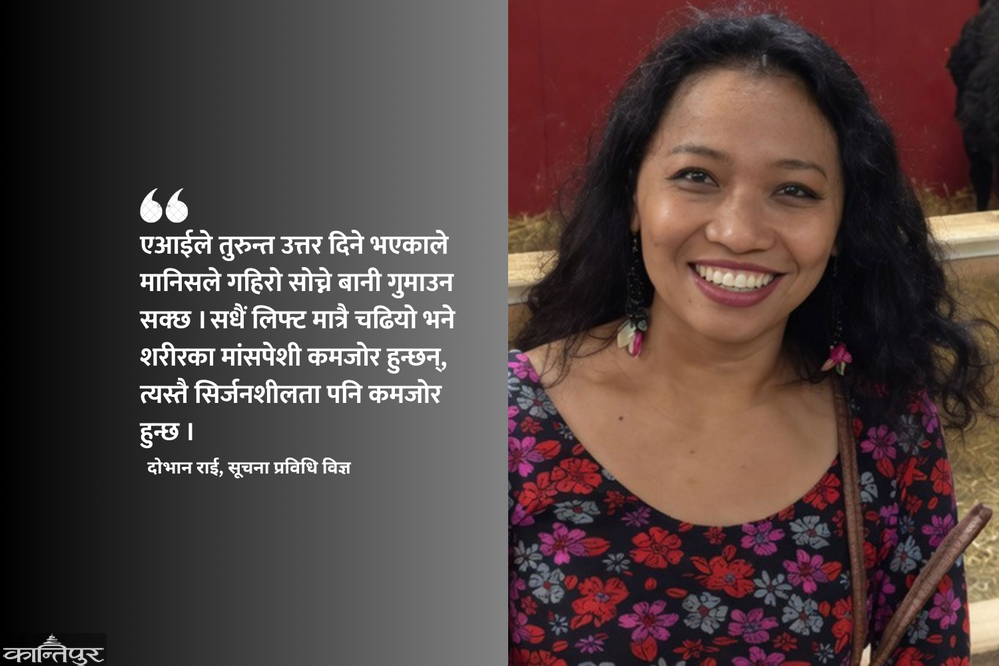
Information technology expert Dobhan Rai said that since creativity requires difficulty, confusion, and long-term thinking, there is a risk that people will lose the habit of deep thinking because AI is used for ease and AI gives instant answers. Comparing the use of AI to physical exercise, she said, ‘If you always take the elevator, the muscles of the body will weaken. Similarly, if you stop using your creative abilities and start relying on instant answers, your creativity will also weaken.’
According to her, as people start relying on AI for every task, doubts about their own ideas will arise and sometimes the question ‘Is this really my own idea?’ may arise. Rai herself is also looking for a balance between where to use AI and where not to use it. She said that when creating pictures for a blog, one should think about whether to use AI or make it with one’s own hands. She said, ‘Just because a tool is available does not mean you have to use it.’
According to psychologist Aarti Gurung of Counseling and Mental Health Center Nepal, people are choosing the easy way out, which is why they are relying on AI. She said, ‘If you rely too much on AI, you may lose confidence in your ideas. People should develop their ideas before using ChatGPT.’
According to Gaurav Pandey, president of Nepal Software and Information Technology Services Company, ChatGPT reorganizes old data and materials. In resource-limited countries like Nepal, he said, AI can increase access to creativity. He said, ‘When AI handles repetitive tasks, people can spend more time on tasks that require decision-making and imagination.’
Nepali scientist Rajat Sainju also agrees. Sainju said that AI will work to create new combinations by mixing different materials. He also said that AI models will be trained to give answers that people like and agree with. He said that AI produces average answers due to ‘reinforcement learning’ based on human responses, and therefore less unexpected or unique ideas. He also compared AI to a ‘blender’, a system that mixes content from the internet and gives it a new form. Sainju said, ‘AI can create new combinations, but they are based on existing content rather than original thinking.’ 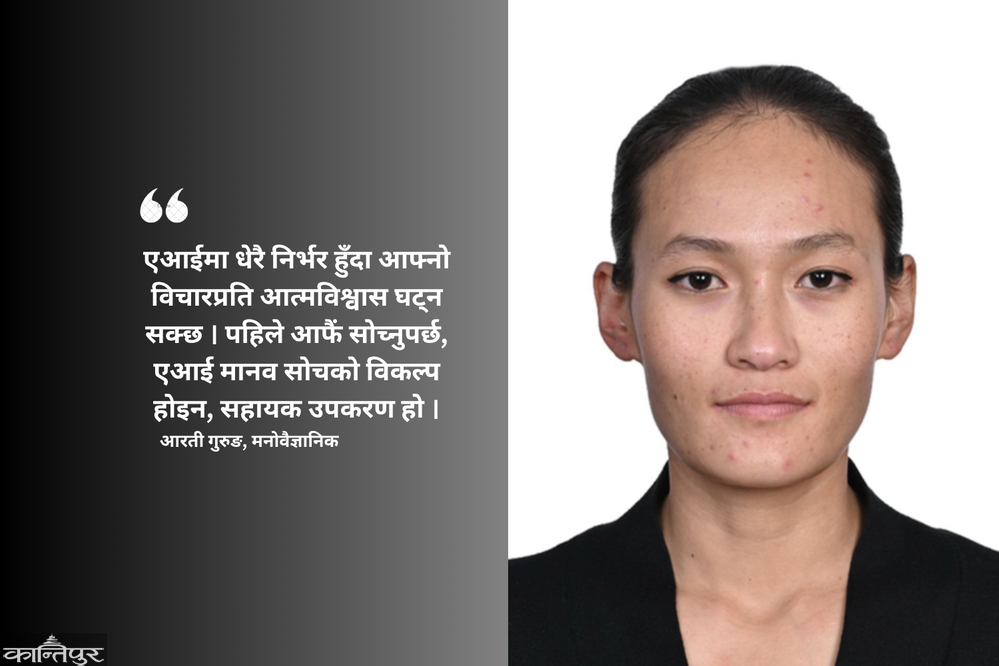
A study published in 2024 by Anil Doshi showed that short stories written with the help of AI were 10 percent more similar than stories written without AI.
According to an economic impact study conducted by CISAC/PMP Strategy, it is estimated that by 2028, creators in the music and audiovisual sectors could lose up to 22 billion euros in revenue due to generative AI. 44 percent of the daily content uploaded to music streaming platform Deezer is created by AI, while 95 percent of listeners cannot distinguish between songs created by humans and AI.

