Nepali players are increasingly playing professionally in foreign competitions. Cricket players are being sold to franchise leagues around the world. This trend is also continuing in football. Volleyball and kabaddi players have also started international professional journeys.
We use Google Cloud Translation Services. Google requires we provide the following disclaimer relating to use of this service:
This service may contain translations powered by Google. Google disclaims all warranties related to the translations, expressed or implied, including any warranties of accuracy, reliability, and any implied warranties of merchantability, fitness for a particular purpose, and noninfringement.
After the rise of democracy in 2046, the rise of Nepali sports has been a journey of struggle from a narrow circle to a broader scope. It has a history of almost four decades, from liberation from the shadow of the Panchayat era to democracy, democracy to republic, freedom, infrastructure construction, professionalism, media influence, sponsor interest, entry of the private sector, international success and professional leap.
Meanwhile, the series of challenges and weaknesses remain . Sports is a very promising field that has progressed slowly overall . It can be seen in three stages:
Beginning after the establishment of democracy
The foundation of the sports sector was laid during the Rana period . At that time, Nepali sports had its own pace . The regulatory bodies of sports, from the National Sports Council to the National Sports Associations, were under the control of the royal family at that time .
However, at that time, from the construction of covered halls to large stadiums in five development zones, were built . As many sports associations were established, sports seemed to have taken its own pace . For some time after the establishment of democracy in 2046, it seemed that Nepali sports had become somewhat chaotic . The sports sector, which had grown under the umbrella of the Panchayat period, seemed to have become leaderless . Sports activities could not progress in a systematic manner . It took time for the national sports associations to take on new leadership. It seemed that international sports participation had also stopped. The message spread that the Panchayat administration had used sports and athletes to suppress the mass movement to stop the rise of democracy. This led to a negative image of the sports sector. This created a situation where athletes who came out wearing tracksuits were beaten. The regular national sports competition was suspended due to this. It was a major competition to activate sports activities across the country. The lack of a major sports competition held every two years also directly affected the production of players. The Asian Games held in 2055 (1998) and the ‘Eighth South Asian Games’ held in 2056 (1999) played a role in reviving the sports sector. The Asian Games, which are considered the widest opportunity for the Nepali sports sector to participate, were being held in Thailand. For that, when the work of player selection competition, preparation, budget and management started, it became active in sports activities. Since the sports sector was organized, it was seen that energy was also added to the players. On the other hand, when the biggest competition of the South Asian Games was to be held in Nepal, the 'National Sports Competition' postponed for 10 years was revived on the pretext of that.
The fourth National Sports Competition held in Nepalgunj in 2055 had revived sports activities across the country. During the 8th SAAF, large-scale sports infrastructure was built. The Dasharath Stadium in Tripureshwor was reconstructed. For the first time, 'floodlights' were installed to provide artificial light for night games in the Nepali field, and a 'synthetic track' was built in the stadium.
 At the same time, a new sports complex was also built in Satdobato, which included a swimming pool, shooting complex and covered hall. Those who used this complex in the 8th South Asian Games praised it openly. Nepal has historically won 31 gold medals in the same SAAF, especially in martial arts sports like karate and taekwondo.
After SAAF, the All Nepal Football Association (ANFA) moved from the parapet of Dasharath Stadium to the ANFA Complex. Its own building and ground greatly expanded the scope of not only Nepali football but also the Nepali Sports Association. ANFA was the first sports association in Nepal to build such a convenient office.
All this helped in the growth of other sports activities. The entry of the private sector into the sports sector also started increasing. Due to which, competitions from school to club level increased. Nepali sports gained momentum again during this period when the number of sports competitions started increasing.
The activities of ANFA and Nepal Cricket Association (CAN) started to increase rapidly. In 2052, CAN took steps to participate in international competitions. Similarly, ANFA had started the South Asian Football Championship (SAFF) from Nepal. At this time, the rapid growth of women's sports activities should be considered an achievement of the sports sector. With the start of the South Asian women's football competition SAFF Championship, it began to make a leap in the development of women's football.
After the achievement of democracy, the media sector also began to play an important role in the development of sports. As the successes of players began to become news to the general public, it attracted the private sector and sponsors. This period is no different from the time when it took a modern form and moved towards independence.
The leap after 2062/63
The increase in the number of sponsors and the increasing attraction of the private sector seem to have helped increase the size of the sports sector. An example of this is the strong support of sponsors when a private Sahara Club in Pokhara organized the Aha Rara Gold Cup.
Even though the infrastructure could not be developed as expected, attention was being drawn to it. Cricket and football had started to increase their participation in international competitions. Club-level leagues and various competitions started to start at the district level. Winning medals in international competitions started to bring this field into the limelight. Players became famous as national heroes.
CAN started to achieve one success after another in international cricket. In 2070 (2014), the men's cricket team had already managed to enter the Twenty20 World Cup. Nepali cricket was later able to organize major international competitions.
Success after 2072
Although it was said that Nepali sports could not become fully professional, it continued to move towards commercialization. Franchise cricket competitions like the Nepal Premier League (NPL) and football competitions like the Nepal Super League (NSL) started franchise sports. Similarly, due to competitions like the franchise women's league of volleyball, EPL women's volleyball, NKL Kabaddi League, sports have become a new destination for sponsors.
The process of Nepali players playing professionally in foreign competitions has accelerated. Cricket players have started being sold to franchise leagues around the world. While this trend continues in football, volleyball and kabaddi players have also started their professional journey. The percentage of individual sponsorship of players has also increased rapidly. Sponsors are taking sports as their main destination.
Franchise model competitions are increasing regularly in districts. Tiger Cup Volleyball is a popular volleyball competition held in Pokhara recently, while the Arjun Trophy held in Dhangadhi can be considered a competition to measure the popularity of cricket in the Mofusal. The media sector, which has entered the digital age, has further helped in commercialization.
As the country has moved towards a federal structure, the local and provincial levels have accepted sports as an indispensable sector and have allocated budgets for it, which has led to a significant increase in local sports activities. Competitions have been added. The challenge now is to protect and improve it. New sports have been added. The entry of young players is increasing.
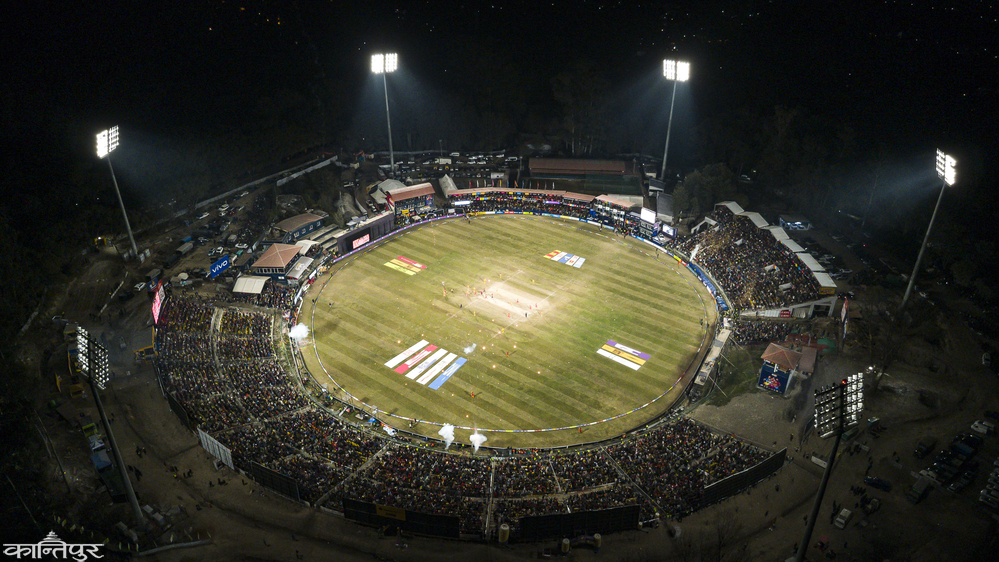 In 2019, Nepal again demonstrated government support for sports by organizing the 13th edition of the South Asian Games. The reconstruction of the Pokhara Stadium and the construction of the Mulpani Cricket Ground were carried out. Infrastructure construction work in mountainous sports such as high altitude sports has gained momentum. As a result, various forms of competitions are now making it operational.
As the country has moved towards federalism, the structure of provincial sports can be considered another dimension of decentralization. With the advent of the era of provincial governments having their own structure and budget management in sports, access to sports has increased in all seven provinces. The provinces are creating their own model for the development of provincial sports. The provincial government's support has increased from organizing provincial sports competitions to competitions held within the province. This has increased the number of local sports.
Weaknesses and challenges
Even though sports have spread internationally and taken a professional form, the problem remains the same. The budget allocated by the government is still low. The government has not been able to make policy reforms. Political interference in sports seems widespread. Although national sports associations are independent, the law has not allowed them to become independent.
Sports infrastructure has been created, but it is still minimal. The condition of sports infrastructure is poor. There are long-term plans for infrastructure announcements, but they have not been implemented. Grassroots programs have been created, but they are not being continued. The exodus of talented players is increasing.
As sports try to take a professional form, the indispensable basic program of sports science has not been able to be formed . The necessary participation in international competitions has not been able to increase . Nepali players have become limited to participation in major international competitions . The indispensable plan to make the sports sector a professional career and dream of a prosperous future is not being formed .
There is no other program that will produce players like Palesha Govardhan, Erica Gurung, Savitra Bhandari, Pratibha Mali, Pooja Mahato, and it seems that Nepali sports have taken the equally challenging aspect of protecting them for granted . Due to the lack of a good platform, players like Gaurika Singh, Shirish Gurung, Neerajan Malla, Bimal Ghartimagar, Shreya Dhital, Kavita Bhatta, Kritika Marasini and others quickly disappeared .
Overall, despite nearly four decades since the Nepali sports sector began practicing democracy, democracy or republic, sports have not yet become a sector with a solid plan. In this regard, unless the government can formulate a structural plan and implement it as an important part of the state, sports will remain limited to temporary development projects.

