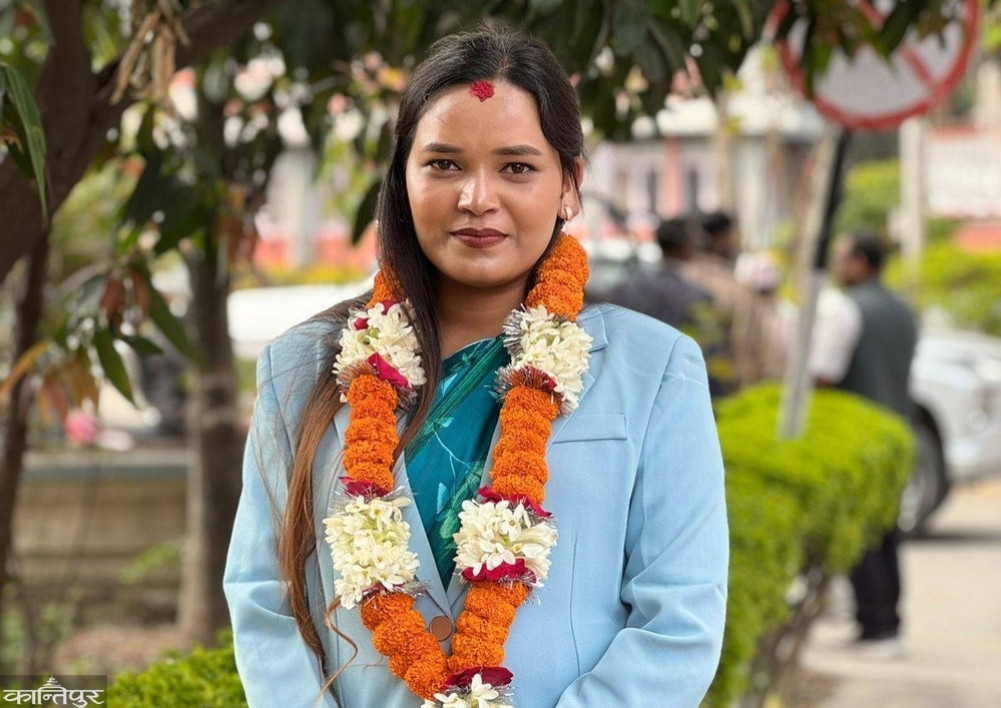
Khima, who was born into a modest family, has surprised everyone by entering politics in a short period of time and even becoming a member of parliament. She became an MP within five months of becoming a party member.
We use Google Cloud Translation Services. Google requires we provide the following disclaimer relating to use of this service:
This service may contain translations powered by Google. Google disclaims all warranties related to the translations, expressed or implied, including any warranties of accuracy, reliability, and any implied warranties of merchantability, fitness for a particular purpose, and noninfringement.
When the Genji uprising broke out on Bhadra 23, Khima BK was working at Siddharthanagar City Hospital in Bhairahawa. The events that had taken place throughout the day did not allow her to sleep at night. Preparations were underway for more protests the next day. She and many other health workers remained on standby at the hospital, thinking that the help of health workers might be needed. There were no major human casualties in Bhairahawa.
An interim government was formed after the Genji uprising and protests on Bhadra 23 and 24. Suddenly, there was a change in politics. Nurses across the country had been agitating for a long time. Even when they raised questions about their rights, the government did not listen. ‘We did not ask for anything big,’ she said. ‘We had demanded that the government implement what it had decided, but the government did not try to fulfill it.’
The incident forced Khima to think a little more seriously. Why couldn’t someone who had already come out on the streets for nursing rights go to Parliament tomorrow and raise their voice? This is what suddenly focused her thoughts on politics. Before that, she did not know much about politics, nor was she interested.
After thinking this, she felt the desire to join a political party and play a role in law-making and implementation. She faced the challenge of choosing a suitable party. ‘I did not see the possibility of getting opportunities and having my views heard in the old party,’ she said, ‘As an alternative, the National Independent Party was the right platform.’
She felt that the RSVP was carrying the voice of the new youth. Then she took membership online in Kartik. Then she received a notice to fill out the form for aspiring candidates for the elections. She also wanted to participate in it. The fee to become a proportional candidate was 50 thousand rupees. She did not have all the money. She asked her husband for more and filled the online form.
To become a candidate, she had to give a presentation about who she was and why she wanted to become an MP. She participated in it. She participated in some door-to-door programs. Finally, there was a presentation in Kathmandu, where she gave her presentation as well. Finally, internal voting took place. She managed to get 9,835 votes from party members across the country and was ranked seventh from the Dalit cluster in the closed list. Since her name was in the back, there was no guarantee that she would become an MP. She did not know how many votes the party would get. Nevertheless, she thought of contesting the elections for some time. She decided to take a leave from the hospital for a few months. She left the hospital for the elections towards the end of Poush. ‘I had not left. I had gone on a long leave to return to work,’ she said. ‘I thought I would have to return to work again. I have not yet been able to talk about not coming to work again.’
After the party received a good number of votes in the elections, 27-year-old Khima has become a proportional representation MP from the Dalit cluster of the Rashtriya Swayamsevak Sangh (RSS). She said that she is now planning to take official leave after talking to the hospital. Khima, born in Dangisharan-2, Kalangkhola, married Pawan Sunar of Swargadwari Municipality-3, Batule, Pyuthan last November. Sunar is an ASI of the police.
Only her husband knew that she was involved in politics. She had not told her parents anything. ‘I understood that politics was not our job. That is why I did not tell her at first,’ she said, ‘I only told her after the election.’ She contested the election in her own constituency, Dang-3. She said that she had campaigned in the villages throughout the election period, feeling that she had to win the direct candidate Kamal Subedi at any cost.
Finally, she was satisfied when the election results came out well. While walking on a steep road while going home to Pyuthan before the election, her leg sprained. Her leg hurt for some time, but she continued to campaign, ignoring the pain in her leg.
She started her studies in Grade 1 at Mavi Center Tulsipur. She studied at the village’s Gyanodaya Boarding School until Grade 6. Then she returned to Tulsipur and studied at Great Araniko Mavi from Grade 7 to 10. She passed her SLC from there in 2073.
She studied nursing at Lord Buddha Nursing College, Kohalpur, Banke. After completing nursing in 2020, she worked in various hospitals for some time. While working, she felt the desire to go abroad. When the consultancy told her that she could work without a nurse's license, she believed it. She went to Dubai on a visit visa after spending 550,000 rupees. The work in Dubai did not go as planned, she did not receive her salary on time, and many problems started arising. After that, she returned to Nepal within 60 days.
'After going abroad, I fell in love with Nepal even more. Now I decided to return to Nepal and work, and so I came to Nepal,' she said, 'A year ago, I returned to Nepal and started working in a hospital in Bhairahawa.' She had joined the job with the plan to work in the health sector. ‘Even when the election results came, I was sure that I would return to work,’ she said. ‘I didn’t think I would become an MP, I was sure that I would contribute my best, otherwise I would return to work.’
Khima, who was born in an ordinary family, has surprised everyone by entering politics in a short time and even representing the parliament. She became an MP within five months of becoming a party member. Her father is a retired police constable and her mother is a housewife.
She is the eldest daughter of the family. Her brother studied agriculture and went to Israel, while her sister is studying pharmacy. The moment she entered parliament directly from the hospital was also surprising for her. Now she wants to play an important role in policy-making for the country. ‘My wish to go from the street to the parliament has been fulfilled,’ she said. ‘Now I will contribute to the country according to the party’s plans and policies.’