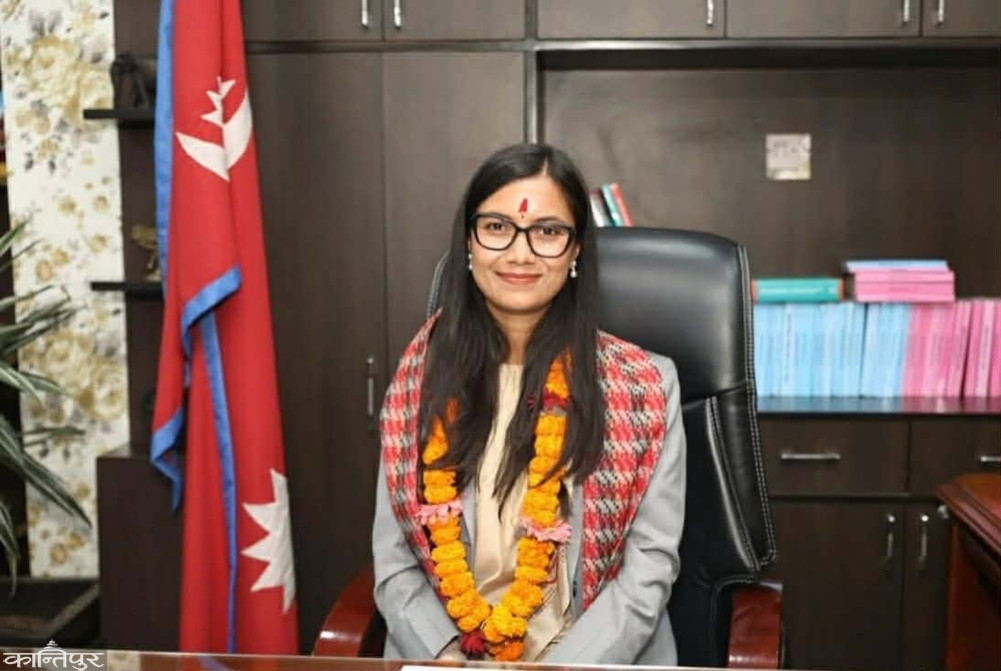
Gautam faces challenges as well as opportunities in the ministry, which is responsible for everything from lawmaking to constitutional amendments to the appointment of judges.
We use Google Cloud Translation Services. Google requires we provide the following disclaimer relating to use of this service:
This service may contain translations powered by Google. Google disclaims all warranties related to the translations, expressed or implied, including any warranties of accuracy, reliability, and any implied warranties of merchantability, fitness for a particular purpose, and noninfringement.
Sobita Gautam has been given the responsibility of the Ministry of Law, Justice and Parliamentary Affairs. Gautam, who has become a member of the House of Representatives for the second time, has been given the responsibility of the ministry by Prime Minister Balendra Shah as she comes from a legal background.
Gautam has a challenge as well as an opportunity in the Ministry of Law, which is responsible for everything from lawmaking, constitutional amendment to the appointment of judges.
Her challenge is to harmonize laws that are duplicative and hinder development. If the appointment of judges is to be made transparent, it is a great opportunity for her. Her next challenge is to resolve the transitional justice issue that has been dragging on for 19 years. It has been a victim of political party division for a long time.
Sobita's 7 challenges
There is no uniformity in the law and it needs to be improved . The government faces the challenge of making such laws relevant to the times— Parashwar Dhungana , Secretary of the Ministry of Law The Ministry of Law is currently unable to determine how many laws are in existence. Laws that have come through regulations, procedures, and ordinances conflict with each other. In 2074 BS, many old laws were repealed by implementing the Civil Code, but there are still thematic laws remaining. This has also caused problems in the work of the government from time to time. For example, the Right to Information Act states that all information, except for certain specific subjects, must be provided to citizens upon request, but many laws, including tax, customs, and the Judicial Council, state that information will not be required to be provided.
Similarly, due to some provisions in the Forest Act, the government has had to stop development work. Secretary of the Ministry of Law Parashwar Dhungana admits that there is a need to improve the law as there is no uniformity. He argues that there is also a challenge in making such laws timely. The employees of the Ministry of Law understand that it will be easier for the Rashtriya Swayamsevak Sangh (RSS) government to get close to two-thirds of the votes when previous governments were in collusion and due to the mandatory consent of the ruling coalition, such laws could not be presented in the House for reform.
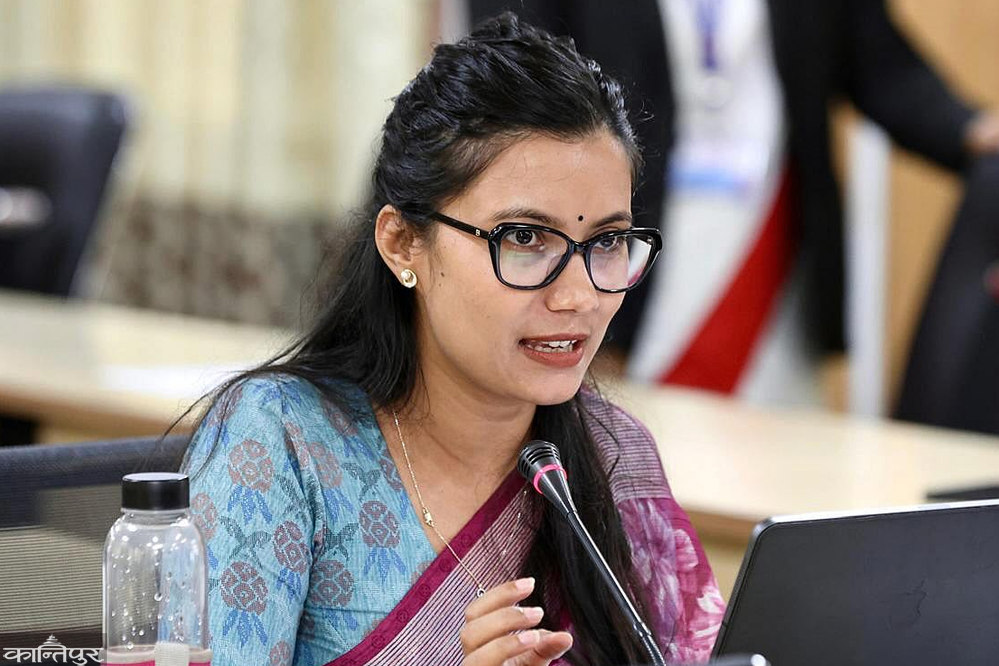
Similarly, another challenge for the new Law Minister is to formulate laws for the implementation of the constitution. Many laws for the implementation of the constitution issued on Asoj 3, 2072 have not yet been formulated. The constitution states that they will be in accordance with federal laws, but since the laws have not been formulated yet, they have not been implemented. The challenge is to identify it and formulate laws in a hurry.
The RSP has mentioned the agenda of amending the constitution in its election manifesto. Since it will take time, it seems that attention should be paid to formulating federal laws. For example, the Human Rights Commission Act, the Commission for the Investigation of Abuse of Authority and other laws have been stalled even after reaching the parliament. It seems that the Law Minister should take the initiative to advance those laws.
Similarly, laws for the implementation of fundamental rights have not yet been formulated. Fundamental rights are called the people's system in the constitution. But no laws have been formulated to implement them for 10 years.
According to the Constitution of Nepal 2072, there are 31 fundamental rights. Of these, only 16 laws have been formulated. Fundamental rights are mentioned in Part 3 (Articles 16 to 46) of the constitution. So far, the Consumer Protection Act 2075, the Right to Housing Act 2075, the Right to Employment Act 2075, the Right to Food and Food Sovereignty Act 2075, the Health Service Act 2075, the Right to Education Act 2075, and the Social Security Act 2075 have been enacted.
Similarly, Article 265 of the Constitution states that other commissions from 2052 to 2064 will be reviewed after 10 years. Since 10 years have passed since the promulgation of the Constitution, a decision will have to be made on whether to maintain these commissions or not. Since the time specified by the Constitution has passed, the RSVP alone does not have two-thirds of the votes to do this through a constitutional amendment, and the RSVP does not have any seats in the National Assembly. In such a situation, there is a challenge to cooperate with other parties present in the Parliament. The Law Minister will have to play this role. The government itself will have to review the National Women's Commission, National Dalit Commission, National Inclusion Commission, Indigenous Nationalities Commission, Madhesi Commission, Tharu Commission, and Muslim Commission and submit a constitution amendment ordinance. For this, it seems that the Law Minister will be responsible for deciding whether to act according to the draft of the constitutional amendment mentioned in the RSP's pledge or separately.
Point 10 of the RSP's pledge states that within three months of assuming power, it will prepare a 'discussion paper' to establish a national consensus. It is mentioned that the issues to be submitted for initial discussion by the RSP will be a directly elected executive, a fully proportional parliament, a system where there will be no MP ministers, non-partisan local governments, and a reformed provincial structure. The Law Minister will be responsible for coordinating with all parties from preparing the draft to implementing this pledge.
Similarly, another challenge for the Law Ministry is to finalize transitional justice. The work of investigating and delivering justice in cases of human rights violations committed during the armed conflict that lasted from 2052 to 2062 has been delayed for 19 years. The Law Minister will have to make a big effort to complete the process of transitional justice from judicial reform to the transitional justice process— Govinda Bandi , former Law Minister Similarly, another challenge for the Law Minister is the reform of the judiciary. Since the Law Minister will also be a member of the Judicial Council, the Law Minister will be responsible for making the appointment of judges transparent and ending the division of political parties. Similarly, since the Law Ministry is also responsible for linking judicial issues with the government, this will remain a challenge. The demand for restructuring the Judicial Council has been raised for a long time, so it will have to be reformed as the Law Minister.
In a situation where every political party has made transitional justice only a stepping stone to power, the challenge is for the new party to complete it. Despite the formation of the Truth and Reconciliation and Disappearance Commissions, there have been allegations that political parties have recruited people who are favorable to them. Victims of armed conflict have filed cases in the Supreme Court expressing their dissatisfaction, while the international community has not openly supported Nepal's transitional justice process. In such a situation, it is a challenge to make it victim-oriented and gather international support to conclude it.
Since Gautam himself studied law, it would be a great success if he can successfully resolve these challenges. Former Law Minister Govinda Bandi said that a lot of effort is needed to complete the transitional justice process from judicial reform to completion.
'Although the Ministry of Law is not a priority ministry, it requires a lot of effort because legal work cannot be done without its approval,' he said. 'In the past, it was not accessible and was kept at the bottom in the party division. But this is a ministry as important as the Ministry of Finance and Foreign Affairs.' He said that a separate law is needed for budget implementation. 'If the budget is not implemented in Shrawan, a law to take action should be made immediately, but difficulties such as employees not making it easy may also arise,' he said. Bandi says that the government that the people have high hopes for has many challenges.
Who is Sovita Gautam?

Gautam, who won from Kathmandu in the 2079 House of Representatives election, was elected from Chitwan-3 in the House of Representatives election held on 21 Falgun. In that constituency, the NCP had fielded former mayor of Bharatpur Metropolitan City Renu Dahal as its candidate. But Sovita defeated Dahal by 38,662 votes.
Born in Asad 2052, Gautam is a law graduate. She is also an advocate. She won from Kathmandu-2 in the first election after the formation of the Rashtriya Swayamsevak Sangh (RSS). She did not hold any executive position in the previous election. But in Parliament, she really showed herself. She got the opportunity to improve her legal studies and experience in parliamentary committees. She turned this opportunity into an opportunity and this time she took on the responsibility of Law Minister.