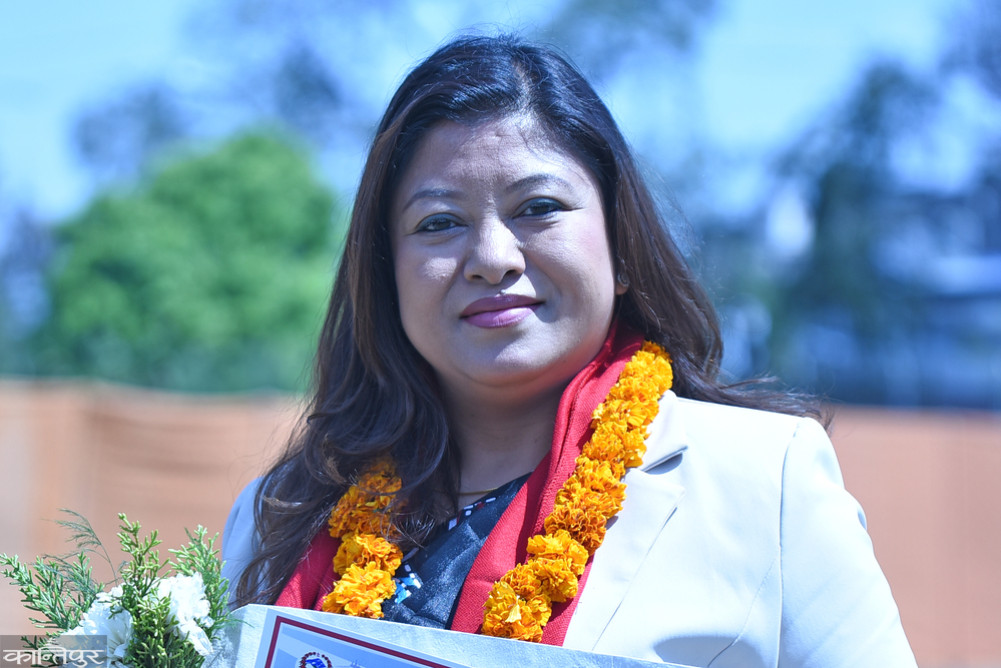
Before becoming an MP, she was not affiliated with any political party. She was working in her own field and was led into politics by the situation in the country. ”We were working in our own field, but when we saw that the situation in the country was weak, we joined politics because it would affect all sectors,” she said.
We use Google Cloud Translation Services. Google requires we provide the following disclaimer relating to use of this service:
This service may contain translations powered by Google. Google disclaims all warranties related to the translations, expressed or implied, including any warranties of accuracy, reliability, and any implied warranties of merchantability, fitness for a particular purpose, and noninfringement.
The Information Technology (IT) sector is expanding in Nepal, but the corresponding policy and structure are still not sufficient. Sirjana Shrestha has reached the Parliament with the aim of solving the policy problems of the IT sector. In the 22 years she has spent in the IT sector, she has worked in various technical, managerial and professional aspects. She also held the responsibility of the former Vice President of the Computer Association of Nepal.
She got the opportunity to understand the policy issues, challenges and prospects of the information technology sector closely. She resigned from the position of Vice President of the CAN Federation and was elected as an MP from the proportional representation of the Rashtriya Swayamsevak Sangh (RSS). She has been particularly active in the field of cyber security. She has worked on issues ranging from personal data security to the safe use of digital systems. She says that she has reached the Parliament with the aim of using this experience in policy making.
Entering politics is a new experience for her. She has faced many challenges while doing business for a long time. She has observed shortcomings in issues such as policy ambiguity, weaknesses in implementation, lack of necessary support in the technology sector, and cybersecurity. She said that she decided to travel to Parliament after realizing the need to work at the policy-making level to find solutions rather than just problems. She said, "While working in the IT sector, we faced many problems, and we realized that those problems were in the policy itself." That is why I felt that we should go to the policy-making level to solve those problems. This thinking led me to politics. She said that she entered politics because she felt that sufficient change would not be possible by lobbying from outside and that she had to get involved herself when she saw that the situation in the country was gradually deteriorating.
According to her, although there is a lot of potential for the development of the IT sector in Nepal, that potential has not been utilized due to policy weaknesses. Especially in the areas of cyber security, data security, digital infrastructure, and startup promotion, a lot of work remains to be done. ‘Cyber security is the most important issue of the day, but it is still not being taken seriously,’ she said.
She was not affiliated with any political party before becoming an MP. The situation in the country, which has been working in her own field, led her to politics. ‘We were working in our own field, but when we saw that the country’s situation was weak, we joined politics because it would affect all sectors,’ she said.
She learned about the political process, working methods and structure in the two-day orientation provided by the party. She said that the orientation program helped her understand the work, responsibilities and processes of the parliament. She says that she is now starting to understand that politics is different. According to her, the current parliament has the presence of experts from various fields, which can help make policymaking more effective. She believes that it will be easier to work based on expertise when people from every field are in the parliament.
She said that after entering politics, she felt the expectations and responsibilities of the people closely. She also said that she has resolved to use the experience, skills and knowledge she has gathered for the country. She said that she aims to play a strong role in the development of the IT sector, building a digital Nepal and formulating technology-friendly policies.