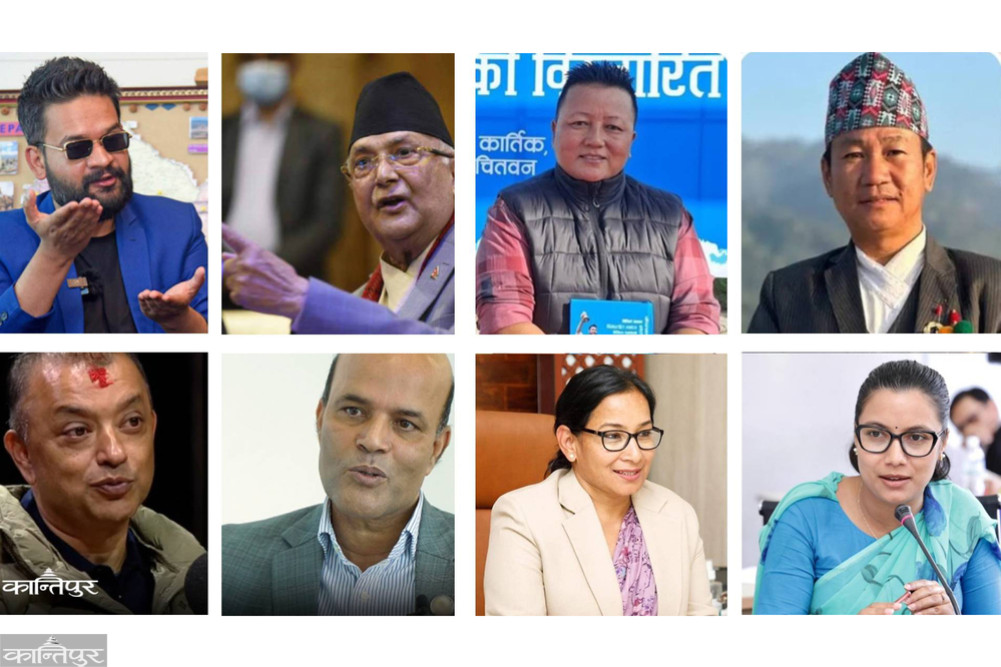
As the results of the House of Representatives elections continue to come in, the results from the areas considered 'hot seats' have been looking interesting. What is the status of the vote counting in each area?
We use Google Cloud Translation Services. Google requires we provide the following disclaimer relating to use of this service:
This service may contain translations powered by Google. Google disclaims all warranties related to the translations, expressed or implied, including any warranties of accuracy, reliability, and any implied warranties of merchantability, fitness for a particular purpose, and noninfringement.
As the results of the House of Representatives election are coming in, the results of the areas considered 'hot seats' are looking interesting.
The scene of Jhapa-5, which is considered a hot seat, is looking interesting. A competition is underway between UML Chairman KP Sharma Oli, who is also a former Prime Minister, and Balendra Shah (Balen), a senior leader of the Rastriya Swatantra Party (RSWP). Oli is the Prime Ministerial candidate from UML, while Shah is the Prime Ministerial candidate from RSWP.
The counting of votes began in Jhapa-5 at 3:15 am on Friday. Looking at the current situation, Balendra Shah of RSWP is in the lead there with 15,169 votes.
Similarly, UML Chairman Oli has received 3,344 votes. Oli was contesting the election from Jhapa for the eighth time, while this is Shah's first 'inning'. Oli was elected as a member of the House of Representatives from Jhapa-6 in the 2048 general election. Then, in the mid-term elections held in 2051 BS, he contested from the same constituency. In that election, he defeated Keshav Kumar Budhathoki.
In the general elections of 2056 BS, Oli had filed his candidacy from two constituencies. He contested from Jhapa-2 and Jhapa-6 and won in both constituencies. In Jhapa-2, he defeated Congress candidate Giriraj Kumari Prasai and in Jhapa-6, he defeated Kashilal Tajpuria.
In the first Constituent Assembly election (2064 BS), Oli changed his constituency and chose Jhapa-7. However, in that election, he was defeated by the then CPN (Maoist) candidate Bishwadeep Lingden Limbu. This was the first election in which the Maoists participated in parliamentary elections after 10 years of armed conflict.
In the second Constituent Assembly election held in 2070 BS, Oli made a comeback. At that time, he was elected to the Constituent Assembly by defeating Congress candidate Suresh Kumar Yongya. After the promulgation of the constitution, Oli changed the constituency again and filed his candidacy from Jhapa-5 in the 2074 BS House of Representatives election. In that election, he defeated Congress candidate Khagendra Adhikari.
In the 2079 BS House of Representatives election, Oli also contested from Jhapa-5. In that election, he defeated the same Congress candidate Adhikari and maintained his continuity. However, in this election, he has been seen as a weak candidate.
Balendra Shah, who entered the parliamentary election field for the first time, has a much larger margin than him. Balendra Shah was elected as mayor in the 2079 BS local level election in Kathmandu Metropolitan City.
Sunsari-1
In Sunsari 1, Dharan Sub-metropolitan City is the center of independent-style politics and competition between established parties. Former Dharan mayor Harkaraj Rai (Harka Sampang) has entered the election fray as the main attraction in this constituency. He has filed his candidacy from the Shram Sanskriti Party. Sampang, who became popular in Dharan for his activities like Shramdan campaign, drinking water and direct participation in public works, is contesting the election saying that he will carry the same style of politics to the federal parliament.
This time, about 26 candidates, including various parties and independents, are in the fray in Sunsari-1, which has made the competition more multifaceted. In the previous House of Representatives election (2079), Ashok Kumar Rai had won from this constituency. He had won the contest by getting more than 17,000 votes, while Rastriya Swatantra Party candidate Goma Tamang was in second place.
This time, Goma seems to have overtaken Harka. So far, Goma is leading with 7,755 votes, while Rai, who is trailing by 1,182 votes, is following him.
Sarlahi-4
As the counting of votes for the House of Representatives elections continues, the results of some constituencies that are considered 'hot seats' are becoming interesting. Among them, Sarlahi-4 in Madhesh Province has also become a center of special interest.
In this constituency, there is a competition between Nepali Congress President Gagan Kumar Thapa and Rastriya Swatantra Party (RSWP) candidate Amresh Kumar Singh. In the initial counting, Singh has taken the lead, while Thapa is following him.
According to the results so far, Singh has received 4,496 votes. Thapa of the Congress is in second place with 2,530 votes.
Sarlahi-4 has long been known as a famous constituency in national politics. Singh has been elected as a member of the House of Representatives from this constituency repeatedly. He was elected from this constituency in the 2070 BS Constituent Assembly elections. Then, in the 2074 BS election, he also won from Sarlahi-4.
Singh also won in the 2079 BS election. At that time, he won by running as a rebel candidate against the Congress.
On the other hand, Thapa has been elected from Kathmandu-4 continuously before. Thapa, who became a member of the Constituent Assembly through proportional representation in 2064 BS, was directly elected from Kathmandu-4 in 2070, 2074 BS and 2079 BS.
This time, Thapa has entered the electoral fray from Sarlahi-4. However, judging by the results so far, the competition seems challenging for him.
Saptari-3
Saptari-3 of Madhesh Province is considered one of the areas with interesting competition in this year's House of Representatives election. Here, candidates from major parties, including Janata Samajwadi Party Chairman Upendra Yadav, are competing. Yadav, who is also a former Deputy Prime Minister, has changed his constituency and filed his candidacy from Saptari-3. In the previous election, he had contested from Saptari-2, but after losing to Janmat Party leader CK Raut, he changed the constituency.
In Saptari district, which is politically dominated by Madhesh parties, the competition between national parties and regional parties has always been intense. In the 2079 BS House of Representatives election, Congress leader Dinesh Kumar Yadav had won from the same constituency. He won the election by securing more than 26,000 votes.
This time, Rashtriya Swayamsevak Sangh (RSS) has pitted Upendra Yadav against Rashtriya Swayamsevak Sangh (RSS)'s Amar Kant Chaudhary in Saptari-3. So far, Upendra Yadav has secured 2,821 votes while Amar Kant has secured 3,175 votes.
This time, the situation seems to be somewhat different. In Madhesh, the influence of Janmat Party, JSP and other regional parties has been increasing recently, while national parties are also trying to expand their base. For this reason, the competition in Saptari-3 is also seen as a test of the changing political equation in Madhesh.
Kathmandu-4
Kathmandu-4 is considered one of the famous constituencies of the federal capital. For a long time, Nepali Congress General Secretary Gagan Thapa has been elected in this constituency, but this time the Congress has put forward a new candidate.
Young candidate Sachin Timalsina from the Congress is in the fray. This is his first parliamentary 'inning'. Pukar Bam of the National Independent Party (NISP) is competing with him.
Bam had previously become a candidate from Kathmandu-1. This time, however, he has chosen Kathmandu-4.
According to the results of the vote counting so far, Bam is seen leading. He has received 20,176 votes. Congress's Timalsina is in second place with 14,118 votes.
A new Congress candidate has to take charge of the election field in Kathmandu-4, which is considered the area of influence of Gagan Thapa. According to the initial results, the competition for Congress's Timalsina is looking challenging as RSP candidate Bam has taken a significant lead.
Bhaktapur-2
Bhaktapur 2 is also the area of most interest. Where UML Secretary Mahesh Basnet and RSP's Rajiv Khatri are the main competitors. Khatri is in first place with 15,261 votes, while Basnet, who is behind by 10,991 votes, is in second place.
In Bhaktapur-2 of Bagmati Province, the main competition is between UML Secretary Mahesh Basnet and RSP candidate Rajiv Khatri. According to the results of the vote counting so far, Khatri is in the lead. He has received 15,261 votes. On the other hand, UML's Basnet is in second place with 10,991 votes.
Bhaktapur-2 has long been known as an area where UML has influence. On that basis, UML Secretary Basnet has entered the election fray this time too. Basnet is also a former minister and is known as an influential leader in the politics of Bhaktapur region. However, in this competition, the election results are being watched with interest after Khatri of the Rashtriya Swayamsevak Sangh (RSS) took the lead in the initial phase.
The final result is not yet decided as the vote counting is ongoing. However, the initial vote results indicate that the candidates of the established parties have been challenged by a new political force.
Chitwan-2
Chitwan-2 has become one of the most popular constituencies in the country since the 2079 House of Representatives elections. Rastriya Swatantra Party President Ravi Lamichhane is contesting here.
Lamichhane, who became popular through journalism and television programs, won the 2079 House of Representatives elections from this constituency. Then, after losing his post due to a citizenship dispute, he returned to parliament by winning again from this constituency. Therefore, this time's election is also seen as another test of his political influence.
Along with Lamichhane, Nepali Congress's Mina Kumari Kharel and CPN (UML)'s Asmin Ghimire are in the fray. According to the results of the vote counting so far, Lamichhane is seen leading. He has received 26,120 votes. He is followed by Congress' Kharel with 7,347 votes. As the Rashtriya Swatantra Party (RSP) emerges as a new party, the results of Chitwan-2 are also seen as an indication of how much influence the party will retain in national politics.
Chitwan-3
Along with Chitwan-2, Chitwan-3 is also a hot constituency this time. The contest is between former mayor of Bharatpur Metropolitan City Renu Dahal and Sobita Gautam of the Rastriya Swatantra Party. Dahal, who was elected mayor of Bharatpur Metropolitan City in the 2074 and 2079 local elections, is entering the fray this time as a member of the House of Representatives. This election is seen as an opportunity for Dahal, who has filed her candidacy from the CPN (Maoist Center), to enter federal politics.
On the other hand, Sobita Gautam was elected from Kathmandu-2 in the 2079 House of Representatives elections. Gautam, known as a youth leader, is trying to expand the influence of the RSP by contesting from Chitwan-3 this time.
According to the current vote count, Gautam is seen in the lead. She has received 17,851 votes, while Dahal has received 9,814 votes. The contest in Chitwan-3 is also being seen as a clash between the established party and the new political force. Therefore, the vote results here have been analyzed as an indication of how much influence the new parties are increasing in national politics.