In 165 direct elections, only a small number of women from major parties have been given opportunities, with 395 women candidates from all parties and independents, representing only 11.34 percent of the total candidates.
We use Google Cloud Translation Services. Google requires we provide the following disclaimer relating to use of this service:
This service may contain translations powered by Google. Google disclaims all warranties related to the translations, expressed or implied, including any warranties of accuracy, reliability, and any implied warranties of merchantability, fitness for a particular purpose, and noninfringement.
The major parties have neglected to field women as direct candidates in the upcoming House of Representatives elections. Out of the 165 direct candidates, only a small number of women have been given the opportunity to run for office by the major parties. 3,484 candidates have registered with the Election Commission to contest the direct election for the House of Representatives, of which 395 are women. This is only 11.34 percent of the total candidates.
The Congress has fielded 11 women candidates this time. This number is 6 percent of the total 165 candidates of the Congress. In the 2079 elections, 8 women were in the race from the Congress.
At that time, the Congress and Maoists, including parties, were in an electoral alliance. This time, the Congress has the highest number of 5 women candidates in Bagmati. Sapana Rajbhandari from Kathmandu-8, Nanu Bastola from Kathmandu-9, Mahalaxmi Upadhyay 'Dina' from Makawanpur-1, Sushila Thing from Sindhuli and Meena Kumari Kharel from Chitwan-2 are candidates.
In Koshi, Sarita Prasai from Jhapa-2 and Mandhara Ghimire from Jhapa-5 are candidates, while in Madhesh, Kiran Yadav from Mahottari-2 and Chandrakalakumari Yadav from Siraha-4 have been given tickets. Kusumdevi Thapa Magar from Rukum East in Lumbini and Basna Thapa from Dailekh-1 in Karnali have become candidates. There are zero female candidates from the Congress in Gandaki and Sudurpaschim.
This time, the UML has fielded only 5.4 percent of its total candidates, or 9 women, in the direct elections, which is a decrease compared to the last election. In the last election, 12 women contested from the UML. This time, the UML has not fielded a single female candidate from Bagmati, Karnali and Sudurpaschim.
The UML candidates are Bhagwati Chaudhary from Sunsari-4 in Koshi, Kalpana Rai from Solukhumbu and Asmita Thapa from Okhaldhunga. In Madhesh, Julie Mahato from Dhanusha-3, Jwala Shah from Bara-3 and Rima Yadav from Parsa-2 have become candidates. In Gandaki, Bhagwati Neupane from Tanahun-1 and Manju Sharma Chalise from Baglung-2 are candidates, while in Lumbini, Bimala BK has got a ticket from Bardiya-2.
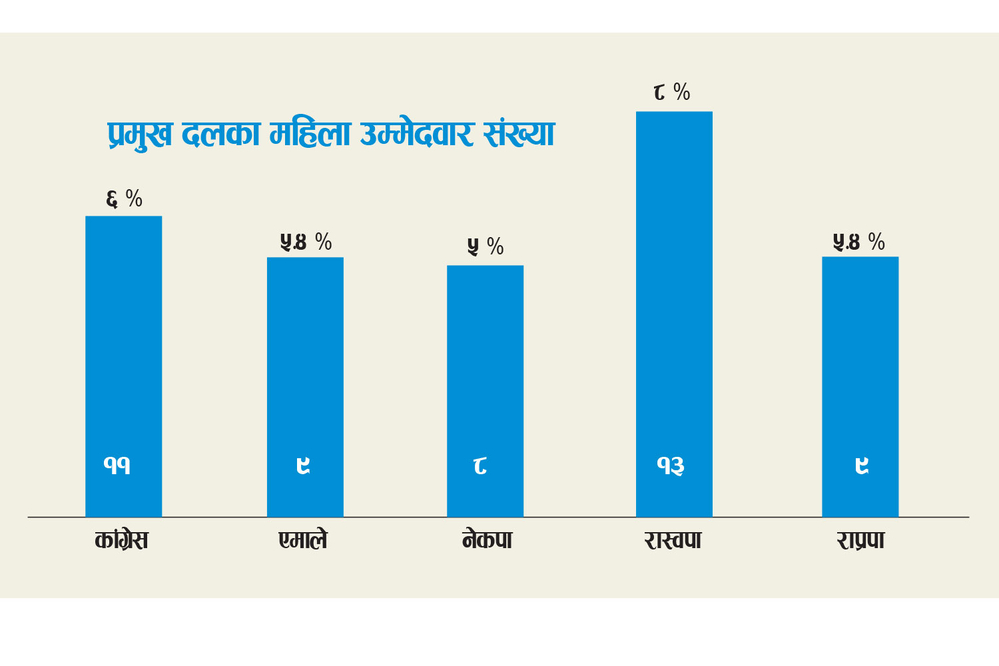
The NCP has also fielded only 8 women candidates, which is only 4 percent of the party's total candidates. Sarita Khadka Thapa from Sankhuwasabha, Ram Kumari Chaudhary from Sunsari-2, Ruby Karna from Saptari-4, Menka Bhandari from Kathmandu-1, Kalpana Sharma from Kathmandu-5, Renu Dahal from Chitwan-3, Sindu Jalesha from Nawalparasi (West)-1 and Bina Magar from Kanchanpur-1 are candidates.
The Rashtriya Swayamsevak Sangh (RSS) has given direct tickets to 13 women while fielding candidates in 164 constituencies. Nisha Dangi from Jhapa-1, Indira Rana from Jhapa-2, Rubina Acharya from Morang, Ranju Darshana from Kathmandu-1, Toshima Karki from Lalitpur-3, Ashika Tamang from Dhading-1, Bina Gurung from Kaski-3 and Binita Kathayat from Jumla are the candidates of the Rashtriya Swayamsevak Sangh (RSS). Gauri Kumari Yadav has been nominated in Mahottari-4, Nitima Karki in Sarlahi-1, Pushpa Chaudhary in Saptari-1, and Kishori Sah in Dhanusha-1.
RPP has given tickets to only 9 women out of 165 candidates. Hiradevi Shrestha from Sankhuwasabha, Bina Jaiswal from Parsa-2, Anisha Nepali from Salyan, Kuntidevi Pokharel from Kathmandu-2, Sajina Karki from Lalitpur-1, Runkumari Mahato from Nawalparasi East-2, Kamala Lalchan from Mustang, Karbika Thapa from Rupandehi-2, and Babita Shahi from Dailekh-2 are candidates.
In the 2079 House of Representatives elections, 235 women had filed their candidacies from both direct parties and independents. There were 85 women candidates from the independents. According to the commission, the UML, Rastriya Swayamsevak Sangh (RSS) and Nemkipa (Nemkipa) fielded the most female candidates at that time. All three parties had fielded 12-12 female candidates.
Even though parties talk about gender equality in their manifestos and public statements, male dominance persists in ticket distribution, said Congress leader Sarita Prasai. She, who has filed a direct candidacy for the House of Representatives from Jhapa-2, said that the trend of not giving women competitive seats and limiting them to safe areas is making the development of female political leadership even more challenging.
She also commented that it is difficult for women to become candidates even though the election competition is expensive. ‘Elections are expensive, we cannot think about elections until women are economically empowered,’ she said.
UML leader Vidya Bhattarai said that there is a tendency to understand the proportional representation system as a system that is reserved only for women. ‘It is not that they cannot compete in direct elections, but the main problem is that the necessary structural support and environment are not ready for it,’ she said. According to her, earlier, women’s names were not even included in the candidate recommendations. But now, they are starting to be recommended and included in the list. She said that women are considered weak in the final decision-making stage.