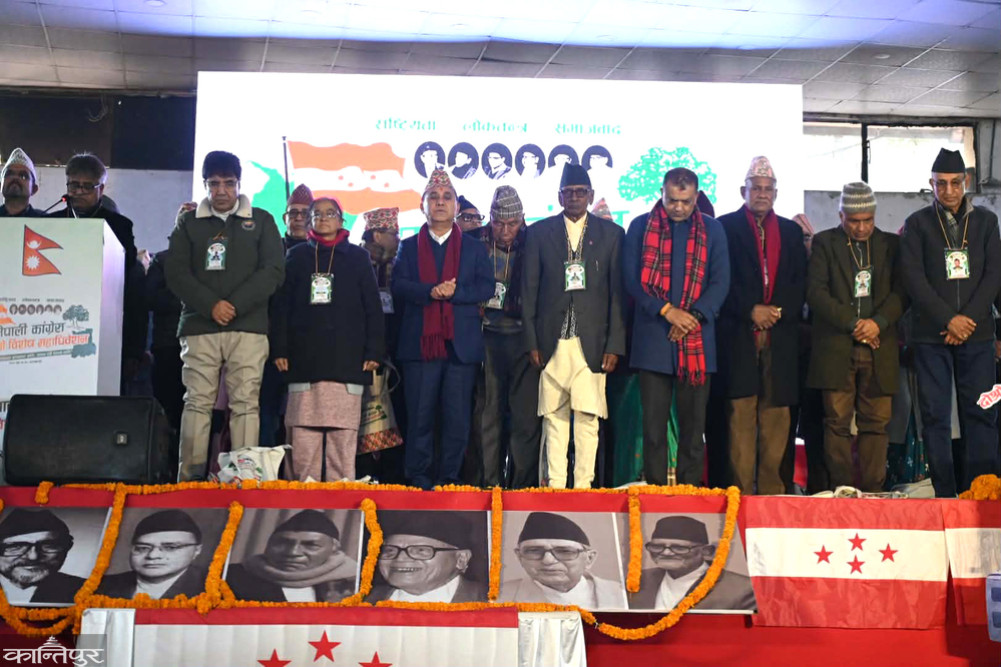
The Election Commission is also studying the controversy that has emerged in the Congress in the midst of the election.
We use Google Cloud Translation Services. Google requires we provide the following disclaimer relating to use of this service:
This service may contain translations powered by Google. Google disclaims all warranties related to the translations, expressed or implied, including any warranties of accuracy, reliability, and any implied warranties of merchantability, fitness for a particular purpose, and noninfringement.
A debate has begun in the Congress over the legitimacy of a special general convention to elect leadership. President Sher Bahadur Deuba's faction consulted with its legal advisors on Monday.
The supporters of the special general convention have claimed that it will be legal as the majority will decide the leadership. The Election Commission has also shown interest in the controversy seen in the Congress in the midst of the election.
After the legal consultation argued that the decision made by the majority at the special general convention should be accepted and that the special general convention is legal, President Deuba has become flexible and is preparing to hold talks with the general secretary himself. Meanwhile, the special general convention side is going to move forward with the election process on Tuesday to elect a new leadership.
The process will be taken forward by dissolving the old election committee and forming a new election committee, said the general convention campaign coordinator Subash Pokharel. "The hall will decide on the report of the general secretary on Tuesday, after which we will start the election process," he said.
If the special general convention side selects the leadership, it will file an application with the Election Commission for an update. Therefore, there is a possibility that this dispute will reach the court through the commission. For this reason, the commission has started a legal study on how to resolve the dispute if it arises. The officials of the Commission and the Law Division are studying the statute, act, rules and past precedents of the Congress.
If the special general convention changes the leadership, the Commission will have to be informed as per Section 51 of the Political Parties Act. The said section states that the party must inform the Commission of any changes or amendments to its name, statute, rules, seal, flag or symbol, changes in office bearers and other matters as specified by the Commission within 30 days.
The Commission shall conduct necessary studies and investigations on the information and activities received in this manner and if found to be in accordance with the constitution, act, rules and the party statute, the Commission shall update the details of the concerned party.
In the event of an internal dispute in the party, it is difficult for the Commission to easily update the details received from one side, so it is customary to take a few days or form a bench and make a decision after hearing both sides.
The other party may approach the Commission to stop it by saying that the details given by the special general convention supporters are incorrect. In such a situation, the issue of dispute resolution regarding the recognition of the party in Chapter 9 of the Act seems to be attracted and the Commission should reach a decision accordingly.
Section 43 under Chapter 9 states that the Commission has the authority to resolve disputes between two or more parties or between two or more parties of the same party regarding the name, seal, statute, flag, symbol, office bearers, central committee or the authenticity of the decisions of the central committee.
If there is a claim from both parties regarding the name, flag, etc. of the central committee and the party, the Commission will proceed with the dispute resolution process in Sections 43, 44, 45 and 46 of Chapter 9, a commissioner of the Commission said. If the two parties do not reach an agreement during the dispute resolution process, the Commission will recognize one of the parties as the party before the dispute arose, based on evidence.
In a situation where only one party cannot be recognized, the party with the majority in the central committee can be recognized as the old party and the other party can be recognized as a separate political party. However, the new party formed in this way cannot participate in the upcoming elections. The deadline for registering parties for the purpose of the House of Representatives elections has already expired on 14 Mangsir.
Former Chief Election Commissioner Ayodhee Prasad Yadav says that if the general convention is called based on the provisions of the party statute, the decision it makes will be legal. ‘If the general convention is held in the presence of a majority of representatives, it gains legitimacy,’ he said, ‘In such a situation, the Election Commission takes a decision by looking at the provisions of the party statute, acts and rules. It can also take a decision by identifying them.’
The Election Commission may also not enter the dispute of the Congress by referring to the regulations on political parties. Rule 23 (6) of the regulations states that ‘no action shall be taken regarding the resolution of disputes of the party during the election period.’
Since the commission is busy with election preparation and management during the election period, such a provision has been made in the regulations because it will not be allowed to enter into dispute resolution and it will also cause many complications. But legal experts say that the commission is capable and cannot be avoided like this.
Senior advocate Shambhu Thapa says that the special general convention will gain legitimacy if the policy and leadership selection is made by the majority. ‘No one can stop the process that has gone before the public by saying it is illegal. It can be said that the right is on my side in a closed room, but after the majority of the general convention representatives selected a new representative, I had extended my term or the decision has not been made by the central committee,’ Thapa said.
He said that the special general convention is the mandate of the Congress workers. ‘President Sher Bahadur Deuba’s two terms have ended. "Extending his term when it is over means wanting to retain the power vested in him," Thapa said, "Such an act does not seem appropriate in the eyes of the law."
Senior advocate and former president of the Nepal Bar Association Gopal Krishna Ghimire said that since the highest body of the Congress is the General Convention and the representatives of the General Convention are decisive and a legal structure, no one can say that they do not accept its decisions.
"This special general convention was called by 54 percent, there is a participation of more than 50 percent, so both the policy and leadership it will adopt are legal," Ghimire said, "This dispute will go to the courts through elections, but the recognition will be in favor of the majority."
Constitutional expert Bipin Adhikari held the view that the General Convention, the highest body of the Congress, is free to exercise its powers as per the statute. ‘The general convention can legally decide its own course,’ he said. ‘If the presence of the majority of representatives in the special general convention makes some decision, it has legal and political legitimacy.’
Senior advocate Chandrakant Gyawali says that there is a mandatory provision in the statute for the president to call a special general convention after 40 percent of the representatives demand it. ‘The president should have called the general convention. That is mandatory. But he did not call it. In that situation, even if another party official calls it, it is still legal,’ he said. ‘The special general convention is seen as statutory and procedural. That is why a decision made with the presence of the majority of members gains legitimacy. Democracy is the rule of the majority.’
He said that it can take any decision legally. ‘If the agenda of leadership change is introduced in the general convention, it can decide on it. It can replace the current central committee and give a new committee,’ he said. ‘Everyone should accept the decision of the general convention held with the presence of the majority of representatives. The current Central Committee should also accept the decision of the General Conference.’