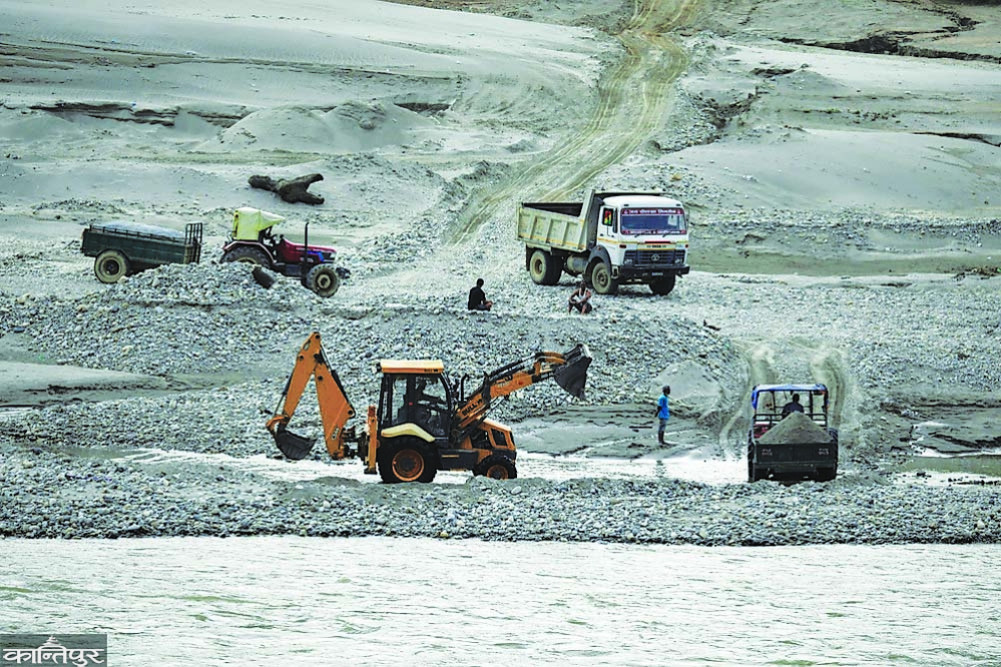
Although there are legal and policy provisions for the conservation of the Chure, the lack of effective implementation is evident.
We use Google Cloud Translation Services. Google requires we provide the following disclaimer relating to use of this service:
This service may contain translations powered by Google. Google disclaims all warranties related to the translations, expressed or implied, including any warranties of accuracy, reliability, and any implied warranties of merchantability, fitness for a particular purpose, and noninfringement.
The Chure region, considered to be very sensitive in terms of geo-structural aspects of Nepal, has reached a serious crisis today. The Chure mountain range stretching from the east to the west of the country is not just a series of mountains, but a natural foundation directly linked to the life and existence of the Terai-Madhesh. The Chure has been playing an important role in water conservation, protection of forest heritage, balance of biodiversity and control of soil erosion. But ironically, today this same Chure region seems to be under the control of over-exploitation, unorganized excavation, deforestation and politically protected mafias.
The Chure region is gradually becoming deserted due to the failure of government agencies to take effective steps in a timely manner. What is even more sad is that there are widespread public complaints that in some cases, government officials who should be protected are directly or indirectly involved in the exploitation process. If the state does not become serious even now, its impact in the future will definitely be serious not only on the environment, but also on the entire national economy and people's lives.
The greatest importance of the Chure region is linked to water resources. The Chure mountain range maintains the balance of natural water resources in the Terai region by storing rainwater underground. However, now due to uncontrolled stone, gravel, and sand mining, the natural structure of the land is weakening. As a result, the groundwater level is continuously decreasing. In many districts of the Terai, wells, taps, and wells that were previously easily available have now started drying up. Farmers are facing extreme problems with irrigation. The drinking water crisis is deepening day by day. The government needs to understand that the water crisis is not just an environmental problem, it is a national crisis linked to human existence.
The deforestation taking place in the Chure region is another terrible problem. With the increase in deforestation, the risk of soil erosion, landslides, and floods has increased sharply. During the rainy season, rivers are being clogged with mud flowing from the Chure, due to which the Terai region is experiencing an increasing number of devastating floods. On the one hand, there is the problem of inundation during the rains, and on the other hand, people are suffering from water shortage in the winter. This paradoxical situation has arisen after the natural balance of the Chure has been disrupted. The government should not delay in understanding that the long-term security of the Terai-Madhesh region is not possible without protecting the Chure region. The tendency to view natural resources only as a means of economic gain is certain to lead to a major national crisis in the future.
Political interference has become one of the main reasons for the destruction of the Chure region. Some political leaders from the local to the federal level have been accused of protecting their close associates for illegal mining. Dozers are running in the forest area, rivers are being exploited, but the administration seems to be keeping quiet. Why does the state appear innocent when influential people break the law? It is said that crores of rupees have been spent in the name of Chure conservation, but why is its real impact not visible? The people are seeking answers to these questions. Therefore, the government must now prove its commitment not just through speeches, but through strict implementation of the law.
The destruction of the Chure region is not only having an environmental impact, it is also causing a social and economic crisis. The destruction of the Chure region is not only causing environmental impacts, it is also causing social and economic crises. Cultivable land is being turned into wastelands. Farmers are being displaced. Poverty and unemployment are increasing in rural areas. Agricultural production is declining due to water shortages, which is directly affecting food security. The Terai-Madhesh region, which is considered the country's grain storehouse, is now facing a natural crisis. If this situation continues, there is a risk of a food crisis in the future. Even if the government talks big about development, how can development be possible when the natural base is weak? It is now necessary to understand that short-term economic gains obtained by destroying the environment will cause great harm to the nation in the long term. The time has come to link the conservation of the Chure with national security and the safety of people's lives.
Although there are legal and policy provisions for the conservation of the Chure, the lack of effective implementation is clearly visible. The Constitution has ensured the right to live in a clean environment as a fundamental right. Although there are clear provisions regarding the conservation of natural resources in the Environment Protection Act, the Forest Act and various policies, those laws have not been effectively implemented in practice. If the state cannot fulfill its legal obligations, how can the people expect justice? Strict monitoring, transparent administration and impartial action are now necessary for the conservation of Chure.
The government now needs to immediately come up with a long-term and practical plan. First, illegal mining in the Chure area must be completely controlled. Second, local communities must be involved in the conservation campaign to prevent deforestation. Third, special programs including scientific studies must be conducted to conserve groundwater. Fourth, strict control is needed over the exploitation of natural resources under political pressure. Fifth, a special security policy must be implemented by making the Chure area a national priority. The problem will not be solved by simply forming a committee or announcing it. Real work must be seen on the ground.
The role of local communities is also very important in the conservation of Chure. Conservation is not only the responsibility of the government, it is the common responsibility of all citizens. Local residents need to play an active role in protecting forests, opposing illegal mining and conserving natural resources. Awareness programs on environmental protection must be conducted at the school and university levels. It is especially necessary to inform the young generation about the importance of Chure. If today's generation fails to protect the Chure, future generations are at risk of losing all their water, forests, and fertile land. It is necessary to spread the awareness in society that 'If we remain silent today, tomorrow's basis for survival will be destroyed.' It has been seen that the conservation campaign should not be just a government program but should be promoted as a people's movement.
Ultimately, Chure conservation is not just an environmental issue, it is a matter linked to national existence. Chure is the basis of water, agriculture, biodiversity, and human life in the Terai-Madhesh. If Chure disappears, its impact will be felt across the country. The government, political parties, administration, civil society, and the general public must now take responsibility. The tendency to legitimize natural destruction in the name of development needs to be stopped immediately. Protecting the Chure means protecting the future. There is still time today, the government should be serious, take effective steps, and promote Chure conservation as a national campaign. Otherwise, water crisis, floods, landslides, desertification, and environmental destruction are certain to push Nepal towards a major crisis.