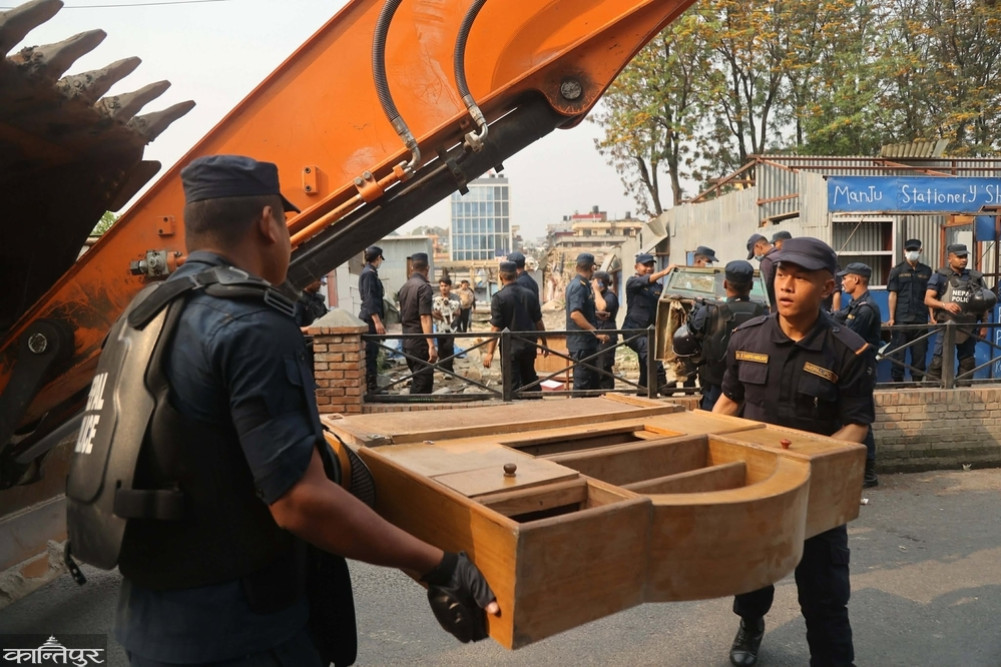
Did the state provide adequate rehabilitation and safe housing for the squatters? Who will bear the responsibility for the human damage and possible deaths that will occur if they are displaced without rehabilitation? Without transparent, impartial, and lawful answers to these questions, the concept of good governance remains incomplete.
We use Google Cloud Translation Services. Google requires we provide the following disclaimer relating to use of this service:
This service may contain translations powered by Google. Google disclaims all warranties related to the translations, expressed or implied, including any warranties of accuracy, reliability, and any implied warranties of merchantability, fitness for a particular purpose, and noninfringement.
The Constitution of Nepal has ensured the fundamental right to live with dignity, the right to housing and social justice to every citizen. However, the situation of the squatter community is extremely sensitive and complex at the level of practical implementation. The government campaign launched in the name of removing unorganized settlements along the river banks within the Kathmandu Valley has now raised many questions on human rights and good governance. In particular, the incident in which a squatter citizen was found dead in the Bagmati River after the dozer operation in the Teku area on April 18 has raised serious questions on the accountability of the state, the rule of law and the constitutional validity of administrative actions. That incident is not just a question of administrative implementation but a practical violation of fundamental rights protected by the state.
According to the factual aspect of the incident, during the settlement removal campaign conducted in the Teku area, a homeless squatter man was later found dead in the Bagmati River. According to preliminary accounts, he was in serious distress due to mental stress, homelessness and lack of basic security after the dozer operation. In this context, from a legal perspective, forced displacement by the state is a very sensitive act according to international human rights standards. It can only be carried out with prior notice, provision of alternative housing, adequate rehabilitation plans and assurance of human security. The UN human rights standards have also clearly stated that forced displacement should be used only as a last resort. Therefore, the question arises – were the ‘due process’ and the ‘principle of proportionality’ fully followed while conducting that campaign?
The government has argued that the settlements are located in a risky area along the riverbank and need to be removed for civil safety due to the high risk of flooding and inundation. However, in legal analysis, displacement based on risk alone is not enough. The state must also ensure alternative housing, temporary shelter and a long-term rehabilitation plan. The government side has presented the argument that the relevant settlements are located in risky areas along the river banks and due to the high risk of flooding and inundation, their removal is necessary for the safety of the citizens. However, when analyzing the law, displacement based on risk alone is not enough. The state must also ensure alternative housing, temporary shelter and a long-term rehabilitation plan. If the structure is removed without rehabilitation, it is a violation of the right to housing guaranteed by Article 37 of the Constitution. In this context, another important question arises – has the state provided ‘adequate alternative housing’ to the affected families? Or is its obligation fulfilled only through temporary relocation?
The squatter community also includes daily wage earners, construction workers, sanitation workers, transport workers and citizens involved in the informal economy, which constitute a significant part of the urban economy. Their forced displacement directly affects not only their right to housing but also their right to livelihood, education, health and social security. Such policy interventions create a crisis of trust in the state-citizen relationship. Therefore, according to the principle of social justice, the principles of ‘inclusiveness’ and ‘non-discrimination’ must be applied while formulating any public policy.
According to legal principles, any intervention by the state must be based on ‘principle’ or ‘proportionality’. Accordingly, a balance must be maintained between the public interest and individual rights. The main question raised after the Teku incident is – was the Dozer campaign really inevitable or could it have been transformed into a phased, humane and rehabilitation-based process? When a citizen dies as a result of any state action, it may not just be a personal accident but also a sign of possible administrative negligence or policy failure, which requires an impartial investigation.
The principle of good governance places transparency, accountability, participation and legal certainty at the center. However, the campaign to remove squatters does not appear to have sufficiently involved the meaningful participation of the affected communities, prior consultation, and exploration of alternatives. If the voice of the affected groups is not included in the policy-making and implementation process, it makes the decision one-sided, unbalanced, and socially insensitive. This not only weakens trust in the state in the long run, but also promotes social conflict.
It is necessary to integrate the solution to the squatter problem with long-term urban planning and social justice policies. Rather than adopting a policy of removal alone, improving their living standards, social housing programs, safe land management, and creating alternative employment opportunities can be a more effective and human rights-friendly solution. If the state adopts a policy of removal without addressing the structural causes, the problem is likely to recur.
Finally, in the current context, some fundamental legal questions have inevitably arisen before the government – was the campaign to remove squatters human rights-friendly according to the constitution, human rights standards, and administrative law? Were adequate rehabilitation and safe housing arrangements made for the affected citizens? If displacement is carried out without proper rehabilitation, who will bear the legal and state responsibility for the resulting human losses and possible deaths? Without transparent, impartial and lawful answers to these questions, the concept of good governance remains incomplete.
Social justice is not just a political slogan but a constitutional duty that must be followed by the state. Violations of this have raised serious questions about the legitimacy and moral authority of the state.