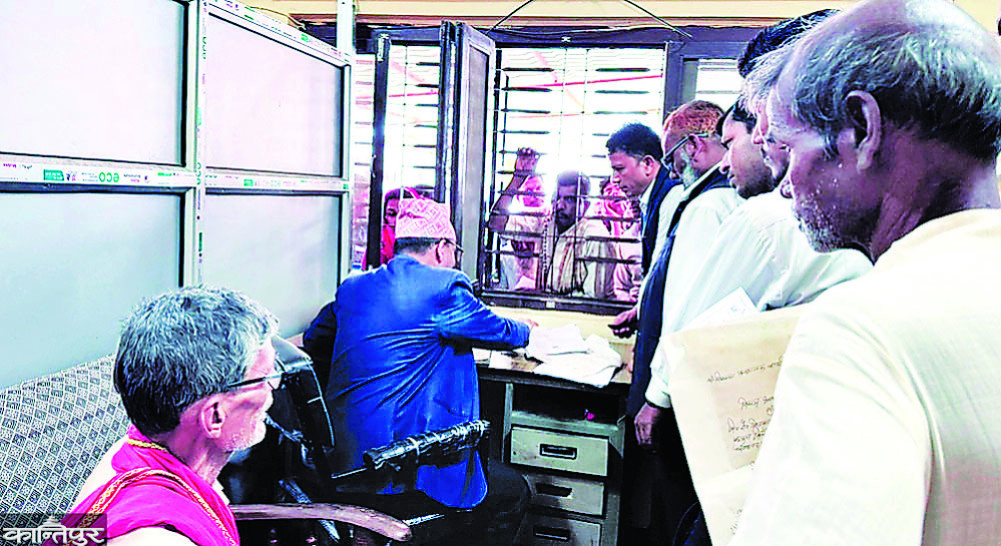
To keep the constitution and democracy alive and dynamic, the balance of power between the bureaucracy and the political leadership must be kept at the center of public interest. The bureaucracy is the backbone of the state, but if this backbone becomes stiff with arrogance instead of bending to serve the people, it will paralyze the body of democracy.
We use Google Cloud Translation Services. Google requires we provide the following disclaimer relating to use of this service:
This service may contain translations powered by Google. Google disclaims all warranties related to the translations, expressed or implied, including any warranties of accuracy, reliability, and any implied warranties of merchantability, fitness for a particular purpose, and noninfringement.
Two parallel streams of power are clearly visible in the political and administrative sectors of Nepal. One stream is the temporary government that enters the Singha Durbar with public approval, i.e. political leadership, while the other stream is the permanent government that bypasses the merit system and stays in the mechanism for a long time, i.e. bureaucracy.
It must be said that the irony of Nepali democracy is that here, the leaders who manage to take over the reins of power with election slogans, manifestos, and dreams of the people become guests for only five years, but the keys from policy formulation to implementation remain safely in the pockets of the bureaucracy. Gazetted officers who have passed through various levels of the Public Service Commission, judicial service, administration, revenue, and security organs have taken the real reins of state administration in their own hands. Leaders come and go with the electoral wave, but this permanent mechanism remains firm like an impenetrable fortress, due to which the shadow of an unaccountable bureaucracy is deepening within the beautiful form of democracy. It is also criticized from time to time.
A politically aware, economically strong and productive community is the cornerstone of national prosperity. The village should not only become a shelter for the elderly but also a center of entrepreneurship. When a village is able to connect its own local products to the market, and the participation of youth in its economic activities increases, only then will the foundation of real democracy be strong. But due to the bureaucracy's complex policy obstacles and cumbersome legal processes, small entrepreneurs are fleeing. Youth have been fleeing for years.
Civil society and the general public should not just remain silent spectators. The tendency of handing over a 'blank check' for five years by voting in elections should be abandoned. No one should be left behind in monitoring the decisions, expenses and policies made in every public body from the citizen level. To create an environment for investment in productive sectors for economic prosperity, the bureaucracy should play a facilitating role, not a controlling one. Only through community-based cooperatives, collective farming and proper use of local resources can we break the chain of dependency. The solution to this complex problem is not possible through superficial changes alone; for this, structural and behavioral surgery by the state is required. As a first step, a legal mechanism should be developed that makes the bureaucracy directly accountable to the people. The practice of becoming 'permanent' only on the basis of passing the exam and remaining in office despite zero performance should end. This should change with the times. The system of performance-based punishment should be strictly implemented and standards should be set.
Second, to uproot the roots of policy-level corruption, the 'word game' in acts, laws and regulations should be made transparent. Only 'and' and 'or' make a difference in sensitive documents like the constitution and laws. This should be improved.
We all need to introspect on the question of what the path ahead should be. Politics should not be just a game of gaining power but should be a resolution to transform society. Leaders should have a studious culture and the ability to operate the administrative machinery. To overcome the compulsion of people without educational qualifications but who have reached leadership based on access to dance at the behest of employees, it is now imperative for intelligent and capable youth to enter the leadership level. The current government of youth leadership should pay special attention to this.
On the other hand, civil society and the general public should not just remain silent spectators. The tendency of handing over a 'blank check' for five years by voting in elections should be abandoned. No one should be left behind in monitoring the decisions, expenses and policies made in every public body from the citizen level. Conscious citizens, investigative journalists and aware students should continue to expose the network of policy-level corruption in the inner lanes of the bureaucracy.
Looking at the political history of Nepal, the governance system has changed repeatedly. From the Rana regime to the Panchayat, the multi-party system, and the establishment of the republic, the bureaucracy has continued to exist as a stable structure. The problem related to Nepal's bureaucracy is not just a personal perception, it is a reality.
First of all, looking at the overall situation of corruption, the corruption reports published by Transparency International have consistently put Nepal in a weak position. Despite political changes, there has been no tangible improvement in the control of corruption within the administrative system. Therefore, the problem is not related to changes in individuals or governments, but is structural in nature, which has deep roots in bureaucracy.
Surveys by the World Bank and other organizations have also shown that there is a lack of transparency in the decision-making process, misuse of resources, and weak accountability of employees in Nepal. What this confirms is that the problem is not only in the political leadership, but also in the implementing bureaucracy. Which needs to be improved.
To make the constitution and democracy alive and dynamic, the balance of power between the bureaucracy and the political leadership must be kept at the center of the public interest. The bureaucracy is the backbone of the state, but if this backbone becomes stiff with arrogance instead of bending to serve the people, it will paralyze the body of democracy.
A more serious problem than the internal conflicts and power struggles of leaders is the invisible dominance of the bureaucracy and the corruption that has grown within it. If this permanent structure cannot be made accountable, transparent and technology-friendly in time, then democracy will remain just a cover and the real power will always remain imprisoned in the pages of files. And, the people will be forced to move around. Therefore, just as the system has changed, creating a storm of citizen awareness and systemic reform to change the situation is an imperative need today. In this regard, the newly elected government and the people's representatives elected by the people must also pay special attention. In addition, the interest of the relevant stakeholders in these matters should also increase. Only this will help to make democracy permanent and sustainable and move it forward.