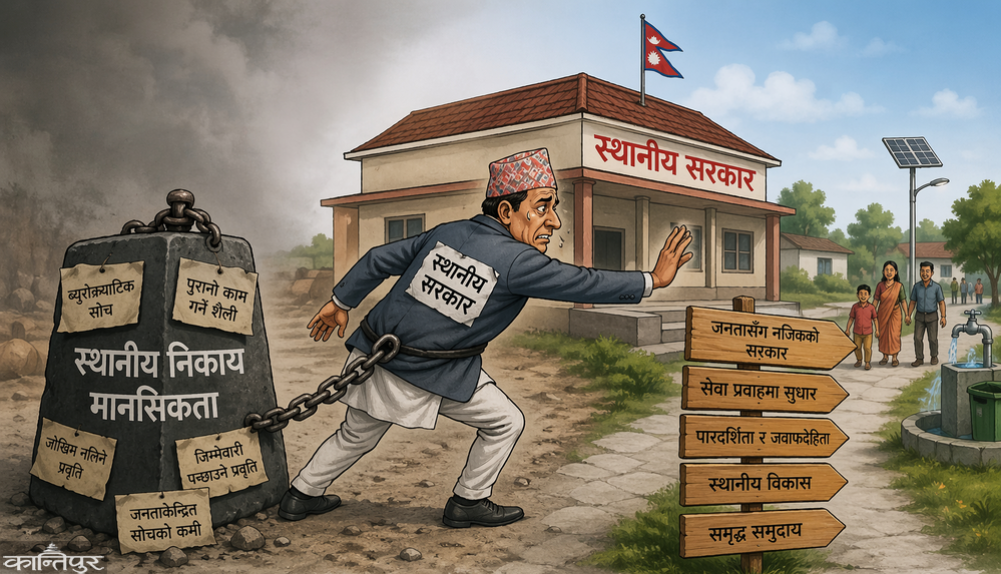
Breaking the notion that local government is subordinate to a lower or higher level in the hierarchical state structure, it must fulfill its constitutional duties autonomously.
We use Google Cloud Translation Services. Google requires we provide the following disclaimer relating to use of this service:
This service may contain translations powered by Google. Google disclaims all warranties related to the translations, expressed or implied, including any warranties of accuracy, reliability, and any implied warranties of merchantability, fitness for a particular purpose, and noninfringement.
The entire government, political parties, provincial and local governments, and employees with a centralized mindset are responsible for the occasional dissatisfaction with federalism in Nepal. In a decade, the public welfare goal of federalism was limited to the preamble and a few articles of the constitution.
As this decade of the establishment and use of federalism approaches, it is clear that there needs to be more debate and interaction on the subject of our federal structure. The first point of interaction should be from the local government, which is closest to the people.
The local government has a big role to play in becoming a public welfare state, which the people expect the most and is also close to them. However, it is felt that the local government has not been able to rise above the ‘local body’ in terms of mentality and working style.
In the current situation, our local government and the situation of Hanuman, who forgot about his incomparable strength in the Ramayana, seem to be the same. Local government is a beautiful concept in the Constitution of Nepal. Although the constitution envisages an autonomous structure based on cooperation, coexistence and coordination between local governments, the union and the provincial levels, these principles in local government are still limited to imagination.
The rights of local governments are unprecedented and incomparable in constitutional terms, but the functioning of local governments is based on the same mentality as when the Local Government Autonomy Act was in force.
Although local governments are practicing very innovative practices in line with the wishes of the people, overall local governments have not been able to make a leap forward at the pace desired by the people. Various structural, political and economic factors are responsible for the inability of local governments to perform as expected.
First of all, underestimating the autonomy and role of local governments after the advent of federalism became the main reason for its failure to produce the expected results. In the constitutional conception, local governments have a public welfare role.
Such a public welfare concept seeks to advance towards innovation, for which the local government and its leadership had to exercise their constitutional authority with autonomy, but the local government was always understood as being structurally subordinate to the union and the provinces.
This also put the local government leadership under a kind of creative and mental restriction. This was supported by the liberal tendency of the union. Due to which the secretary-level circular of the ministry created a situation where even the local law and policy-making process was stopped.
Secondly, since political parties distribute tickets according to tier-wise priority, the local government leadership is forced to work in accordance with the ideology and beliefs of the upper level of the party in policy-making other than daily activities rather than on the basis of originality.
The need for federalism in the country was due to various geographical and fundamental challenges, but our federal structures are still based on centralized party policies. While the importance of local government is limited to the existing system of productive and credit-sharing to show integrated development for elections, there is confusion about innovation.
Except for the third metropolis and municipalities in accessible areas, many local governments are ignorant of legal and policy-making processes and lack the skills to formulate laws. Appropriate laws and policies should be formulated for the use of constitutionally acquired rights and their implementation should be carried out by the authorized bodies. Despite support in the initial stage for formulating laws, the lack of formulation of laws for new uses has led to the need for new laws related to energy, disaster, sports, investment, and education in addition to regular procedural acts and guidelines.
The right to formulate laws is the main basis for differentiating local governments from previous local bodies. However, due to the lack of legislation, it is clear that federal intervention is taking place even in matters that had sole authority, and this is also the main reason for the failure of the local level.
Fourth, the concept of service delivery, management and development is becoming the main goal in the mindset of local governments. Service delivery, road infrastructure and status quo management are major parts of the work of all levels of government, but apart from that, there is no sense of responsibility to adopt creative and innovative work and working style in line with the original wishes and aspirations.
As a result, a huge gap has been created between aspirations and results. Therefore, when limited to the above work, there is a need for innovation in local governments, except for exceptions. In this, not only the leadership but also the employees of the local government have been accustomed to service delivery and management for a long time and since they are run centrally, the local level has not been able to work as an autonomous government and give the people the feeling of the same proportion.
Finally, with the speed with which federalism came, the federation has not yet made many laws to institutionalize federalism, giving them economic, political and administrative authority. Since the need to look to the Union for issues like revenue sharing, conditional grants, and appointment of Chief Administrative Officers affects even the regular and normal work of the local government, it is very difficult to bring the new concept as per Schedule-8 of the Constitution to life. And, amidst these structural and legal obstacles, there is no way for the local government to work autonomously.
It is not a sad aspect to call federalism an experiment, but it is a sad aspect that local governments do not find their role in that experiment or are forced to get stuck due to various issues when they try to use it in a new way. It is our harsh reality that while the local government is singing the song of the central government, it has not been able to move forward towards the advancement of innovative and creative policies and programs.
It should fulfill its constitutional duties autonomously by breaking the assumption that the local government is subordinate to the lower or higher level in the hierarchical state structure. In accordance with the preamble of the Constitution of Nepal, local governments need to change and modernize their work and working style based on the expectations of the people as a modern public welfare government.
Local governments should move forward on the path of citizen upliftment by adopting creative and innovative work and working style. In the coming decade, capacity building of local governments and development of cooperation and coordination among all three levels should become a matter of national importance. In accordance with Schedule-8 of the Constitution, local governments should develop revenue sources locally by drawing a blueprint for sustainable development based on local needs and originality.
Employment should be created for the youth by investing and promoting sectors such as agriculture, energy, and tourism. Structurally, local governments should be autonomous and their leadership should be dedicated to local needs rather than party politics. Only then will the voice and originality of the locals be reflected in local development.
Finally, since the current Prime Minister has set an example of using local government authority for personal gain, the local government should also present a good example of federalism by empowering the federal government with law-making and revenue-sharing powers during this term and collaborating in the path of unified national interest.