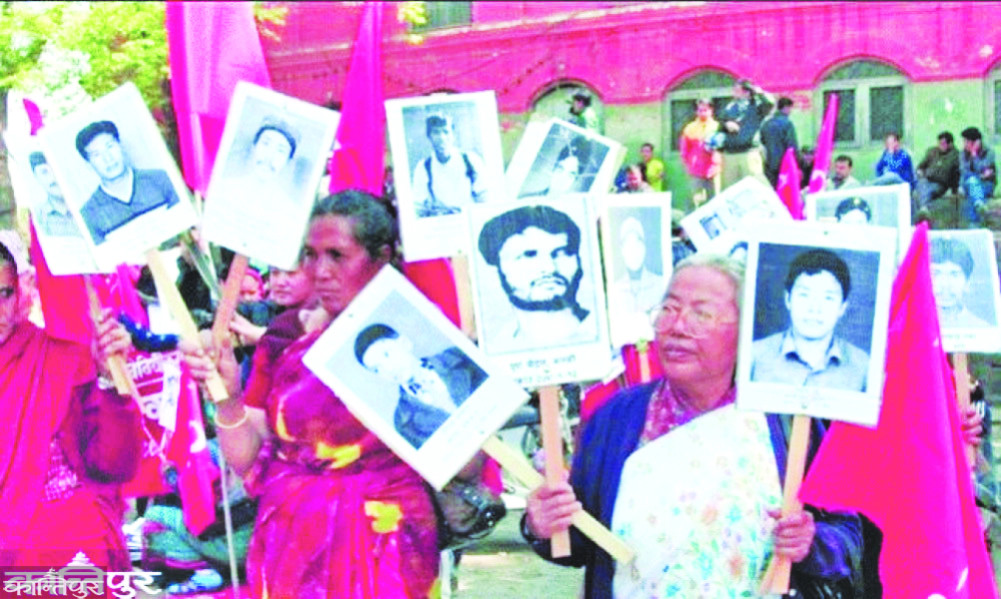
Transitional justice is no longer an option, it is an inevitable necessity, and now is the right time to fulfill that need.
We use Google Cloud Translation Services. Google requires we provide the following disclaimer relating to use of this service:
This service may contain translations powered by Google. Google disclaims all warranties related to the translations, expressed or implied, including any warranties of accuracy, reliability, and any implied warranties of merchantability, fitness for a particular purpose, and noninfringement.
The Cabinet meeting held on 2 April 2083 decided to ‘receive a grant of 1 million Swiss francs from the Swiss government for the Investigation, Truth and Reconciliation of Disappeared Persons Fund’. Is this a real sign of reactivating the transitional justice process that has been stalled for years? The Comprehensive Peace Agreement signed with the end of the armed conflict that laid the foundation for the Federal Democratic Republic made a clear promise to Nepali society – the truth will come out, justice will be ensured, and ultimately reconciliation will be possible.’ But even after almost two decades, that promise is still unfulfilled. The Truth and Reconciliation Commission and the Commission of Inquiry on Disappeared Persons, which were formed for transitional justice, have failed to deliver the expected results. Therefore, with every new initiative, there is hope, but past experiences raise concerns that those hopes will turn into disappointment again.
There has been no satisfactory progress in any of the four basic pillars of transitional justice – truth, justice, reparation and guarantees of non-recurrence of conflict. According to the 2080/81 report, out of 3288 complaints registered with the Commission in search of truth, only 746 complaints have been resolved, while 2542 complaints are still in process. Each of these complaints is not just a number, but a symbol of the pain of a family, the story of a life and an incomplete justice. Being stuck in investigations for years means pushing the truth away, and reconciliation without truth is limited to empty slogans.
The aspect of justice is still weak. The fact that the Commission has not yet recommended the government for prosecution in any case has brought the very spirit of transitional justice into question. When the guilty are not identified, when they are not forced to face legal action, then justice remains limited to paper only. This not only disappoints the victims, but also weakens their trust in the state. More seriously, the culture of impunity increases the risk of such violations being repeated in the future.
The situation with reparations is equally worrying. Only 1,349 families have received victim identification cards, and out of 551 families recommended for relief, 458 families have not yet received any relief. Reparations for victims are not just financial support, it is a sign of recognition and respect from the state. When the state cannot fulfill even that minimum obligation, the suffering of the victims deepens and their trust in the state erodes.
Guarantees that conflict will not recur and institutional reforms and structural changes have also not progressed as expected. The commissions have recommended to the government through various interim reports on the causes of the conflict and measures to be taken to prevent it from recurring, but these recommendations do not appear to have been implemented. If institutional weaknesses persist, the transitional justice process will only be a review of the past, not a means of ensuring future security.
The ‘Enactment of the Commission for the Investigation, Truth and Reconciliation of Disappeared Persons’ Act’ of 2071 created the institutional structure of transitional justice and two commissions were formed accordingly. These commissions were given the authority to make suggestions to the government for truth-finding, identification of victims and perpetrators, recommendation of reparations and prosecution. But the creation of a legal framework is not enough; its effective implementation is the main basis for ensuring justice. Nepal has consistently been weak in this implementation. The question now is not about creating a framework, but how to make it competent, credible and result-oriented. For this, it is imperative to ensure the professional independence of the commissions, competent and impartial leadership, and clear accountability in their work performance. It seems necessary to review the appointments and working style affected by previous political influences and take steps towards process reform, and although the current government has indicated that it will take some initiatives in this direction, its real test will be to convert it into results.
The problem is not just one of delay, it is also a question of the state's commitment. The accusation that previous governments have failed to prioritize or are unwilling to prioritize transitional justice is not new. Political parties have always been hesitant to take fair and tough decisions because they are themselves parties to the conflict, but the current context is different. Since the new government does not come directly from the parties to the conflict or at least is not directly controlled by such forces, and since the previous major ruling forces are outside the current government, it is estimated that the pressure of direct political interests may be relatively less. For this reason, the current government has an important opportunity to meaningfully advance the justice process without repeating the shortcomings of the past. But the main question remains the same - is transitional justice really a priority for the current government?
The lack of clear mention of transitional justice in the recently released 100 agenda on governance reforms by the government is a worrying sign in this regard. On the other hand, the RSVP's pledge made public before the elections expressed a commitment to immediately move forward with the remaining transitional justice tasks, but did not present a clear roadmap for their implementation. The gap between the commitments made before the elections and the silence seen after coming to power raises the question of where the government's real priorities lie. In fact, this is an important opportunity for the current government to provide justice to the victims of the transition period, if it so desires.
But along with the opportunity, the challenges are equally serious. The role of Nepali security agencies in the transitional justice process has always been sensitive. The government's approach to impartial investigation and real accountability is decisive here. Can the state ensure an independent, impartial and credible investigation while respecting institutional autonomy? Or, will political interference, compromise with security agencies and pressure weaken the justice process? This question will determine the credibility of the entire transitional justice process and its ultimate outcome. It would be a grave mistake to view transitional justice as a matter of the past. It is directly linked to the legitimacy of the present democracy and the rule of law of the future. When a state cannot impartially address serious human rights violations committed against its own citizens, the rule of law weakens and citizens’ trust in justice diminishes. This undermines the very foundation of democracy.
Therefore, the need now is not just to reactivate the commissions. It is to reimagine the entire transitional justice process. This requires equal attention to all four pillars – effective truth-seeking, a clear commitment to holding the guilty accountable, dignified reparations to victims, and institutional reforms to ensure that such incidents do not happen again. If any one of these aspects is prioritized and the others are ignored, the entire process will remain incomplete.
Ultimately, this is not just another agenda for the current government. It is a historic responsibility. This government has a rare opportunity, relatively free from the political burdens of the past, to make fair and courageous decisions. This government, not directly involved in the conflict and not bound by the direct pressure of past agreements, may be able to take real steps towards ensuring justice. Justice has been delayed too long. The patience of victims who have been waiting for years has now reached its limit. Further delay would not only be an administrative failure, it would also be a moral failure. If the state fails to fulfill its promise even now, it would be an injustice not only to the past, but also to the future.
Therefore, the question now is not simply ‘what can be done?’, but ‘why not do it now?’. The new government has the opportunity, the capacity and, most importantly, the potential for fairness. Transitional justice is no longer an option, it is an imperative need and now is the right time to fulfill that need.
(The author is an advocate and a student of constitutional law and international law)